Five groups, one cheque
This closing cost calculator adds up one loan amount and five groups of costs: the loan is the price minus the down payment, and every percentage fee hangs off either the loan or the price — origination, title insurance, transfer tax, tax escrow, prepaid interest and the loan-type fee. The total is the cheque you actually write at closing. The whole calculation is one loan amount and five additions. The loan is the price minus the down payment, and every percentage fee hangs off either the loan or the price:
loan ($) = home price − down payment · origination ($) = loan × origination % · title insurance ($) = loan × title %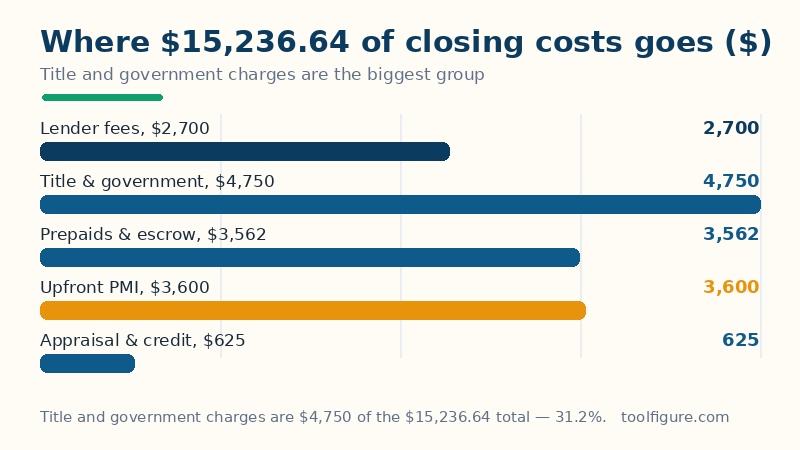
transfer tax ($) = price × transfer tax % · tax escrow ($) = price × tax rate % × escrow months ÷ 12prepaid interest ($) = loan × rate % × prepaid days ÷ 365 · loan-type fee ($) = loan × 1% (conventional, down under 20%) or 1.75% (FHA) or 1.5–2.3% (VA)total closing costs ($) = lender fees + title & government + prepaids & escrow + loan-type fee + appraisal & credit · cash to close ($) = down payment + total closing costs − seller creditThe loan-type fee is the line buyers most often miss. A conventional loan with less than 20% down usually carries private mortgage insurance — this page charges it once, up front, at 1% of the loan, the way the published example does. An FHA loan always adds 1.75% of the loan as upfront mortgage insurance premium. A VA loan adds a funding fee of 2.3% with no down payment, 1.65% with 5% down and 1.5% with 10% down on first use. The table above prices all three on the same purchase so the comparison is like for like.
Worked example: a $400,000 home, 10% down — $15,236.64 to close
The loan is $400,000.00 − $40,000.00 = $360,000.00. The lender fees are the origination at 0.75% of the loan, $2,700.00. The title and government charges are title insurance at 0.5% of the loan, $1,800.00, plus $800.00 of title and settlement, $150.00 of recording fees and transfer tax at 0.5% of the price, $2,000.00 — $4,750.00 together. The prepaids and escrow are 3 months of property tax at 1.1% of the price, $1,100.00, plus $1,500.00 of homeowners insurance prepaid and 15 days of prepaid interest at 6.5% on the $360,000 loan, $961.64 — $3,561.64 together. The upfront PMI at 1% of the loan is $3,600.00, and the appraisal and credit report are $625.00. The total is $2,700.00 + $4,750.00 + $3,561.64 + $3,600.00 + $625.00 = $15,236.64, which is 3.81% of the price, and the cash to close is $40,000.00 + $15,236.64 = $55,236.64. The shares are 17.7% lender fees, 31.2% title and government, 23.4% prepaids and escrow, 23.6% upfront PMI and 4.1% appraisal and credit, which add to 100.0%. Two published cross-checks reproduce. Calculators Planet's closing cost calculator runs the same inputs — the same $2,700.00 origination, $550.00 appraisal, $75.00 credit report, $1,800.00 title insurance, $800.00 title and settlement, $150.00 recording, $2,000.00 transfer tax, $1,100.00 tax escrow, $1,500.00 insurance, $961.64 of prepaid interest and $3,600.00 of upfront PMI — and reaches the same $15,236.64 total. The Consumer Financial Protection Bureau's sample Loan Estimate for a $180,000 home with a $162,000 loan totals $8,054 of closing costs, 4.5% of the price, which sits inside the same 2% to 5% band Freddie Mac publishes. The price ladder shows the same maths scaling: a $200,000 home is $9,155.82 to close, a $300,000 home is $12,196.23 and a $500,000 home is $18,277.05 — and with 20% down instead of 10%, the same $400,000 home costs $11,029.79 to close and $91,029.79 cash to close, because the loan is smaller and the upfront PMI drops away entirely.
How to read your result, and its limits
Four cautions keep the number honest. First, the total is an estimate, not a quote: the figures pre-filled here are typical published amounts, and your lender's Loan Estimate — which the lender must send within three business days of your application — is the document that sets the real numbers, with the final Closing Disclosure fixing them at the table. Second, transfer tax is the most local line on the page: it runs from 0% to over 1% of the price depending on the state, and within a state it can vary by county and city, so a total built on the 0.5% default is a different purchase's total in a high-tax state. Third, the prepaids are not fees: the tax escrow, the insurance and the prepaid interest are money you would pay anyway, collected early — so a total that looks high because of them is not a lender overcharging you. Fourth, the upfront PMI here is a simplification: many conventional loans charge PMI monthly instead of up front, in which case this page's 1% line should be set to zero and the monthly PMI — typically 0.3% to 1.5% of the loan a year — budgeted separately. For the purchase this closing follows, the down payment calculator prices the deposit itself, the house affordability calculator prices the most home your income can carry, and the mortgage calculator prices the monthly payment the loan behind it becomes.
Common mistakes
- Budgeting only the down payment. On the worked example the down payment is $40,000.00 and the closing costs add $15,236.64 — the cash to close is $55,236.64, 38% more than the deposit alone. Buyers who save only the deposit discover the gap at the closing table.
- Quoting the 2% to 5% rule as a price. On a $400,000 home the rule spans $8,000 to $20,000. Your actual number is $15,236.64 at these inputs and $11,029.79 with 20% down — the rule is a sanity check, not an estimate.
- Forgetting the loan-type fee. The FHA upfront MIP is 1.75% of the loan and the VA funding fee runs 1.5% to 2.3% — on a $360,000 loan that is $6,300.00 and $5,400.00 respectively, the single biggest swing between loan types on the same purchase.
- Counting the seller credit twice. A seller credit reduces the cash to close, not the closing costs themselves — so it is subtracted once, at the end, after the total is added up.
- Treating prepaid interest as a fee. It is interest for the days between closing and the end of the month, so closing on the 28th instead of the 2nd cuts it from about 28 days to about 2 — the one line on the page the closing date itself controls.
Frequently asked questions
How much are closing costs?
Freddie Mac says buyers should expect 2% to 5% of the home purchase price. On a $400,000 home that is $8,000 to $20,000 — the worked example on this page is $15,236.64, or 3.81%. The exact figure depends on the loan type, the state's transfer tax, and the prepaid items on your Loan Estimate.
What is cash to close?
The cash you bring to the closing table: the down payment plus the total closing costs, minus any seller credit. On the worked example that is $40,000.00 + $15,236.64 = $55,236.64. It is the number to save toward — not the down payment alone.
Can the seller pay my closing costs?
Yes, in most deals. A seller credit or seller concession is an amount the seller agrees to pay toward your closing costs, and it is subtracted from the cash to close. Enter it in the seller credit field and the cash-to-close figure drops by exactly that amount.
How do FHA and VA closing costs differ from conventional?
The loan-type fee is the difference. An FHA loan adds 1.75% of the loan as upfront mortgage insurance premium — $6,300.00 on a $360,000 loan. A VA loan adds a funding fee of 2.3% with no down payment, 1.65% with 5% down and 1.5% with 10% down on first use. A conventional loan with less than 20% down usually carries PMI instead — charged here once up front at 1% of the loan, though many lenders charge it monthly.