Height is the size in Europe
The confusion in kids' clothing sizes comes from two different ideas of what a size is. In the US and UK, a size is an age: US 5 means a child of about 4–5 years, and UK 5 means the same. In Europe, a size is a height in centimetres: EU 110 is cut for a child up to 110 cm tall, whatever their age. The two systems meet in the table below, but they meet loosely — a tall 4-year-old may already need EU 116, and a petite 6-year-old may still fit EU 110 — which is why the height column, not the age column, is the one to trust. The US scale also skips numbers: after 8 comes 10, after 12 comes 14, so there is no US 9, 11 or 13 to convert, and two US sizes each cover two rows — US 10 sits on both EU 134 and EU 140, and US 16 on both EU 158 and EU 164 — so a US size alone sometimes cannot be converted at all, and this page refuses to guess through those cases.
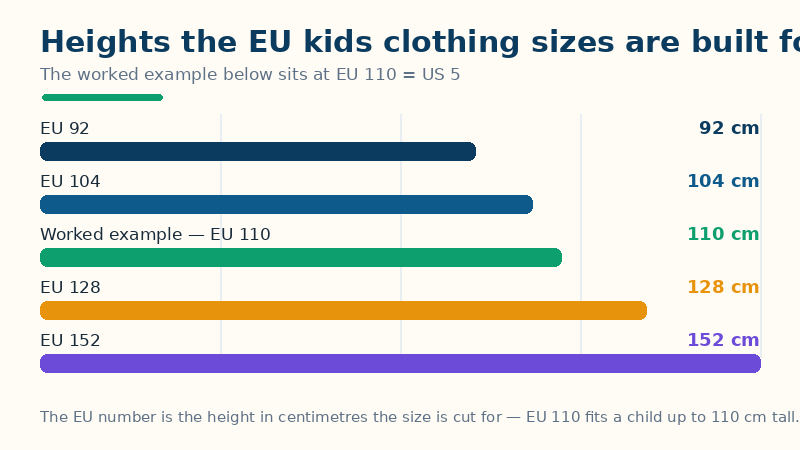
Worked example: a child 110 cm tall
Take a child measured at 110 cm. The height falls exactly on a step, so the size is EU 110 = US 5 = UK 5, age about 4–5 years. Four more conversions prove the table holds: EU 122 is US 7, UK 7, up to 122 cm, age 6–7 years; US 2T is EU 92, UK 2, up to 92 cm; a height of 100 cm falls between steps and takes the next size up, EU 104 = US 4T, UK 4, age 3–4 years; and a height of 115 cm takes EU 116 = US 6, UK 6. The honest failure case is part of the design: US 10 appears on both the EU 134 row (up to 134 cm, age 8–9 years) and the EU 140 row (up to 140 cm, age 9–10 years), so the tool reports both rows and asks for the height or the EU size instead of picking one.
Kids' clothing size table
| EU | Height up to (cm) | Age | UK | US |
|---|---|---|---|---|
| 92 | 92 | 18–24 months | 2 | 2T |
| 98 | 98 | 2–3 years | 3 | 3T |
| 104 | 104 | 3–4 years | 4 | 4T |
| 110 | 110 | 4–5 years | 5 | 5 |
| 116 | 116 | 5–6 years | 6 | 6 |
| 122 | 122 | 6–7 years | 7 | 7 |
| 128 | 128 | 7–8 years | 8 | 8 |
| 134 | 134 | 8–9 years | 9 | 10 |
| 140 | 140 | 9–10 years | 10 | 10 |
| 146 | 146 | 10–11 years | 11 | 12 |
| 152 | 152 | 11–12 years | 12 | 14 |
| 158 | 158 | 12–13 years | 13 | 16 |
| 164 | 164 | 13–14 years | 14 | 16 |
| 170 | 170 | 14–15 years | 15 | 18 |
| 176 | 176 | 15–16 years | 16 | 20 |
How to read your result, and its limits
Three checks before ordering. First, measure, never guess from age: children grow in bursts, and two children of the same age can differ by two sizes — measure standing barefoot, back to a wall, and use the centimetres, not the birthday. Second, between two EU steps, take the larger size: EU numbers are ceilings, not midpoints, so a child of 100 cm takes EU 104, not EU 98, and the extra room is growing room, not a mistake. Third, this is the standard table, and brands move a step either side of it: the table stops at EU 176, above which adult sizing begins; width, length and fit (slim, regular) are not covered here at all; and for a child under 92 cm, the baby sizes page — which runs EU 56 to 86 on the same height principle — is the right table.
Related tools: Baby Size Converter — Baby & toddler clothing sizes — EU height sizes, US labels and UK ages, newborn to age 5; Kids Shoe Size Converter — Kids' shoe sizes — US toddler (C) & youth (Y), UK and EU, with foot lengths; Clothing Size Converter — Men's and women's clothing sizes between US, UK and EU — with the measurements behind them.
Frequently asked questions
What is EU 110 in US kids' clothing size?
US 5, UK 5, for a child up to 110 cm tall, age about 4–5 years. The EU number is the height in centimetres the size is cut for.
What if my child is 100 cm tall — what EU size is that?
EU 104. EU sizes step in 6 cm (92, 98, 104...), and each one fits a child up to that height, so a child measured between two steps takes the next size up — in this case US 4T, UK 4.
Why does US 10 give two kids' clothing sizes?
Because US 10 appears on both the EU 134 row (up to 134 cm, age 8–9 years) and the EU 140 row (up to 140 cm, age 9–10 years). A US 10 alone cannot be converted — enter the EU size or the child's height to settle it.
Is there a US 9 kids' clothing size?
No — US kids' clothing skips numbers: after 8 comes 10, after 12 comes 14. A size labelled 9 in another system is not a US size, so convert from the EU size or the height instead.
