The official formula, in both unit systems
Wind chill is not a temperature the air has — it is a rate of heat loss from exposed skin, expressed as the temperature calm air would need to be to cool skin at the same rate. The formula in current use was developed in 2001 by the Joint Action Group for Temperature Indices and adopted by the US National Weather Service and Environment Canada, replacing an older formula that overstated the effect. It takes exactly two inputs — air temperature and wind speed — because humidity barely moves the result, and it assumes a person walking at about 3 mph, at night, with no sun warming the skin. In Fahrenheit and miles per hour it reads: wind chill = 35.74 + 0.6215T − 35.75(V0.16) + 0.4275T(V0.16), where T is the air temperature in °F and V is the wind speed in mph. In Celsius and kilometres per hour it reads: wind chill = 13.12 + 0.6215T − 11.37(V0.16) + 0.3965T(V0.16), where T is in °C and V is in km/h. The two forms are the same equation restated, not two different models — the same air and wind, converted between systems, give the same wind chill to within a degree of rounding.
Wind chill (°F) = 35.74 + 0.6215T − 35.75(V^0.16) + 0.4275T(V^0.16) — Wind chill (°C) = 13.12 + 0.6215T − 11.37(V^0.16) + 0.3965T(V^0.16) — Valid only for T ≤ 50°F (10°C) and V ≥ 3 mph (5 km/h)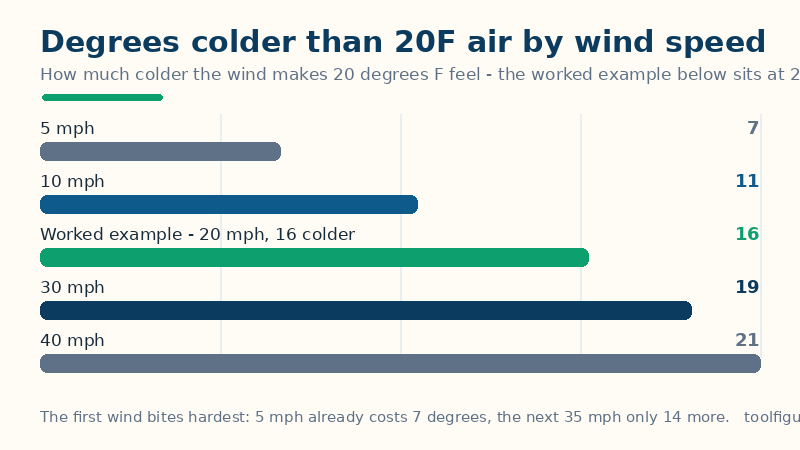
Every variable in that box is an input on this page. The 0.16 power is the heart of the formula and the reason wind chill behaves the way it does: the first few miles per hour of wind bite hardest, and each extra unit of wind adds less than the last. That is why a calm 20°F day and a 20°F day with a 5 mph breeze feel so different, while the step from 30 mph to 40 mph at the same temperature is barely noticeable — the curve flattens as the wind rises, and no wind, however strong, can push the wind chill below the air temperature's own cooling limit for an inanimate object, because wind chill is about skin, not about the air.
Worked example: 20°F with a 20 mph wind
An air temperature of 20°F with a 20 mph wind feels like 4°F — 16°F colder than the air itself. The working: first the wind term, 200.16 = 1.615. Then wind chill = 35.74 + 0.6215 × 20 − 35.75 × 1.615 + 0.4275 × 20 × 1.615 = 35.74 + 12.43 − 57.74 + 13.81 = 4.24°F, shown as 4°F, which is −15.4°C. The gap, 20 − 4.24 = 15.8°F, is the "feels colder by" figure the page reports. The same arithmetic at other temperatures, all at 20 mph, shows the gap widening as the air gets colder: 32°F becomes 20°F (12°F colder), 10°F becomes −9°F, 0°F becomes −22°F, −10°F becomes −35°F and −20°F becomes −48°F. And at a fixed 20°F, the wind-speed curve flattens exactly as the 0.16 power predicts: 5 mph gives 13°F, 10 mph gives 9°F, 20 mph gives 4°F, 30 mph gives 1°F and 40 mph gives −1°F — the first 15 mph of wind costs 9 degrees of feel, while the last 20 mph costs only 5. As a metric cross-check, −7°C with a 32 km/h wind gives −15.9°C (about 3°F), within a degree of the imperial worked example, as expected from rounded equivalent inputs.
How to read your result, and its limits
Three limits decide whether a passing figure is enough. First, the frostbite bands are about exposed skin and time: the bands this page uses run from "very cold" below −10°C, through frostbite in about 10 to 30 minutes between −28°C and −39°C, 5 to 10 minutes between −40°C and −47°C, and 2 to 5 minutes below −48°C — and good clothing moves you out of those bands entirely, because the formula assumes bare skin. Second, sunshine and shelter are not in the equation: the formula assumes nighttime conditions with no solar heating, so a sunny, sheltered spot usually feels milder than the printed figure, while wet skin or a wind funnelled between buildings feels worse. Third, wind chill never cools objects below air temperature: a car engine, a water pipe or a tent left out overnight reaches the air temperature and no lower, whatever the wind chill says — wind only speeds the journey there for warm things, and for skin it speeds the loss of body heat.
Common mistakes
- Dressing for the air temperature, not the wind chill. The forecast's headline number is the air temperature; the number your skin experiences is the wind chill, and on a windy day the two can be 20 degrees apart.
- Reading a wind chill above 50°F or below 3 mph. Outside the formula's range the number is meaningless, not merely approximate — this page refuses to print one there, and so do weather services.
- Thinking wind chill freezes pipes below air temperature. It does not: wind chill applies to warm-blooded skin losing heat, not to objects, which stop at the air temperature no matter how hard the wind blows.
- Trusting a phone's "feels like" without checking what it includes. Many apps blend humidity, sun and other factors into a feels-like figure; the wind chill on this page is the official two-input formula only, which is the figure to use for cold-weather clothing decisions.
Related tools: Temperature Converter — Convert °C, °F, K, °R and °Ré — every answer in all five scales, formulas shown; Hiking Time Calculator — Your trail time from distance and ascent by Naismith's Rule — walking time, breaks and arrival time, in metric or imperial units; Sleeping Pad R-Value Calculator — The minimum sleeping pad R-value for your coldest expected night — plus the cold-sleeper step up and a stacking check for a pad you already own.
Frequently asked questions
Why is wind chill different from the air temperature?
Because wind chill measures how fast exposed skin loses heat, expressed as the temperature calm air would need to be to cool skin at the same rate. Wind strips away the thin layer of warmed air next to the skin, so skin cools faster in wind than in calm air at the same temperature — and the faster the wind, the faster the loss, up to the flattening curve of the 0.16 power.
Why does the formula stop working above 50°F or below 3 mph?
Because outside that range wind does not meaningfully change how cold the air feels: above 50°F the body sheds heat by other means and wind feels refreshing rather than chilling, and below 3 mph there is too little airflow to strip the warmed layer. Weather services report no wind chill there, and neither does this page.
Does wind chill affect cars, pipes or water bottles?
No. Wind chill describes heat loss from warm skin; an inanimate object cools to the air temperature and stops there, however hard the wind blows. Wind only makes a warm object reach air temperature faster — it cannot push it below it.
Does clothing change the wind chill?
The formula assumes exposed skin, so clothing changes the outcome even though it does not change the printed number: a windproof shell restores the warmed layer the wind strips away, which is why the same wind chill can be dangerous for bare skin and unremarkable for a properly dressed person. Cover skin first, then judge the outing by the band, not the number alone.
