Two totals: the direct costs, then the credit
The whole calculation is two additions, one percentage and one cap, and the adoption type is the one people get wrong. The eight direct lines — agency and program fees, legal fees, home study, birth parent expenses, travel and accommodation, immigration and visa fees, post-adoption fees and other costs — are added together once. The contingency is a percentage of that direct total, not of the final total, and the tax credit is the smaller of the total and the IRS maximum, reduced by the income phase-out:
direct costs ($) = agency + legal + home study + birth parent + travel + immigration + post-adoption + other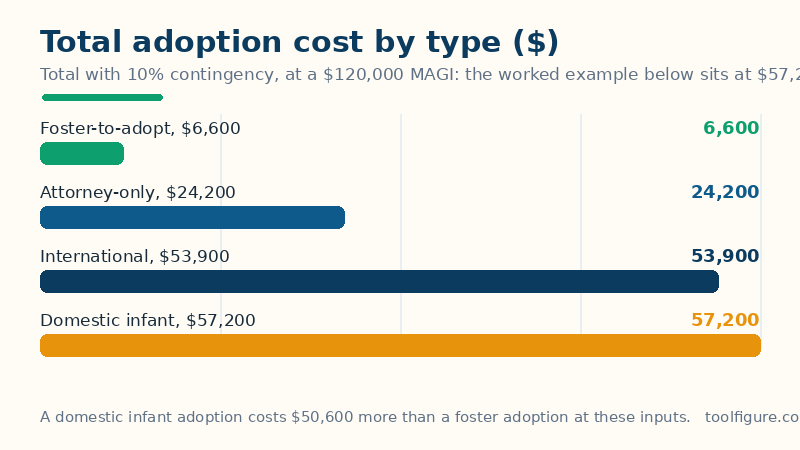
total ($) = direct costs × (1 + contingency ÷ 100)tax credit ($) = smaller of (total, $17,670 × phase factor)phase factor = 1 below a $265,080 MAGI, 0 at $305,080, and a straight line between the twonet cost ($) = total − tax creditThe table above shows the same maths for every adoption type at a $120,000 MAGI, with the same 10% contingency on every row. Foster-to-adopt is $6,000 of direct costs and $6,600 with contingency — and because the credit is capped at what was spent, it covers the whole $6,600, leaving a net cost of $0. An attorney-only domestic adoption is $22,000 direct and $24,200 with contingency, $6,530 after the credit. An international adoption is $49,000 direct and $53,900 with contingency, $36,230 after the credit. The worked example's domestic infant adoption is $52,000 direct and $57,200 with contingency, $39,530 after the credit.
Worked example: a domestic infant adoption
A private domestic agency charges $30,000, the attorney $8,000, the home study $2,500, birth parent expenses $5,000, travel $3,000, post-adoption fees $2,000 and other costs $1,500 — immigration and visa fees are $0, because the adoption is domestic. The direct costs are $30,000 + $8,000 + $2,500 + $5,000 + $3,000 + $0 + $2,000 + $1,500 = $52,000: the agency is the largest line at 57.7% of the direct costs, legal fees next at 15.4%, birth parent expenses 9.6%, travel 5.8%, home study 4.8%, post-adoption 3.8% and other costs 2.9%, adding to exactly 100.0%. A 10% contingency adds $5,200, for a total of $57,200. At a $120,000 MAGI there is no phase-out — the threshold starts at $265,080 — so the 2026 federal Adoption Tax Credit is the smaller of $57,200 and the $17,670 maximum, which is $17,670, with up to $5,120 of it refundable. The net cost is $57,200 − $17,670 = $39,530. Three published cross-checks reproduce exactly: complete.tools puts a domestic infant adoption through a private agency at $25,000–$55,000 — this page's $52,000 of direct costs sits inside that range, and an attorney-only adoption at $15,000–$35,000, where this page's $24,200 total sits — and calls foster adoption "nearly free", which this page's $6,600 total and $0 net cost are; CalculatorZilo's worked example of the 2026 credit itself — $20,000 of expenses, a $200,000 MAGI and a $12,000 tax liability — gives a base credit of $17,670, a refundable portion of $5,120, $12,000 used against the liability, a $550 carryforward and a $17,120 total benefit, on the same $17,670 maximum, $5,120 refundable cap and $265,080–$305,080 phase-out this page uses; and the cal67 adoption calculator builds its total the same way — the eight lines summed, then a 10% contingency — with published totals of $60,830 and $67,275, in the same band as the $57,200 and $53,900 totals here.
How to read your result, and its limits
Four cautions keep the number honest. First, the credit shown is what you can claim, not what you can use this year: only up to $5,120 of the 2026 credit is refundable; the rest only offsets your federal tax liability, and any part you cannot use generally carries forward — so a family with a small tax bill sees less of the $17,670 in year one than a family with a large one. Second, the contingency is a guess, not a quote: 10% is the published calculators' rule of thumb, but a disrupted placement, an extra trip or a contested case can cost far more than 10% — and a smooth one can cost nothing at all. Third, international costs vary by country and program: the $8,000 of travel and $2,500 of immigration fees in the table are typical figures, but a country with a long in-country stay or a second trip doubles the travel line, and program fees differ by agency. Fourth, state rules change the lines: birth parent expenses are permitted in some states and restricted in others, home study costs differ by state, and foster adoption costs are often reimbursed in part by the state — your own agency's fee schedule beats any national average. For the first year after the adoption, the baby cost calculator prices the first year the same way — one-off costs plus a year of yearly costs — and the childcare cost calculator prices the largest line of that first year on its own; for the long horizon, the college savings calculator prices the 529 plan the same way — a monthly contribution, a rate and a number of years.
Common mistakes
- Budgeting the agency fee and stopping there. The agency is the largest line at the worked example's inputs — $30,000, 57.7% of the direct costs — but the other seven lines add $22,000, and the contingency adds $5,200 more. A budget built from the agency fee alone is short by $27,200.
- Forgetting the credit entirely. The 2026 credit cuts the worked example from $57,200 to $39,530 — nearly a third of the total. A plan that ignores it over-saves by $17,670.
- Assuming the whole credit comes back as a refund. Only up to $5,120 of the 2026 credit is refundable; the rest offsets tax liability, and any part you cannot use generally carries forward to later years rather than arriving as cash.
- Comparing totals that include different things. A $52,000 direct-cost figure and a $57,200 total are both right for the same adoption — one leaves out the 10% contingency and the other includes it. Compare line by line, not total by total.
- Using the national average as a local quote. Agency fees run from about $20,000 to $45,000 for a private domestic adoption, and birth parent expenses are permitted in some states and restricted in others — get your own agency's fee schedule before deciding.
Frequently asked questions
How much does adoption cost?
At the worked example's inputs a domestic infant adoption through a private agency costs $57,200 in total — $52,000 of direct costs plus a 10% contingency — and $39,530 after the 2026 federal Adoption Tax Credit. By type the totals are $6,600 for foster-to-adopt ($0 after the credit), $24,200 for an attorney-only domestic adoption ($6,530 after the credit) and $53,900 for an international adoption ($36,230 after the credit). Published ranges put a domestic infant adoption at $25,000–$55,000 of direct costs and an attorney-only adoption at $15,000–$35,000.
How does the adoption tax credit work?
For 2026 the federal Adoption Tax Credit is worth up to $17,670 per child, with up to $5,120 of it refundable — the refundable part can come back even with no tax liability. The credit phases out between a modified adjusted gross income of $265,080 and $305,080: at $285,080 it is halved to $8,835, and at $305,080 it is gone. The credit cannot exceed what was spent, which is why a $6,600 foster adoption gets a $6,600 credit and a $0 net cost. Claim it on IRS Form 8839.
Why is foster adoption so much cheaper?
Foster-to-adopt uses no agency, so there is no $25,000–$30,000 agency fee, and the state often covers part of the legal and home study costs. At the table's inputs the direct costs are $6,000 — legal $2,500, home study $1,500, travel $500, post-adoption $1,000 and other $500 — $6,600 with contingency, and the adoption tax credit covers the whole amount, leaving a $0 net cost. Some states also pay a monthly subsidy until the child turns 18.
What does an international adoption cost?
At the table's inputs an international adoption costs $53,900 in total — $49,000 of direct costs plus a 10% contingency — and $36,230 after the tax credit. The lines a domestic adoption does not have are travel at $8,000 and immigration and visa fees at $2,500, and the agency fee is $25,000. Costs vary widely by country and program: a longer in-country stay, a second trip or a country with higher program fees can push the total well above $53,900.