What molar concentration is
Molar concentration — molarity — is how many moles of solute sit in each litre of solution. A mole is a count of particles, about 6.022 × 10²³ of them, so molarity counts particles per volume rather than weighing them: a 0.25 mol/L solution holds a quarter of a mole of solute in every litre, whatever the solute weighs. The SI unit is the mole per litre, written mol/L and also written M — 1 M means 1 mol/L, exactly, not approximately. Laboratories, though, work at very different scales: clinical reports quote millimoles per litre, biochemistry protocols quote micromoles per litre, environmental tables quote nanomoles and picomoles per litre, and engineering tables quote moles per cubic metre, so the same solution arrives under half a dozen labels. This page restates any molar concentration in all eight units at once, worked through moles per litre with every factor defined, and answers the question the conversion alone cannot: in a volume you enter, how many moles of solute are actually there?
The formula
answer = moles per litre ÷ (mol/L in one "to" unit)
moles in the volume = moles per litre × litres
Three terms, all visible on the page. value is the number you enter. mol/L in one "from" unit is the definition of the unit you are converting from: 1 for the mole per litre itself and for the kilomole per cubic metre, 0.001 for the millimole per litre and for the mole per cubic metre, 0.000001 for the micromole per litre, 0.000000001 for the nanomole per litre, 0.000000000001 for the picomole per litre, and 1,000 for the mole per millilitre. answer is the result in the unit you asked for. litres is the solution volume you enter, and the amount line multiplies the concentration by it — the definition of molarity, run backwards, so the moles in the flask fall out of the concentration on the label.
Worked example
Convert 0.25 moles per litre to millimoles per litre — the solution made by dissolving 0.5 moles of solute in enough water to make 2 litres — the way the tool does it.
Step 1 — get to moles per litre. The input is already in moles per litre, so the base value is 0.25 mol/L itself, and the origin checks: 0.5 mol ÷ 2 L = 0.25 mol/L.
Step 2 — divide by the target factor. One millimole per litre is 0.001 mol/L, so 0.25 ÷ 0.001 = 250.
Step 3 — read the display. The headline reads 250 mmol/L, and the detail line shows the working: 0.25 mol/L = 250 mmol/L — worked through moles per litre: 0.25 mol/L ÷ the Millimole per litre factor. The full table for this example reads: 0.25 mol/L, 250 mmol/L, 250,000 µmol/L, 250,000,000 nmol/L, 250,000,000,000 pmol/L, 250 mol/m³, 0.25 kmol/m³ and 0.00025 mol/mL. The amount line, at the default volume of 0.25 litres, reads 0.0625 mol (62.5 mmol): 0.25 × 0.25 = 0.0625 mol, and 0.0625 × 1,000 = 62.5 mmol.
Check it. Multiplying back, 250 mmol/L × 0.001 = 0.25 mol/L exactly, and 250 mol/m³ × 0.001 = 0.25 mol/L exactly — no rounding shadow anywhere, because every factor here is an exact power of a thousand. The amount line checks the same way: 0.0625 mol in 0.25 litres is 0.0625 ÷ 0.25 = 0.25 mol/L, the concentration we started from.
Conversion table
The conversions lab notebooks, clinical reports and datasheets reach for most, each one the same two steps as the example:
| From | To |
|---|---|
| 1 mol/L | 1,000 mmol/L |
| 1 mmol/L | 1,000 µmol/L |
| 0.5 mol/L | 500 mol/m³ |
| 1 µmol/L | 1,000 nmol/L |
| 1 nmol/L | 1,000 pmol/L |
| 2 mol/L | 2 kmol/m³ |
| 1 mol/m³ | 1 mmol/L |
| 0.001 mol/L | 1 mol/m³ |
| 5 mmol/L | 5 mol/m³ |
| 1 mol/mL | 1,000 mol/L |
| 0.1 mol/L | 100 mmol/L |
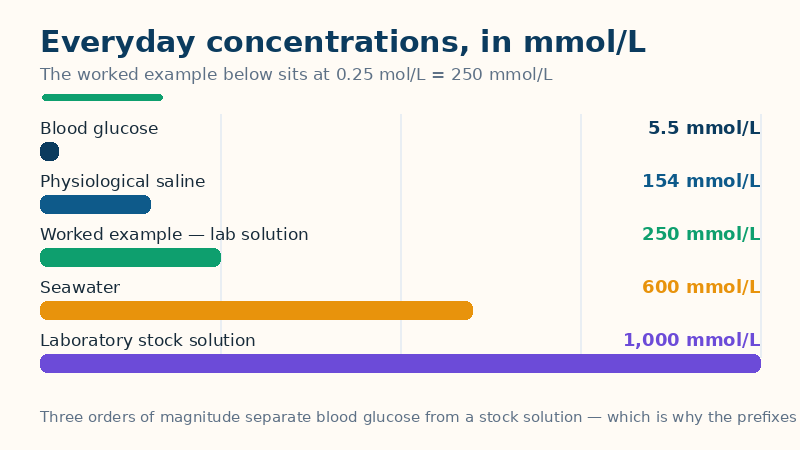
Three everyday cross-checks for the scale, each one the same two steps: a normal fasting blood glucose near 5.5 mmol/L is 0.0055 mol/L; physiological saline at 0.154 mol/L is 154 mmol/L and 154 mol/m³; and seawater, roughly 0.6 mol/L of dissolved salts, is 600 mmol/L. The two same-number traps in the table are worth memorising rather than deriving each time: a figure in mol/m³ reads the same number as in mmol/L, and a figure in kmol/m³ reads the same number as in mol/L, because each pair carries one thousand on both sides of the division.
Reading the result, and its limits
Four distinctions keep this page honest. First, molarity is not molality: molality counts moles per kilogram of solvent, not per litre of solution, and the two cannot be converted without the solvent's mass and the solution's density — a molality figure has no place in this converter's table, and forcing one in would be a category error, not a conversion. Second, molarity is not mass concentration: grams per litre cannot become moles per litre without the solute's molar mass, in grams per mole, because the mole counts particles and the gram weighs them — divide g/L by g/mol to get mol/L, and only then does this page take over. Third, molarity moves with temperature: a solution's volume expands as it warms, so the same moles in a warmer, larger volume read a slightly lower molarity, while molality, counting per kilogram, does not move — state the temperature when a molarity must be exact. Fourth, the display has a finest step: values below 0.000001 print at six decimal places, so a 1 pmol/L solution restated in mol/L reads 0 on this page while its exact value, 0.000000000001 mol/L, stands in the note above the tool — the table rows at ordinary lab scales are exact, and only the picomolar-to-molar corner hits the display limit.
Related tools: Unit Converter — Convert length, weight, temperature and volume — km to miles, kg to pounds, °C to °F, litres to gallons; Volume Converter — Convert US cups, gallons, litres, millilitres and spoons — every answer in all ten units, through the exact US customary definitions; Density Converter — kg/m³ to lb/ft³, g/cm³ to lb/in³, lb/gal and more — every answer in all nine units, through the exact definitions.
Frequently asked questions
Is 1 M the same as 1 mol/L?
Yes, exactly. M is the symbol for molar concentration, and 1 M means 1 mole of solute per litre of solution. A 0.25 M solution and a 0.25 mol/L solution are the same solution, and this page converts between the two labels by doing nothing — the number does not change.
How do I convert mmol/L to mol/L?
Divide by 1,000. A clinical report of 250 mmol/L is 250 ÷ 1,000 = 0.25 mol/L, the worked example on this page. To go the other way, multiply mol/L by 1,000 to get mmol/L.
Why does kmol/m³ give the same number as mol/L?
Because both thousands cancel: a kilomole is 1,000 moles and a cubic metre is 1,000 litres, so 1 kmol/m³ = 1,000 mol ÷ 1,000 L = 1 mol/L. The same cancellation makes mol/m³ read the same number as mmol/L — one thousand on the volume side only.
Can I convert grams per litre to moles per litre here?
Not directly, because that conversion needs the solute's molar mass. Divide the mass concentration by the molar mass in grams per mole — g/L ÷ g/mol = mol/L — and then convert the resulting mol/L figure on this page. Without the molar mass, no converter can bridge a weight and a particle count.
