One charge, three dialects
Electric charge is the quantity that flows in a current, sits on a capacitor's plates and is stored in a battery — and it is quoted in three dialects that rarely meet. Physics uses the coulomb: one ampere flowing for one second. Battery labels use the amp-hour family: a phone battery is 5,000 mAh, a car battery is 60 Ah, and neither label mentions coulombs at all. Electrochemistry uses the faraday: the charge of a mole of electrons. This page restates any charge in all ten units at once, worked through the coulomb with every factor defined, so a figure in any dialect can be read in any other. It also answers the question battery labels leave hanging — how much energy that charge holds — once you supply a voltage, because charge alone is not energy.
The formula
answer = coulombs ÷ (coulombs in one "to" unit)
Two terms, both visible on the page. value is the number you enter. coulombs in one "from" unit is the definition of the unit you are converting from: 1 for the coulomb itself, 0.001 for the millicoulomb, 0.000001 for the microcoulomb, 0.000000001 for the nanocoulomb, 0.000000000001 for the picocoulomb, 3,600 for the ampere-hour, 3.6 for the milliamp-hour, 10 for the abcoulomb, about 0.0000000003335641 for the statcoulomb, and about 96,485.33212 for the faraday. answer is the result in the unit you asked for. The statcoulomb and faraday factors are approximate — the statcoulomb comes from the speed of light in CGS units and the faraday from the measured charge of a mole of electrons — and this page labels them approximate wherever they appear, rather than dressing them up as exact definitions like the amp-hour factors are.
Worked example
Convert 5,000 milliamp-hours to coulombs — a typical phone battery — the way the tool does it.
Step 1 — get to coulombs. One milliamp-hour is 3.6 C, so 5,000 × 3.6 = 18,000 C.
Step 2 — divide by the target factor. The target is the coulomb itself, whose factor is 1, so 18,000 ÷ 1 = 18,000.
Step 3 — read the display. The page prints six decimals below 0.001, four below 10 and two above, so the headline reads 18,000 C, and the detail line shows the working: 5,000 mAh = 18,000 C — worked through coulombs: 18,000 C ÷ the Coulomb factor.
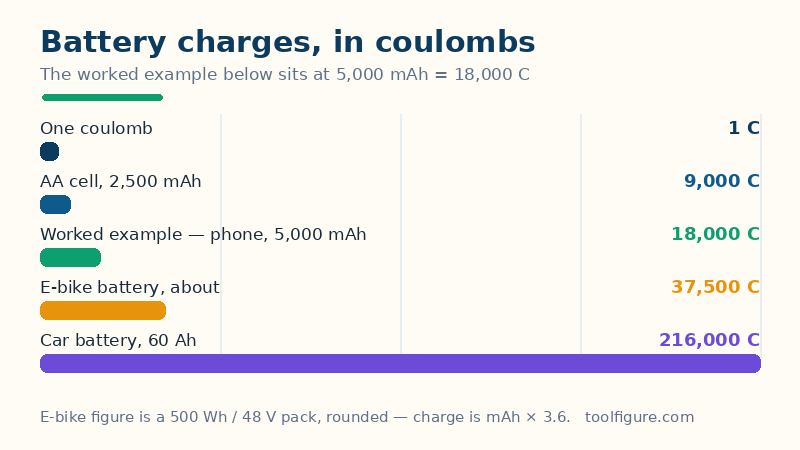
Check it. Multiplying back, 18,000 ÷ 3,600 = 5 exactly — the amp-hour factor closes, so the same battery is 5 Ah. The table underneath restates the same 18,000 C in all ten units (18,000,000 mC, 18,000,000,000 µC, 18,000,000,000,000 nC, 18,000,000,000,000,000 pC, 5 Ah, 5,000 mAh, 1,800 abC, 53,962,641,663,176.59 statC, 0.1866 F), so the from/to choice only changes which row is the headline. And the energy line finishes the job for this battery: at the default 3.7 V, that 18,000 C stores 66,600 J (18.5 Wh) — the watt-hour figure airlines and laptop labels actually use, worked out in the open from charge × voltage.
Conversions worth memorising
Every row below is the tool's own output, checked figure by figure:
| From | To | Result |
|---|---|---|
| 1 C | millicoulomb | 1,000 mC |
| 1 C | milliamp-hour | 0.2778 mAh |
| 1 Ah | coulomb | 3,600 C |
| 5,000 mAh | coulomb | 18,000 C |
| 60 Ah (car battery) | coulomb | 216,000 C |
| 1 abC | coulomb | 10 C |
| 1 F (approx.) | coulomb | 96,485.33 C |
| 1 C | statcoulomb (approx.) | 2,997,924,536.84 statC |
| 100 mAh | coulomb | 360 C |
Three rows deserve a second look. The 1 C row is the identity the whole battery world runs on in reverse: one coulomb is only 0.2778 mAh, so a battery rating in thousands of mAh is tens of thousands of coulombs — the phone in your pocket holds 18,000 C, a number that sounds enormous until it is divided by 3,600 back into the familiar 5 Ah. The car battery row is the scale jump that catches people out: 60 Ah is 216,000 C, twelve times the phone, and it is still only 0.622 faradays — a mole of electrons is an industrial quantity of charge, not a household one. And the statcoulomb row is the display-floor trap in reverse: one coulomb is nearly three billion statcoulombs, so going the other way, a single statcoulomb reads as 0 C at the page's finest step, because 0.0000000003335641 C rounds to zero at six decimals — read the statcoulomb row for anything on that scale, not the coulomb row.
Three traps worth knowing
Milliamp-hours measure charge, not energy. A 5,000 mAh phone battery at 3.7 V holds 18.5 Wh, but the same 5,000 mAh at 12 V would hold 60 Wh — the same charge, more than three times the energy. Battery comparisons that quote mAh alone are comparing charges, and two batteries with the same mAh at different voltages store different energy. This page's energy line exists for exactly that reason: charge × voltage is the energy, and the voltage is not optional.
Amps and amp-hours are different quantities. An ampere is a rate — one coulomb per second — while an amp-hour is a total — 3,600 coulombs delivered whenever. A charger rated 2 A does not hold 2 Ah; it delivers 2 Ah in one hour, 1 Ah in half an hour, and nothing at all when it is unplugged. The electric current converter on this site handles rates; this page handles totals, and mixing the two is the most common battery-arithmetic error there is.
Charge is quantised, but this page does not pretend to count electrons. Every charge is a whole number of elementary charges — one coulomb is about 6.2415 × 10¹⁸ of them — but at household scales that granularity is invisible, and this page does not carry the elementary charge as a table row, because a row reading 18,000,000,000,000,000,000 for a phone battery helps nobody count anything. The faraday row is the usable version of the same idea: 18,000 C is 0.1866 faradays, a mole-fraction a chemist can actually use.
How to read your result, and the limits
Results show six decimals below 0.001, four below 10 and two above — more precision than any battery label justifies, so round to the label for real use. Four limits belong with the page. Negative values are allowed, deliberately: a negative charge gets a result, not an error, because the sign here is the charge's type — electrons carry negative charge — and refusing it would hide physics. Empty input clears quietly; type and the table rebuilds, delete and the page waits. Anything past a trillion in any unit gets a clear error instead of a meaningless digit string. And this page converts charge, not capacity in service: it will restate any charge in any unit, but it will not tell you how long a battery lasts — that depends on the current drawn, the voltage under load, temperature and age — or how much usable energy a real battery delivers, which is always less than charge × nominal voltage. For that you need the discharge curve, and this page will at least help you read the charge on it correctly.
Related tools: Electric Current Converter — Amps to milliamps, microamps and more — every answer in all eight units, plus the watts at your voltage; Ohm's Law Calculator — Enter any two of voltage, current, resistance and power — get the other two, with the working; Power Converter — Horsepower to kW, kW to hp, watts and tons of refrigeration — every answer in all eight units, through the exact definitions.
Frequently asked questions
How many coulombs are in a milliamp-hour?
Exactly 3.6. So 1 mAh is 3.6 C, 5,000 mAh — a typical phone battery — is 18,000 C, and 60 Ah — a car battery — is 216,000 C. To go back, divide coulombs by 3,600 for amp-hours or by 3.6 for milliamp-hours: 1 C is 0.2778 mAh.
What is the difference between mAh and Wh?
Milliamp-hours measure charge; watt-hours measure energy. Energy is charge × voltage, so a 5,000 mAh battery at 3.7 V holds 18.5 Wh, while the same 5,000 mAh at 12 V holds 60 Wh. Two batteries with the same mAh at different voltages store different energy — which is why this page asks for a voltage before it quotes joules or watt-hours.
How many coulombs are in a faraday?
About 96,485.33 — the charge of one mole of electrons, approximately, because it rests on a measured constant rather than a definition. A phone battery's 18,000 C is 0.1866 faradays. The faraday factor on this page is labelled approximate wherever it appears, unlike the amp-hour factors, which are exact.
What is a statcoulomb?
The CGS unit of charge: about 3.335641 × 10⁻¹⁰ coulombs, so one coulomb is about 2,997,924,536.84 statcoulombs. It appears in older electromagnetic theory, where the abcoulomb (10 C) is its CGS sibling. Because a single statcoulomb rounds to 0 C on this page, read the statcoulomb row for anything on that scale.