Three steps: watts, duty, rate
The whole calculation is three multiplications, and the compressor duty is the one people get wrong. Watts divided by 1,000 is kilowatts; kilowatts times the compressor duty divided by 100 is the average draw; the average draw times 24 hours is the energy of one day; the day's energy times 365 days is the year's energy; the year's energy times the price is the year's money. The month is the year divided by 12, not the day times 30 — the two differ by a few cents on a mini fridge, and the year-divided-by-12 figure is the one this page uses, so it agrees with the yearly total exactly:
energy per day (kWh) = watts ÷ 1,000 × duty ÷ 100 × 24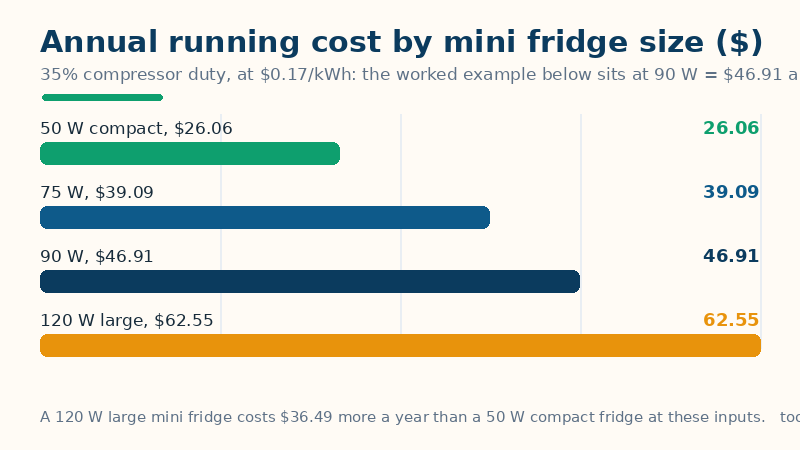
energy per year (kWh) = energy per day × 365annual cost ($) = energy per year × electricity priceThe watts on the label are the mini fridge's maximum draw, and the compressor does not draw them all day. Most mini fridges sold in the US run 50 to 120 W — 1.7 cu ft models at 50 to 65 W, 3.2 cu ft at 65 to 85 W, 4.4 cu ft at 85 to 100 W and 7.0 cu ft at 100 to 120 W, per Fridge.com's size table. What matters is the compressor duty: the fridge cycles on and off as the thermostat holds temperature, and costtorun's mini fridge calculator puts typical cycling at about 35% of the time at full power. The duty is the whole estimate — the hours are fixed at 24, so a fridge in a warm room at 50% duty costs $67.01 a year against $46.91 at 35%.
Worked example: 90 W, 35% duty, $0.17/kWh
A 90 W mini fridge at 35% duty draws 0.09 × 0.35 = 0.0315 kW on average and uses 0.0315 × 24 = 0.756 kWh a day, costing $0.13. A month is 275.94 ÷ 12 = 23.0 kWh, costing $3.91. A year is 0.756 × 365 = 275.94 kWh, costing $46.91. The table above shows the same maths for the other mini fridge sizes at 35% duty: a 50 W compact fridge costs 0.3¢ an hour on average and $26.06 a year, a 75 W fridge costs 0.4¢ an hour and $39.09 a year, and a 120 W large mini fridge costs 0.7¢ an hour and $62.55 a year. One hour at these settings uses 0.03 kWh on average and costs 0.5¢; at full power without cycling it costs $134.03 a year, and with the compressor cycling at 50% it costs $67.01 a year. Ten years of running at this pace costs $469.10. Four published cross-checks reproduce exactly: costtorun's 90 W mini fridge at 35% duty and 15 cents costs $0.11 a day, $3.40 a month and $41.39 a year — this page gives the same $0.11 a day and $41.39 a year, while its $3.40 a month is the day times 30 against this page's $3.45, the year divided by 12. Fridge.com's 75 W, 3.2 cu ft mini fridge running 24 hours a day at 13 cents costs $7.02 a month — this page gives the same $0.23 a day at full power, while its $7.02 a month is the day times 30 against this page's $7.12. Their 100 W fridge at the same rate costs $9.36 a month — this page gives the same $0.31 a day, with the month $9.49. And Fridge.com's Energy Index, built on US EPA and DOE ENERGY STAR records, puts the median certified compact refrigerator at 246 kWh a year — this page's worked example uses 275.9 kWh a year, a little above the median, which is what a non-certified 90 W unit at 35% duty should be.
How to read your result, and its limits
Four cautions keep the number honest. First, the duty is the average: the compressor cycles, so a mini fridge at 50% duty costs $67.01 a year against $46.91 at 35% — and in a hot garage the compressor may run at 70% or more, so enter the duty you actually see, not the duty you hope for. Second, the fridge never switches off: there is no hours input on this page because a mini fridge runs 24 hours a day, 365 days a year — the duty does all the work, which is why a small change in duty moves the yearly figure more than a small change in watts. Third, size and certification move the duty: Fridge.com's Energy Index puts the median ENERGY STAR certified compact refrigerator at 246 kWh a year, and most mini fridges land between 100 and 300 kWh a year — an old fridge with worn door seals, a freezer compartment iced up, or a door opened every few minutes runs at a higher duty than a new certified one in a cool room. For the full-size fridge the refrigerator cost calculator prices the same maths, and for the freezer beside it the freezer cost calculator does the same. Fourth, the electricity price is the all-in rate: the total on the bill divided by the kilowatt-hours on the bill, including delivery charges. For the cost of running anything else in the house, the electricity cost calculator prices any appliance by watts and hours.
Common mistakes
- Multiplying the label watts by 24 hours. A 90 W mini fridge does not use 2.16 kWh a day — at 35% duty it uses 0.756 kWh, $0.13 a day, not $0.37. Enter the duty, not just the watts.
- Multiplying the daily cost by 30 for the month. Thirty days is not a twelfth of a year: the day times 30 gives $3.86 a month at the worked example's inputs, while the year divided by 12 gives $3.91. Use the year-divided-by-12 figure, which is the one that adds up.
- Judging a mini fridge by its purchase price. A mini fridge is cheap to buy and cheap to run — $46.91 a year at the worked example's inputs — but an old inefficient one in a hot room at 70% duty costs $93.82 a year, double the figure, so the running cost is still worth checking before buying second-hand.
- Putting a mini fridge in a hot garage. The duty climbs with the room temperature: a fridge that cycles at 35% in a cool bedroom may run at 70% in a hot garage, doubling the yearly cost from $46.91 to $93.82. Keep it in a cool room if the bill matters.
- Adding the standing charge to every hour. The daily supply charge is payable whether the fridge runs or not. Only the per-kWh rate belongs in the per-hour maths — the fixed charge is a separate line on the bill.
Frequently asked questions
How much does it cost to run a mini fridge per month?
At the worked example's inputs — 90 W, 35% duty — a mini fridge uses 23.0 kWh a month and costs $3.91 at $0.17 per kWh, or $46.91 a year. A 50 W compact fridge costs $2.17 a month and a 120 W large one $5.21 a month at the same duty and rate.
How much electricity does a mini fridge use per year?
The worked example uses 275.9 kWh a year. Fridge.com's Energy Index puts the median ENERGY STAR certified compact refrigerator at 246 kWh a year, and most mini fridges land between 100 and 300 kWh a year depending on size, duty and how often the door opens.
Does a mini fridge use a lot of electricity?
No — a mini fridge is one of the cheapest appliances to run: about $3.91 a month at the worked example's inputs, against roughly $6 to $7 a month for a full-size fridge. The catch is the duty: the compressor cycles, so the label watts are the ceiling and the average draw is about a third of them. A 90 W mini fridge at 35% duty averages 31.5 W, not 90.
What compressor duty should I enter?
About 35% for a mini fridge in a cool room that is not opened often — the figure this page uses by default, and the figure costtorun uses for its mini fridge calculator — and 50% for a warm room, a fridge opened often, or one with a freezer compartment that is iced up. In a hot garage the compressor may run at 70% or more, so watch the cycling, not the label.