Three steps: motor energy, water heating, cost
The whole calculation is two additions and one multiplication. The motor's energy is watts times cycle hours divided by 1,000; the water heating is added on top — nothing for a cold wash, about 3.5 kWh for a warm wash and about 7.0 kWh for a hot wash on a standard top-loader; then the total per load times the loads a week times 52 weeks times the price is the year's money:
motor energy per load (kWh) = motor watts × cycle hours ÷ 1,000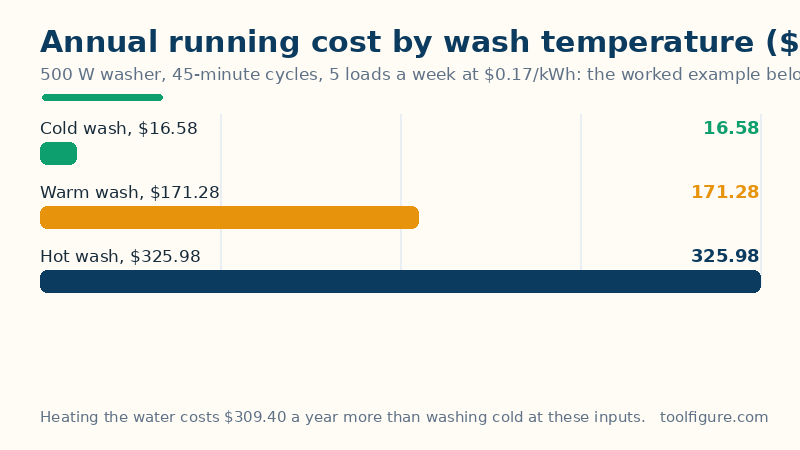
energy per load (kWh) = motor energy + water heating (0 cold, 3.5 warm, 7.0 hot)annual cost ($) = energy per load × loads a week × 52 × electricity priceThe motor on a modern washer draws only 300 to 500 watts, and a cycle lasts roughly 45 minutes, so the motor's share is small — a 500 W motor for 45 minutes uses 0.375 kWh. The water heating is the cost: a standard top-loader heats roughly 35 gallons of water a load, and heating that water from a 55°F cold supply to a 120°F hot wash takes about 7.0 kWh, with a warm wash taking about half of that. The heating figures on this page are the standard top-loader figures; a front-loader uses far less water per load, so its heating is proportionally less, and a washer that draws hot water from a gas water heater pays for the heating in gas therms rather than kilowatt-hours — the water heater cost calculator prices that side of it.
Worked example: 500 W, 45 minutes, 5 loads a week, cold, $0.17/kWh
A standard top-loader draws 500 W and runs 45-minute cycles, 5 loads a week, on a cold wash at $0.17 per kWh. The motor energy is 500 × 0.75 ÷ 1,000 = 0.375 kWh a load, and a cold wash adds no water heating, so one load costs 0.375 × $0.17 = $0.06. A week is 0.375 × 5 = 1.9 kWh, costing $0.32. A month is 97.5 ÷ 12 = 8.1 kWh, costing $1.38. A year is 0.375 × 5 × 52 = 97.5 kWh, costing $16.58. The same loads on warm cost $171.28 a year (3.875 kWh a load, $0.66 a load) and on hot $325.98 a year (7.375 kWh a load, $1.25 a load) — switching from hot to cold saves $309.40 a year. The table above shows the same maths for other washers at the same 45-minute cycles, 5 loads a week and $0.17/kWh, all on cold: an HE front-loader at 350 W uses 0.2625 kWh a load and costs $11.60 a year, and a standard agitator at 600 W uses 0.45 kWh a load and costs $19.89 a year. Two published cross-checks reproduce exactly: a 500 W washer running 30-minute cycles, 5 loads a week, uses 65 kWh a year and costs $11.05 at $0.17/kWh; and at $0.18/kWh a standard top-loader costs $0.07 a load on cold (0.4 kWh), $0.70 on warm (3.9 kWh) and $1.33 on hot (7.4 kWh), with the hot-to-cold saving working out to $327.60 a year — about $328.
How to read your result, and its limits
Four cautions keep the number honest. First, the heating figures are for a standard top-loader: a front-loader uses roughly a third of the water, so its warm and hot figures are roughly a third of these — enter a smaller heating figure by choosing cold and adding the difference yourself, or take the page's warm and hot numbers as the top-loader's. Second, a gas water heater changes the currency, not the physics: the heating energy is the same 7.0 kWh of heat, but bought as gas at about $0.051 per kWh of heat before efficiency, so a hot wash on gas-heated water costs far less in money than the same wash on an electric element — the water heater page prices both fuels. Third, the label's kWh per 100 cycles is the measured figure: a label showing 51 kWh per 100 cycles is 0.51 kWh a cycle, which at $0.17/kWh is about $0.09 a load — if your machine's label gives that number, it beats any estimate from watts and guessed heating. Fourth, this page prices electricity only: water, detergent and maintenance are separate costs, and the dryer that follows the wash costs far more than the wash itself — the clothes dryer cost calculator prices it by kWh per load. For the cost of running anything else in the house, the electricity cost calculator prices any appliance by watts and hours.
Common mistakes
- Pricing the motor and ignoring the water. The motor is $16.58 a year on cold; the same loads on hot are $325.98. Any estimate that quotes the motor alone understates a hot wash by a factor of twenty — the temperature dial is the cost, not the motor.
- Using the nameplate watts as if the motor draws full power the whole cycle. A washer's motor draws its rated watts only while it is spinning; much of the cycle is filling, soaking and draining at a fraction of that draw. The 0.375 kWh figure already assumes the full 500 W for the whole 45 minutes, so it is, if anything, generous — the label's kWh per cycle is the tighter number.
- Adding the standing charge to every load. The daily supply charge is payable whether the washer runs or not. Only the per-kWh rate belongs in the per-load maths — the fixed charge is a separate line on the bill.
- Comparing washers on watts instead of kWh per load. A 600 W agitator and a 350 W front-loader look very different on watts, but on cold at the same cycle they cost $19.89 and $11.60 a year — an $8.29 gap, not a doubling. The kWh per load, or the label's kWh per 100 cycles, is the comparison; the watts are not.
Frequently asked questions
How much does a washing machine cost to run per load?
On cold, very little: a 500 W washer on 45-minute cycles costs $0.06 a load at $0.17 per kWh. The same loads cost $0.66 a load on warm and $1.25 a load on hot, because heating the water takes 3.5 kWh and 7.0 kWh a load against 0.375 kWh for the motor.
Why is a hot wash so much more expensive than a cold wash?
Because heating water is far more energy-intensive than spinning a drum: a standard top-loader heats roughly 35 gallons of water a load, which takes about 7.0 kWh, against 0.375 kWh for the motor — roughly nineteen times as much. The temperature dial, not the motor, is the cost.
How much does a washing machine cost per year?
At 5 loads a week and $0.17 per kWh, a 500 W washer on 45-minute cycles costs $16.58 a year on cold, $171.28 on warm and $325.98 on hot. An HE front-loader at 350 W costs $11.60 a year on cold at the same loads and rate.
How much do I save by washing cold?
At 5 loads a week and $0.17/kWh, switching every load from hot to cold saves $309.40 a year — $325.98 down to $16.58. At $0.18/kWh the same switch saves about $328 a year. Most modern detergents are made to work in cold water, so the saving rarely costs a clean wash.