Four steps: energy, cost, payback, replacements
A bulb's cost is its wattage times the hours it burns, and the saving is the difference between two such multiplications. First the energy: bulbs times watts times hours a day times 365 days, divided by 1,000 to turn watt-hours into kilowatt-hours. Then the money: energy times the electricity price. The payback divides what the LEDs cost to buy by what they save each year, and the 10-year figure is ten years of saving minus the purchase price. The replacement bulbs are counted separately, because they are real money that a pure energy figure hides:
annual energy (kWh) = bulbs × watts × hours a day × 365 ÷ 1,000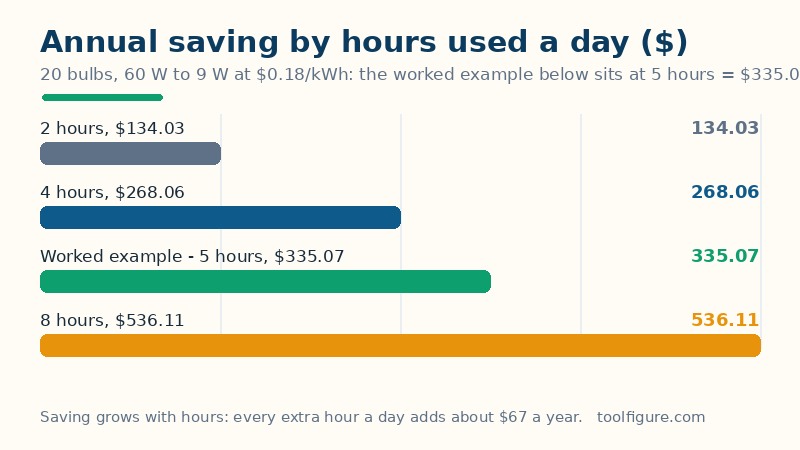
annual cost ($) = annual energy × electricity priceannual saving ($) = old annual cost − LED annual costpayback (months) = bulbs × LED price ÷ annual saving × 1210-year saving ($) = 10 × annual saving − bulbs × LED pricereplacement bulbs avoided in 10 years = bulbs × (hours in 10 years ÷ old bulb life) − bulbsThe last line needs a word of explanation. Over ten years at five hours a day each socket burns for 18,250 hours. An incandescent rated at 1,000 hours lasts about 200 days at that rate, so each socket needs roughly 18 bulbs in the decade — 365 across 20 sockets — while the 20 bulbs already in the sockets are not a purchase, so about 345 replacement bulbs are avoided. The LED, rated at 25,000 hours, is still on its first bulb at the end of the same decade. That is the second half of the saving, and it is why a bulb that costs three times as much still wins: it is bought once where the cheap bulb is bought eighteen times.
Worked example: 20 bulbs, 60 W to 9 W, 5 hours a day
A home replaces 20 sixty-watt incandescents with 9 W LEDs, the lights on five hours a day, electricity at $0.18 per kWh. The old bulbs use 20 × 60 × 5 × 365 ÷ 1,000 = 2,190 kWh a year, costing 2,190 × $0.18 = $394.20. The LEDs use 20 × 9 × 5 × 365 ÷ 1,000 = 328.5 kWh a year, costing $59.13. The saving is 1,861.5 kWh and $335.07 a year — 85% of the old lighting bill, which is the point of the swap: a 9 W LED gives about 800 lumens, the same light as the 60 W bulb it replaces, for 85% less energy. Twenty LEDs at $3 each cost $60, so the payback is $60 ÷ $335.07 × 12 = 2.1 months. Over ten years the energy saving is 10 × $335.07 − $60 = $3,290.70, and about 345 replacement bulbs are avoided — roughly another $345 at $1 each. Even at two hours a day the same swap saves $134.03 a year and pays back in 5.4 months, and at eight hours a day it saves $536.11 a year. The table above shows the same house with other bulbs: a 100 W incandescent costs $657.00 a year where the 9 W LED costs $59.13, and a 13 W CFL at $85.41 already captures most of the saving — the LED's remaining advantage is its life, not its watts.
How to read your result, and its limits
Four cautions keep the number honest. First, match lumens, not watts: the wattage you enter for the LED must give the same light as the old bulb — 800 lumens for a 60 W replacement, about 1,100 for 75 W and 1,600 for 100 W. An LED that is too dim gets supplemented with another lamp, and the saving evaporates. Second, the electricity price is the all-in rate: the number on the bill divided by the kilowatt-hours on the bill, including delivery charges, not the generation rate alone — using the smaller number understates the saving by a third in some states. Third, rated life is a median, not a guarantee: a 25,000-hour rating means half the bulbs last that long, and heat is the enemy — an LED in an enclosed fixture or a hot recessed can runs hotter and dies sooner, so the replacement count is an estimate, not a promise. Fourth, dimming and smart bulbs change the maths: a dimmed LED uses less power than its rating, which increases the saving, while a smart bulb draws a small standby load around the clock, which trims it — neither effect is in this page, and both are small beside the 85% gap. For the cost of running anything else in the house, the electricity cost calculator prices any appliance by watts and hours; for the panels that can supply the saved energy, the solar panel calculator sizes the array; and for the biggest single load in most homes, the air conditioner cost calculator prices the cooling by SEER.
Common mistakes
- Comparing watts instead of lumens. A 9 W LED replaces a 60 W incandescent because both give about 800 lumens. Buying the same wattage in LED gives a floodlight, and buying too few lumens gives a dim room that gets a second lamp — both mistakes erase the saving the page calculates.
- Counting only the energy and forgetting the replacements. In the worked example the replacement bulbs are worth about $345 over ten years on top of $3,290.70 of energy saving. A page that prices energy alone understates the case for LEDs by a tenth.
- Using the generation rate instead of the all-in rate. The saving is priced at the rate the household actually pays per kilowatt-hour. Delivery charges, which can be a third of the bill, are part of that rate — leave them out and the payback looks months longer than it is.
- Assuming the payback is the same in every room. A bulb burning five hours a day pays back in 2.1 months; a cupboard bulb burning ten minutes a day takes years. Replace the hard-working sockets first and leave the rarely used ones until they fail.
Frequently asked questions
How much do LED bulbs actually save?
About 85% of the lighting energy for the same light: a 9 W LED gives roughly 800 lumens, the same as a 60 W incandescent. In the worked example — 20 bulbs, 5 hours a day, $0.18/kWh — the saving is 1,861.5 kWh and $335.07 a year, plus about 345 replacement bulbs avoided over ten years.
How long until LED bulbs pay for themselves?
Divide what the LEDs cost by what they save each year. In the worked example 20 LEDs at $3 each cost $60 and save $335.07 a year, so the payback is 2.1 months. At 2 hours a day the same swap saves $134.03 a year and pays back in 5.4 months; a bulb that burns rarely takes much longer, so replace the hard-working sockets first.
What wattage LED replaces a 60 watt bulb?
A 9 W LED, giving about 800 lumens. Match lumens, not watts: 40 W is about 450 lumens (a 6 W LED), 75 W is about 1,100 lumens (an 11 W LED) and 100 W is about 1,600 lumens (a 14–15 W LED). A bulb with too few lumens gets a second lamp added, which erases the saving.
Do LED bulbs really last 25,000 hours?
That is the rated life — the point at which half the bulbs in a test batch are still running at 70% brightness. At 5 hours a day 25,000 hours is about 13.7 years. Cheap bulbs and hot enclosed fixtures can fail sooner, so treat the replacement count on this page as an estimate, not a guarantee.