Girth first, inseam second, shoe third
Wader guides agree on the order, and it is worth following it exactly because each measurement answers a different question. First, the largest girth — the biggest of your chest, waist and hips — picks the letter size: S 34–38 in (86–97 cm), M 38–42 in (97–107 cm), L 42–46 in (107–117 cm), XL 46–50 in (117–127 cm), XXL 50–54 in (127–137 cm). Using the largest measurement, not just the chest, is the point: a wader that fits the chest but not the hips will not close comfortably, and the guides say to start from the largest girth, then match the inseam, then the boot. Second, the inseam — crotch to floor, wearing socks — picks the length: Short under 30 in, Regular 30–32 in, Long over 32 in. Third, the shoe size is checked against the bootie range that letter size comes with: S 7–9, M 9–11, L 10–12, XL 10–12, XXL 11–13, in US men's sizing. For stockingfoot waders the bootie is not your shoe at all — you buy wading boots separately, about one size up from your street shoe, to fit over the neoprene bootie — while for bootfoot waders the boot is attached and the range has to fit your foot directly.
Size = girth band (S 34–38 in · M 38–42 · L 42–46 · XL 46–50 · XXL 50–54) + inseam length (Short < 30 in · Regular 30–32 · Long > 32) — bootie range checked against your shoe size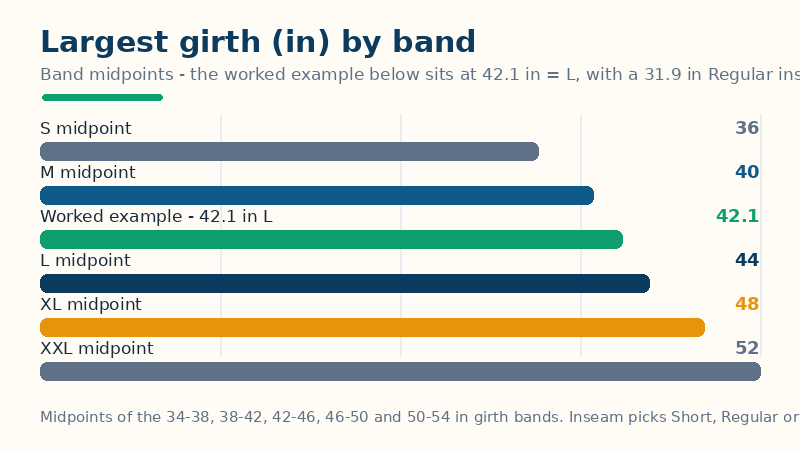
A girth exactly on a boundary belongs to the larger size: 42 in reads as L, not M, and 38 in reads as M, not S. That follows the guides' between-sizes rule — if you fall between two sizes, size up — because a wader that is too snug stretches its seams and can leak, while a slightly roomy wader only costs a little freedom of movement.
Worked example: 107 cm girth, 81 cm inseam, US 11 shoe
An angler with a 107 cm largest girth, an 81 cm inseam and a US men's 11 shoe needs size Large Regular. The working: 107 cm ÷ 2.54 = 42.1 in, which falls in the L girth band, 42–46 in; 81 cm ÷ 2.54 = 31.9 in, which is Regular, 30–32 in; and a US 11 shoe sits inside the Large bootie range, US 10–12, so the bootie fits. The same arithmetic at other measurements shows all three steps in action:
| Girth | Inseam | Shoe | Working | Size |
|---|---|---|---|---|
| 91 cm | 76 cm | US 8 | 35.8 in (S) · 29.9 in (Short) · 8 inside 7–9 | S Short |
| 117 cm | 84 cm | US 12 | 46.1 in (XL) · 33.1 in (Long) · 12 inside 10–12 | XL Long |
| 132 cm | 81 cm | US 13 | 52.0 in (XXL) · 31.9 in (Regular) · 13 inside 11–13 | XXL Regular |
Notice the second and third rows together: the XL Long and XXL Regular anglers have inseams only 3 cm apart, yet one is Long and the other Regular — the 32 in boundary is what switches the length, not the girth — while the first row shows the other direction, a small girth with a short inseam landing on the shortest combination of all.
How to read your result, and its limits
Three checks before trusting the size. First, measure over what you will actually wear: take the measurements wearing the thickest socks you anticipate wading in, and remember that bulky layers underneath change the girth — the guides say to size for the clothing you will actually fish in. Second, between sizes, size up: a snug wader stretches its seams and can leak, and the fit should be snug but not tight — comfortable, with room to move, rather than skin-tight. Third, the maker's chart outranks this page for the waders you buy: every brand sizes differently — some offer King variants for a larger girth on a regular inseam, some offer Short, Regular, Long and Tall variants the general grid does not split, and women's charts run on their own measurements — always compare girth, inseam and boot against the label of the actual waders, and try them on before wading deep. This page also does not choose the wader type — chest, waist or hip height, stockingfoot or bootfoot, breathable or neoprene — it only sizes the waders once the type is chosen.
Common mistakes
- Using the chest alone. The size comes from the largest of chest, waist and hips — a wader that fits the chest but not the hips will not close comfortably.
- Forgetting the bootie. A letter size can be right while the boot is wrong — check your shoe against the bootie range, and for stockingfoot waders buy boots about one size up to fit over the bootie.
- Measuring the inseam in shoes. Inseam is crotch to floor in socks — shoes add height that is not leg length, and push the length one step too long.
- Sizing down between sizes. A snug wader stretches its seams and can leak — when you fall between two sizes, the guides say to size up.
Related tools: Fishing Rod Length Calculator — Your fishing rod length from what you fish for and your height: one length to shop, with the matching power and action; Wetsuit Size Calculator — The right wetsuit size from your height and weight, plus the suit thickness for your water temperature: one consolidated chart, honestly stated; Life Jacket Size Calculator — Your life jacket size: children by body weight, adults by chest measurement — plus the fit test that confirms it.
Frequently asked questions
What size fishing waders do I need?
It comes from three measurements: the largest of your chest, waist and hips picks the letter — for example, 107 cm (42.1 in) is Large — your inseam picks Short, Regular or Long (81 cm, 31.9 in, is Regular), and your shoe is checked against that size's bootie range (Large is US 10–12, so a US 11 fits).
How do I measure myself for waders?
Measure the largest of your chest, waist and hips with a soft tape, level, wearing the thickest socks you will wade in, and measure the inseam from crotch to floor in socks, not shoes. Use your regular street shoe size as the starting point for the boot check.
Should I size up or down if I am between wader sizes?
Size up. A wader that is too snug stretches its seams and can leak, while a slightly roomy wader only costs a little freedom of movement — the guides agree on this rule, and this page applies it at every boundary.
What is the difference between stockingfoot and bootfoot waders for sizing?
Stockingfoot waders end in a neoprene bootie, and you buy wading boots separately, about one size up from your street shoe, to fit over the bootie. Bootfoot waders have the boot attached, so your shoe must sit inside the size's bootie range directly — this page checks that for you when you enter a shoe size.
