Four parts: the rate, the overtime, the extras, the tax
The whole calculation is one effective rate, one gross pay, one tax and two divisions, and the only thing that needs care is what the overtime and the tax are calculated on. The per-child bump raises the rate before anything else is worked out, so the overtime is paid on the higher rate; the extras are spread over the weeks of the month and taxed with the pay; and the employer tax is charged on the pay plus the extras together:
effective rate ($) = base rate + bump × (children − 1)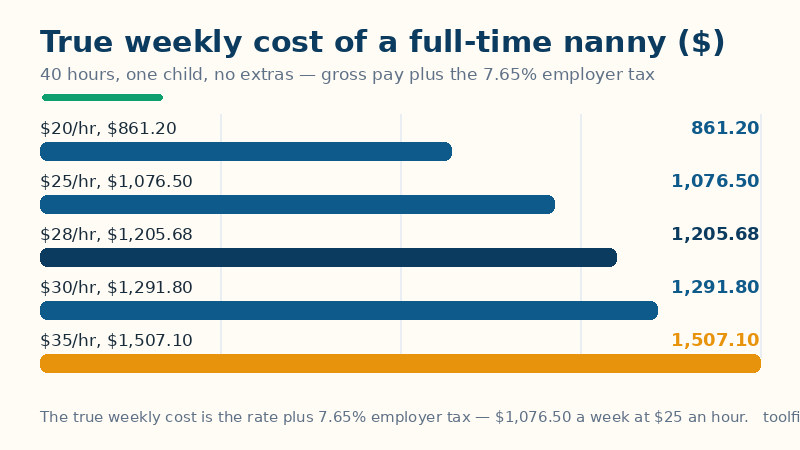
gross weekly pay ($) = effective rate × regular hours + effective rate × overtime multiplier × overtime hoursweekly extras ($) = monthly extras × 12 ÷ 52household weekly cost ($) = (gross weekly pay + weekly extras) × (1 + employer tax %)monthly cost ($) = weekly cost × 52 ÷ 12 · yearly cost ($) = weekly cost × 52The table above prices the same maths at five hourly rates for a full-time week — 40 hours, one child, no extras, 7.65% tax: $20 an hour is $861.20 a week and $44,782.40 a year, $25 is $1,076.50 and $55,978.00, $28 is $1,205.68 and $62,695.36, $30 is $1,291.80 and $67,173.60, and $35 is $1,507.10 and $78,369.20. The tax alone is $61.20 a week at $20 an hour and $107.10 at $35 — the line the rate-times-hours estimate leaves out entirely.
Worked example: $28 an hour, two children, five overtime hours — $1,609.99 a week
The effective rate is $28 + $3 × (2 − 1) = $31.00 an hour. The gross pay is $31 × 40 = $1,240.00 of regular pay plus $31 × 1.5 × 5 = $232.50 of overtime — $1,472.50 a week. The extras are $100 × 12 ÷ 52 = $23.08 a week. The pay plus the extras are $1,472.50 + $23.08 = $1,495.58, and the employer tax at 7.65% is $1,495.58 × 0.0765 = $114.41. The true weekly cost is $1,495.58 + $114.41 = $1,609.99, the monthly cost is $1,609.99 × 52 ÷ 12 = $6,976.62, and the yearly cost is $83,719.41 — worked from the unrounded weekly cost, so it sits one cent under $1,609.99 × 52, the same rounding step CalculatorZilo's published figures carry. The effective cost is $1,609.99 ÷ 45 hours = $35.78 for every hour worked, against a $28.00 headline rate. Without the 5 overtime hours the same week costs $1,359.70 a week, $70,704.52 a year — the overtime alone is $250.29 a week. Two published cross-checks reproduce. CalculatorZilo's Nanny Payment Calculator runs the same quick answer — $28 an hour, 40 regular hours plus 5 overtime hours at 1.5×, 2 children with a $3-an-hour bump, $100 a month of extras and 7.65% tax — and reaches the same figures: $1,472.50 of gross pay a week, $1,609.99 a week to the household, $6,976.62 a month and $83,719.41 a year; their $20-an-hour table row is $800.00 of gross pay, $61.20 of tax and $861.20 a week, which is the first row of the table above. NovaCalculator's worked example is a nanny at $22 an hour for 40 hours a week: the gross pay is $22 × 40 × 52 = $45,760.00 a year, and the employer tax alone at 7.65% gives $45,760 × 1.0765 = $49,260.64 a year, $23.68 an hour — while NovaCalculator's published all-in figure is $50,177, which is $916.36 higher because it adds benefits and workers compensation on top of the 7.65% tax. Set against daycare, the nanny is the expensive option by a wide margin: one child at $25 an hour, 40 hours a week and no extras is $55,978.00 a year against $14,400.00 for a year of childcare for one child — about 3.9 times as much — and the worked example's two children are $83,719.41 a year against $27,360.00 for two children in daycare, about 3.1 times as much. What the nanny buys for the difference is one-to-one care at home, on your hours, with no centre closures.
How to read your result, and its limits
Four cautions keep the number honest. First, the 7.65% is the federal floor, not the whole tax: it is the employer's share of Social Security (6.2%) and Medicare (1.45%) only, and state unemployment insurance, workers compensation and paid-leave costs sit on top of it at rates that vary by state — the true tax line is higher wherever those apply. Second, the tax does not apply below the IRS threshold: if you pay a household employee under about $3,000 in a year (the 2026 threshold), no Social Security or Medicare tax is owed, so set the tax rate to 0 for a short engagement and 7.65% once the year's wages pass the threshold. Third, the nanny is an employee, not a contractor: a household worker gets a W-2 and the family files Schedule H with its tax return — a 1099 does not apply, and paying under the table leaves the family exposed to the tax and to the nanny's lost Social Security credits. Fourth, the extras line is the only place the soft costs live: paid time off, sick days, holidays, mileage beyond the extras figure, agency fees, background checks and live-in room and board are not in this total — price them as separate lines before calling the number final. For the daycare side of the same decision, the childcare cost calculator prices the monthly rate, the sibling discount and the weeks actually paid for; for the first year around it, the baby cost calculator prices the delivery, the gear and the other monthly lines; and the overtime pay calculator splits any working week at its two rates the same way this page splits the nanny's.
Common mistakes
- Budgeting the rate times the hours. $28 × 45 hours is $1,260.00 a week; the true cost is $1,609.99 — $349.99 a week, $18,199.48 a year, missing, because the second child, the overtime premium and the tax were never counted.
- Paying the base rate for the second child. The $3-an-hour bump is $135.00 a week at 45 hours — $7,020.00 a year — and it also raises the rate the overtime is calculated on, so forgetting it understates the overtime as well as the regular pay.
- Calculating overtime on the base rate. Five overtime hours at the $31.00 effective rate are $232.50 a week; at the $28.00 base rate they are $210.00 — $22.50 a week short, because the bump applies to the overtime hours too.
- Treating the nanny as a contractor. A household employee gets a W-2 and the family files Schedule H. A 1099 does not apply, and the 7.65% employer tax is owed on top of the pay whether or not it was budgeted.
- Comparing the nanny and daycare on the hourly rate alone. One child at $25 an hour is $55,978.00 a year against $14,400.00 for a year of childcare — about 3.9 times as much — and the comparison only makes sense on the yearly totals, tax included.
Frequently asked questions
How much does a nanny cost per year?
At the worked example's inputs — $28 an hour, 2 children, 40 regular hours plus 5 overtime hours at 1.5×, $100 a month of extras and 7.65% employer tax — the true cost is $1,609.99 a week, $6,976.62 a month and $83,719.41 a year. A full-time week at one child and no extras runs $44,782.40 a year at $20 an hour to $78,369.20 at $35.
What is the nanny tax?
The employer's share of Social Security (6.2%) and Medicare (1.45%) — 7.65% of the nanny's wages, filed on Schedule H with the family's tax return, with the nanny on a W-2, not a 1099. If the year's wages stay under about $3,000 (the 2026 IRS household-employer threshold), no Social Security or Medicare tax is owed. State unemployment, workers compensation and paid-leave costs sit on top of the 7.65%.
Do nannies get overtime pay?
Yes — under the Fair Labor Standards Act, domestic workers are paid 1.5 times their regular rate for hours past 40 in a week, and the overtime is calculated on the effective rate including the per-child bump. At the worked example's $31.00 effective rate, 5 overtime hours are $232.50 a week.
Is a nanny cheaper than daycare?
No. One child at $25 an hour, 40 hours a week and no extras costs $55,978.00 a year against $14,400.00 for a year of childcare for one child — about 3.9 times as much. Two children are $83,719.41 a year for a nanny against $27,360.00 in daycare. What the nanny buys for the difference is one-to-one care at home, on your hours, with no centre closures.