Three steps: into the battery, off the wall, onto the bill
Charging an electric car is priced in three steps, and skipping the middle one is the usual mistake. First, the energy that reaches the battery: battery capacity times the charge window. Second, the energy drawn from the wall: that figure divided by charging efficiency, because some energy becomes heat in the charger, cables and battery. Third, the cost: wall energy times the price per kilowatt-hour where you plug in:
energy added (kWh) = battery capacity × (target % − start %) ÷ 100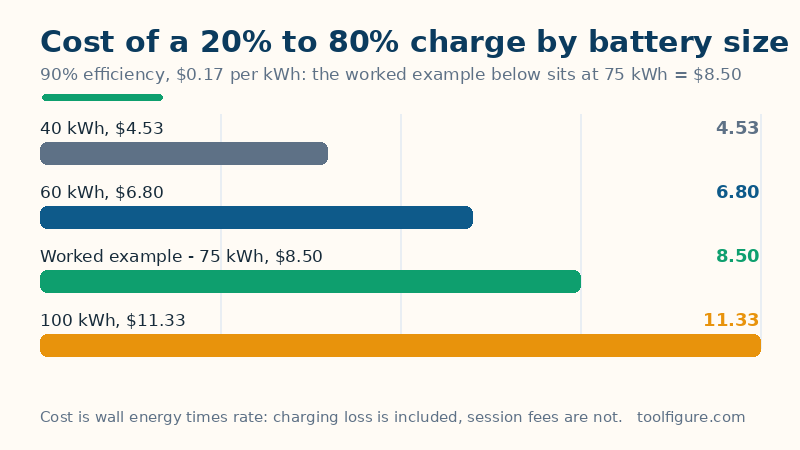
energy from the wall (kWh) = energy added ÷ charging efficiencycost = energy from the wall × price per kWhcharging time = energy from the wall ÷ charger power (kW)Efficiency is the step most tools hide. Home AC charging typically runs about 90% efficient — the onboard charger converts alternating current to direct current and loses roughly a tenth — while DC fast charging bypasses the onboard charger and runs about 95%. That is why a charge that adds 45 kWh to the battery draws 50 kWh from a home wall box but only about 47.4 kWh from a DC charger: the same battery, the same window, a different meter reading. The charging time uses the wall figure, not the battery figure, because the charger delivers wall energy at its rated power; on a 7.4 kW home wall box the worked example takes 6 hours 45 minutes, which is why home charging is an overnight job and fast charging is a roadside stop.
Worked example: 75 kWh battery, 20% to 80%, $0.17/kWh, 90% efficiency
Energy added = 75 × 60% = 45.0 kWh. Energy from the wall = 45.0 ÷ 0.90 = 50.0 kWh — the extra 5.0 kWh is charging loss. Cost = 50.0 × $0.17 = $8.50. Charging time = 50.0 ÷ 7.4 kW = 6.76 hours = 6h 45m. Range added = 45.0 × 3.5 miles per kWh = 157.5 miles. Cost per mile = $8.50 ÷ 157.5 = 5.4 cents. At a $0.48/kWh DC fast-charger price, the same 50.0 kWh from the wall would cost $24.00 — $15.50 more for the same charge, before any session fee. The calculator's table shows the same method at other battery sizes (20% to 80%, 90% efficiency, $0.17/kWh): 40 kWh → 26.7 kWh from the wall, $4.53; 60 kWh → 40.0 kWh, $6.80; 100 kWh → 66.7 kWh, $11.33. As a monthly figure, driving 1,000 miles at 3.5 miles per kWh needs 285.7 kWh in the battery, 317.5 kWh from the wall at 90% efficiency, costing $53.97 a month at $0.17/kWh — against about $116.67 for a petrol car at 30 mpg and $3.50 a gallon (33.3 gallons), a saving of roughly $62.70 a month on fuel alone.
How to read your result, and its limits
Four cautions keep the number honest. First, the rate is everything: the same charge costs $8.50 at a $0.17 home rate and $24.00 at a $0.48 fast-charger price, so a tool that does not ask where you charge cannot price your charge. Off-peak home tariffs often halve the daytime rate, and that alone can beat any efficiency gain. Second, charging slows near full: the time figure assumes the charger holds its rated power for the whole session, but real cars taper sharply above about 80%, so a 20% to 100% session takes longer than the simple division suggests — one reason the 20% to 80% window is the standard comparison. Third, battery capacity here means usable capacity: a car advertised with a 82 kWh pack may offer only about 77 kWh usable, and using the advertised figure overstates the charge by that gap. Fourth, public prices are not just per-kWh prices: session fees, idle fees, membership rates and demand-based pricing all sit outside this calculation, so treat the fast-charger comparison as a per-kWh comparison, not a receipt. For what the electricity itself costs at home, the electricity cost calculator prices any appliance's use; for the emissions side of the same driving, the carbon footprint calculator totals a household's CO2.
Common mistakes
- Pricing the battery energy instead of the wall energy. Multiplying 45.0 kWh by $0.17 gives $7.65, not $8.50 — the missing 85 cents is the 5.0 kWh lost in charging. Always divide by efficiency before multiplying by the rate.
- Using the advertised pack size instead of usable capacity. The gap between gross and usable capacity is typically a few kilowatt-hours, and it inflates every cost figure built on it. Use the usable figure from the car's spec sheet.
- Assuming the charger holds full power to 100%. Charging tapers above about 80%, so a session to full takes materially longer than wall energy divided by charger power. The time figure is exact for the rated-power assumption and optimistic near full.
- Comparing a home rate with a fast-charger receipt. A fast-charger bill can include session and idle fees on top of the per-kWh price, so the per-kWh comparison on this page understates a real fast-charging stop. Compare per-kWh with per-kWh, then add the fees.
Related tools: Solar Panel Calculator — How many panels your roof needs — system size, panel count, roof area, cost and payback from your monthly use and local sun.
Frequently asked questions
How much does it cost to charge an electric car at home?
Multiply the energy drawn from the wall by your home rate. For a 75 kWh battery charged from 20% to 80% at 90% efficiency, that is 50.0 kWh from the wall, which costs $8.50 at $0.17 per kWh — plus nothing else, since home charging has no session fee.
Why does charging cost more than the battery size suggests?
Because of charging loss: the energy that reaches the battery is less than the energy drawn from the wall. At 90% home AC efficiency, a 45.0 kWh charge draws 50.0 kWh from the meter, so you pay for 50.0 kWh, not 45.0 kWh.
How long does it take to charge an EV at home?
Wall energy divided by charger power. The worked example — 50.0 kWh on a 7.4 kW home wall box — takes 6 hours 45 minutes. A standard household outlet at about 1.4 kW would take roughly 36 hours for the same charge, which is why a wall box matters.
Is home charging cheaper than public fast charging?
Usually by a large margin, because the per-kWh price differs most. The worked example costs $8.50 at a $0.17 home rate and $24.00 at a $0.48 fast-charger price for the same 50.0 kWh from the wall — $15.50 more, before any session fee.