One formula, four bills
A footprint is not measured, it is added up: each activity multiplied by its emission factor — the kilograms of carbon dioxide equivalent released per unit of that activity — and the results summed. CO2e, carbon dioxide equivalent, folds the other greenhouse gases into the same unit by their warming effect, so one number can cover electricity, gas, petrol and jet fuel:
total CO2e = Σ (activity × emission factor)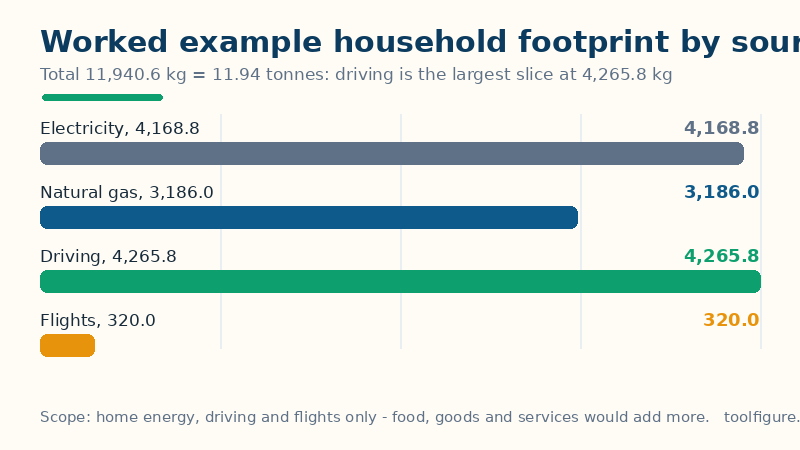
electricity = kWh per month × 12 × grid factor (kg per kWh)natural gas = therms per month × 12 × 5.31 kg per thermdriving = miles per month × 12 ÷ mpg × 8.887 kg per gallonflights = passenger-miles per year × 0.16 kg per passenger-mileThe factors are the published US EPA figures, with one deliberate simplification: the flight factor. Real flight factors vary by distance class — short flights run roughly 0.21 kg per passenger-mile because take-off and landing dominate, medium flights about 0.13 and long flights about 0.16 — so this page uses 0.16 as a mid-range blend and says so, rather than pretending one number fits a 200-mile hop and a transatlantic flight equally. The grid factor is the input that most deserves your attention: 0.386 kg per kWh is the US average, but grids range from under 0.2 on nuclear- and hydro-heavy grids to over 0.7 on coal-heavy ones, so two identical homes can differ by tonnes on electricity alone. If your utility publishes its grid factor, use it.
Worked example: 900 kWh, 50 therms, 1,000 miles, 2,000 flight miles
Electricity: 900 × 12 × 0.386 = 4,168.8 kg. Natural gas: 50 × 12 × 5.31 = 3,186.0 kg. Driving: 1,000 × 12 ÷ 25 × 8.887 = 480 gallons × 8.887 = 4,265.8 kg (480 × 8.887 is 4,265.76, shown rounded). Flights: 2,000 × 0.16 = 320.0 kg. Total: 4,168.8 + 3,186.0 + 4,265.8 + 320.0 = 11,940.6 kg = 11.94 tonnes a year. The shares are electricity 34.9%, natural gas 26.7%, driving 35.7% and flights 2.7% — they sum to exactly 100.0%, and driving edges out electricity as the largest slice in this household, which surprises people who expect the house to dominate. The calculator's per-unit table shows the same factors one unit at a time: 100 kWh a month → 463.2 kg a year, 10 therms a month → 637.2 kg, 100 car miles a month at 25 mpg → 426.6 kg, 1,000 flight miles → 160.0 kg. Two sensitivities show where the total moves: change only the grid factor to 0.20 and the total falls to 9.93 tonnes; to 0.70 and it rises to 15.33 tonnes — the same house, the same habits, a five-tonne swing from the grid alone. And for scale: at the EPA's roughly 4.6 tonnes a year for a typical passenger vehicle, this household's 11.94 tonnes equals about 2.6 cars, before food, goods and services are counted at all.
How to read your result, and its limits
Four cautions keep the number honest. First, this is a household energy-and-travel footprint, not a full personal footprint: diet, clothing, electronics, services and the emissions from extracting and refining your fuel are excluded, so do not compare this total directly against whole-person figures (often quoted near 4–5 tonnes per person globally) without adding those categories. Second, the grid factor is an average, not your meter reading: if your electricity comes from a coal-heavy grid or a renewable tariff, the electricity slice moves by tonnes, as the sensitivity above shows. Third, the flight blend is approximate: a year of short hops at 0.21 per mile would exceed the blended figure, and a year of long-haul at 0.16 is close to it — split your flights by distance class if you want better than a blend. Fourth, this is an estimate, not an audit: factors are national averages, driving assumes one car at one fuel economy, and household size is not divided out — a four-person household's 11.94 tonnes is under 3 tonnes per person for these categories, while a single occupant's is the full 11.94. For the solar side of the same household, the solar panel calculator sizes the system that would cut the electricity slice; for what that electricity costs today, the electricity cost calculator prices it.
Common mistakes
- Comparing a partial total with a full-person figure. This page covers energy, driving and flights only. A total of 11.94 tonnes here is not "three times the global average person" — the global figure includes food and goods this page leaves out.
- Using the wrong grid factor. The default 0.386 is a US average. On a coal-heavy grid the electricity slice nearly doubles; on a clean grid it halves. Check your utility's figure before quoting the total.
- Counting flights per trip instead of per passenger-mile. A 2,000-mile round trip for two people is 4,000 passenger-miles, not 2,000. The factor is per person per mile, so multiply by passengers.
- Forgetting that mpg already converts miles to gallons. Driving emissions are gallons times 8.887 kg, and gallons are miles divided by mpg. Multiplying miles directly by 8.887 would overstate driving by a factor of 25 at the worked example's economy.
Related tools: Heat Index Calculator — How hot it really feels — the official NWS heat index from temperature and humidity, with the danger band.
Frequently asked questions
What is a carbon footprint?
The total greenhouse gases caused by a person or household, expressed in tonnes of CO2 equivalent (CO2e) per year — CO2e folds gases like methane into the same unit by their warming effect. This calculator totals home electricity, natural gas, driving and flights; the worked example household is 11.94 tonnes a year for those categories.
How is a carbon footprint calculated?
By multiplying each activity by its emission factor and adding the results: electricity kWh × grid factor, gas therms × 5.31 kg, car miles ÷ mpg × 8.887 kg per gallon, and flight passenger-miles × 0.16 kg. The factors used here are the published US EPA figures.
What is not included in this carbon footprint?
Food, shopping, services, and the emissions from producing and delivering fuel. Those categories add substantially to a full personal footprint, so this total — energy, driving and flights only — is lower than a complete figure and should not be compared directly with whole-person averages.
Why does the grid factor change the result so much?
Because electricity's emissions depend entirely on how your grid makes power. At the worked example's use, a grid factor of 0.20 kg per kWh gives a 9.93-tonne total while 0.70 gives 15.33 tonnes — the same house and habits, a five-tonne swing from the grid alone. Use your utility's published factor when you can.