Height, plus the allowance your position needs
A sleeping bag must be longer than you are, and the allowance depends on how you sleep. A back or side sleeper needs 5 cm (2 in) beyond their height: room for the bag to cinch around the neck without the toes pushing into the footbox loft. A stomach sleeper, who points their toes, needs 13 cm (5 in) — the pointed foot is longer than the flat foot, and a bag sized on the flat measurement will press the toes into the insulation, compressing it into a cold spot. The minimum length is therefore height plus 5 cm, or height plus 13 cm for stomach sleepers, and the size to buy is the smallest standard size covering that minimum. Standard adult sizes run: Short 168 cm (5 ft 6 in), Regular 183 cm (6 ft 0 in), Long 198 cm (6 ft 6 in), XL 213 cm (7 ft 0 in). The temperature side of the page is a separate rule: shop for a comfort rating 5 °C below the coldest night you expect — the safety margin that covers a forecast that runs colder than predicted — and shop by the comfort rating, never by the limit or extreme figures printed beside it.
Minimum length = height + 5 cm (back or side) or + 13 cm (stomach) — Sizes: Short 168 · Regular 183 · Long 198 · XL 213 cm — Size = smallest size at or above the minimum — Comfort rating to shop for = expected low − 5 °C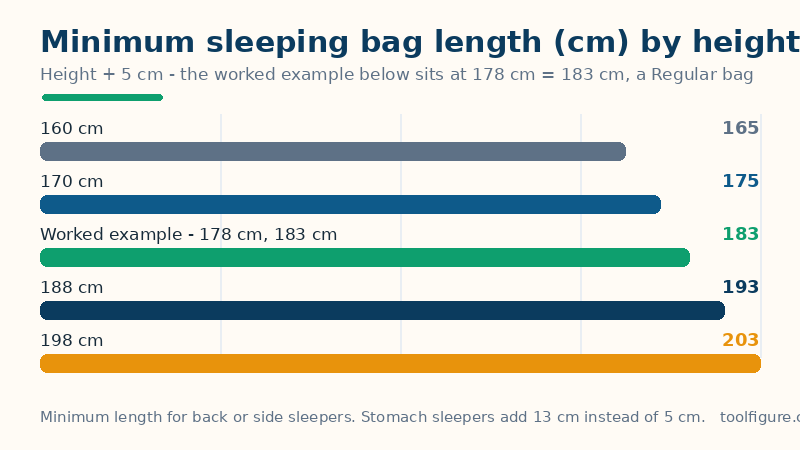
A minimum exactly equal to a size takes that size, not the next one up: 183 cm is a Regular bag, not a Long, because the Regular interior of 183 cm already covers it. The size letters are a guide, not a standard — brands cut differently — which is why the page prints the interior length beside every letter and why the check below says to compare the maker's interior length against your minimum, not just to trust the letter.
Worked example: 178 cm tall, back sleeper, coldest night 5 °C
A camper who is 178 cm tall, sleeps on their back, and expects a coldest night of 5 °C should buy a Regular bag, 183 cm (6 ft 0 in), with a comfort rating of 0 °C (32 °F). The working: the minimum length is 178 + 5 = 183 cm, which is 183 ÷ 2.54 = 72.0 in, or 6 ft 0 in. The smallest standard size covering 183 cm is Regular at exactly 183 cm. The comfort rating to shop for is 5 − 5 = 0 °C, which is 0 × 9 ÷ 5 + 32 = 32 °F. The same arithmetic at other heights shows the sizes stepping, and the stomach allowance moving one sleeper a whole size:
| Height | Position | Minimum length | Size |
|---|---|---|---|
| 160 cm | Back or side | 165 cm (5 ft 5.0 in) | Short (168 cm) |
| 170 cm | Back or side | 175 cm (5 ft 8.9 in) | Regular (183 cm) |
| 178 cm | Back or side | 183 cm (6 ft 0 in) | Regular (183 cm) |
| 188 cm | Back or side | 193 cm (6 ft 4.0 in) | Long (198 cm) |
| 198 cm | Back or side | 203 cm (6 ft 7.9 in) | XL (213 cm) |
| 178 cm | Stomach | 191 cm (6 ft 3.2 in) | Long (198 cm) |
Notice the third and last rows together: the same 178 cm sleeper buys a Regular bag on their back but a Long bag on their stomach — the 13 cm stomach allowance pushes the minimum from 183 cm to 191 cm, past the Regular length. And notice the first row: a 160 cm back sleeper's minimum of 165 cm fits Short, with only 3 cm to spare — the tightest fit on the table, and the one most worth checking against the maker's actual interior length.
Temperature ratings, and the margin rule
The rating to shop for is the expected low minus 5 °C, and the table below runs the same subtraction across typical nights. The 5 °C margin is the forecast margin: nights run colder than predicted, and a bag bought exactly to the forecast has no room for that. Cold sleepers should treat the comfort rating as the figure and keep the full margin; warm sleepers may find the limit rating usable, but the limit rating is where a standard sleeper survives curled up, not where they sleep well — buying to the limit rating to save weight is a gamble on the forecast, not a saving.
| Expected low | Comfort rating to shop for |
|---|---|
| 10 °C (50.0 °F) | 5 °C (41.0 °F) |
| 5 °C (41.0 °F) | 0 °C (32.0 °F) |
| 0 °C (32.0 °F) | −5 °C (23.0 °F) |
| −5 °C (23.0 °F) | −10 °C (14.0 °F) |
| −10 °C (14.0 °F) | −15 °C (5.0 °F) |
How to read your result, and its limits
Three checks before trusting the size. First, compare the maker's interior length, not the letter: a Regular from one brand is 183 cm and from another is 178 cm or 188 cm, and the letter alone cannot tell you which — the interior length against your minimum can. Second, girth is not in this number: a bag long enough can still be too tight across the shoulders, and broad or restless sleepers should check the shoulder girth against the maker's spec — a tight bag compresses its own insulation and sleeps colder than its rating. Third, the pad is half the system: the ground steals heat from below, a bag's rating assumes an insulated pad underneath, and no bag length or rating fixes a summer pad on a freezing night. This page also does not size quilts, which are sized by width and attachment, not by a closed footbox length, and it does not size children's bags, which follow age and height bands of their own.
Common mistakes
- Buying to the limit rating. The limit rating is survival, not comfort — a bag bought to the limit rating on a night at that temperature leaves you curled up and cold, not asleep.
- Sizing a stomach sleeper on the flat-foot length. Pointed toes add length: a stomach sleeper sized as a back sleeper gets a bag that presses the toes into the footbox and makes a cold spot.
- Trusting the size letter across brands. Regular means different interior lengths at different makers — compare the published interior length against your minimum.
- Buying long for room. A bag much longer than you need is dead air your body must heat all night — size to the minimum plus the position allowance, not to the largest bag on the shelf.
Related tools: Tent Size Calculator — Your tent size from sleepers and comfort — the floor area you need and the rating that covers it — with the packs-inside allowance; Backpack Size Calculator — Your backpack size in two parts: frame size from torso length, and litres from trip length, packing style and season; Hammock Size Calculator — Your hammock size from height — the minimum length, the 10, 11 or 12 ft size to buy, the width and the hanging distance.
Frequently asked questions
What size sleeping bag do I need?
It comes from your height plus a position allowance: back or side sleepers add 5 cm, stomach sleepers add 13 cm for pointed toes, and the size is the smallest standard size covering the total — Short 168 cm, Regular 183 cm, Long 198 cm, XL 213 cm. For example, 178 cm on your back needs 183 cm, a Regular bag, but on your stomach needs 191 cm, a Long bag.
How much longer than you should a sleeping bag be?
At least 5 cm (2 in) longer for a back or side sleeper, and 13 cm (5 in) longer for a stomach sleeper, whose pointed toes need the extra room. Less than that, and the toes compress the footbox insulation into a cold spot.
What temperature rating sleeping bag do I need?
Shop for a comfort rating 5 °C below your expected coldest night: a 5 °C night calls for a 0 °C comfort rating, a 0 °C night for −5 °C. Shop by the comfort rating, not the limit rating (survival, not sleep) or the extreme rating (a survival figure).
Does a longer sleeping bag sleep warmer?
No — a bag much longer than you need is dead air your body must heat all night, so it can sleep colder, not warmer. Size to your minimum length plus the position allowance, and spend the weight budget on the rating and an insulated pad instead.
