One flow, eight dialects
Electric current is the flow of charge past a point, and the ampere is its SI unit: one ampere is one coulomb per second, roughly 6.24 × 10¹⁸ electrons per second past that point. Everyday life speaks it in different sizes. A phone charger delivers a couple of amperes; an LED runs on tens of milliamperes; a microcontroller asleep sips microamperes; a sensor's leakage is counted in nanoamperes and picoamperes. Industry counts in kiloamperes for smelters and transmission, and old physics texts add two CGS ghosts: the abampere, exactly 10 A, and the statampere, about 3.335641 × 10⁻¹⁰ A. This page restates any current in all eight units at once, worked through amperes with every factor defined, and tells you the watts that current carries at the voltage you enter — because a current figure without a voltage is only half a power story.
The formula
answer = amperes ÷ (amperes in one "to" unit)
watts = amperes × volts
Four terms, all visible on the page. value is the number you enter. amperes in one "from" unit is the definition of the unit you are converting from — 1 for the ampere itself, 0.001 for the milliampere, 0.000001 for the microampere, 0.000000001 for the nanoampere, 0.000000000001 for the picoampere, 1,000 for the kiloampere, 10 exactly for the abampere, and about 3.335641 × 10⁻¹⁰ for the statampere. answer is the result in the unit you asked for. volts is the voltage you enter for the watts line — 5 V for a USB charger, 230 V for a mains appliance — and watts are what you get when a current and a voltage meet.
Worked example
Convert 2.5 A to milliamperes — a phone charger's rating — the way the tool does it.
Step 1 — get to amperes. The input is already in amperes, so 2.5 × 1 = 2.5 A.
Step 2 — divide by the target factor. One milliampere is 0.001 A, so 2.5 ÷ 0.001 = 2,500.
Step 3 — read the display. The page prints four decimals below 10 and two above, so the headline reads 2,500 mA, and the detail line shows the working: 2.5 A = 2,500 mA — worked through amperes: 2.5 A ÷ the Milliampere factor.
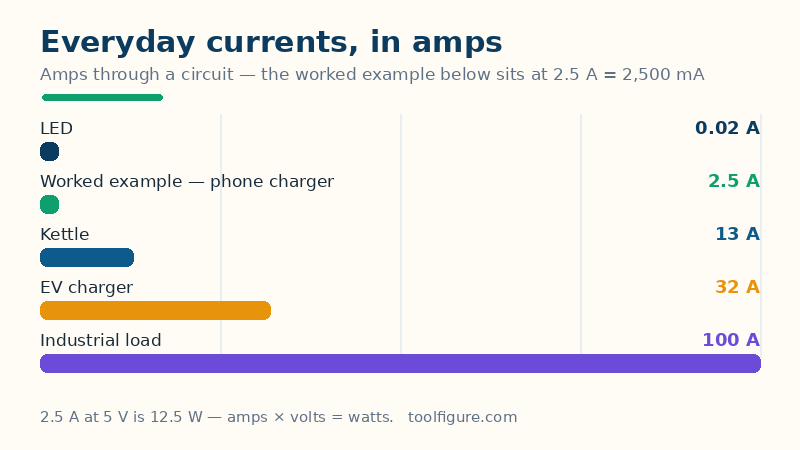
How many watts? Watts are amperes times volts: 2.5 A × 5 V = 12.5 W, which is the line the tool adds under the answer — the charger's actual power at USB voltage, and the reason a "2.5 A charger" and a "12.5 W charger" can be the same product described two ways.
Check it. Multiplying back, 2,500 × 0.001 = 2.5 exactly — the milli prefix closes with nothing lost. The table underneath restates the same 2.5 A in all eight units (2,500 mA, 2,500,000 µA, 2,500,000,000 nA, 2,500,000,000,000 pA, 0.0025 kA, 0.25 abA, 7,494,811,342.11 statA), so the from/to choice only changes which row is the headline.
Conversions worth memorising
Every row below is the tool's own output, checked figure by figure:
| From | To | Result |
|---|---|---|
| 1 A | milliamperes | 1,000 mA |
| 500 mA | amperes | 0.5 A |
| 2.5 A | milliamperes | 2,500 mA |
| 1 mA | microamperes | 1,000 µA |
| 20 mA | amperes | 0.02 A |
| 100 µA | milliamperes | 0.1 mA |
| 1 kA | amperes | 1,000 A |
| 13 A | kiloamperes | 0.013 kA |
| 1 abA | amperes | 10 A |
| 0.5 abA | amperes | 5 A |
| 3 A | microamperes | 3,000,000 µA |
| 1,000 µA | milliamperes | 1 mA |
Three rows deserve a second look. The 500 mA row is the old USB standard — 0.5 A — and it is why a device that draws "500 mA" and a charger rated "0.5 A" are the same load, not two different ones. The 20 mA row is an ordinary indicator LED — 0.02 A — and the reason LED circuits always carry a resistor: twenty milliamperes through an LED is plenty, and an unresisted mains connection would be catastrophic. And the 13 A row is a British kettle plug's fuse rating — 0.013 kA — the largest current an ordinary household socket circuit is built to carry, which is why a kettle, a heater and a hair dryer on one extension lead is how fuses earn their keep.
Three traps worth knowing
Milliamps and milliamps are the same word, but amps and milliamps differ by a thousand. The single most common current mistake is reading a 500 mA rating as 500 A, or entering 2.5 mA where 2.5 A was meant — a factor-of-a-thousand error that turns a charger into a substation. This page prints the unit beside every figure, and its table restates the same current in all eight units, so a thousand-fold slip shows up as a row that looks absurd next to its neighbours.
The statampere is approximate, and the page admits it. Every SI prefix on this page is exact by definition, and the abampere is exactly 10 A, but the statampere's factor — about 3.335641 × 10⁻¹⁰ A — comes from the speed of light and carries the approximation with it. Convert a statampere figure and treat the last digits as decoration; for anything that matters, work in amperes.
Tiny currents hit the display floor. The page prints four decimals below 10 and two above, so 1 pA prints as 0 A in the ampere row — not a zero current, but a current smaller than the display's finest step. Read the milli, micro or nano row instead for anything below a microampere: the factor is exact, and the readable row is the one on the current's own scale.
How to read your result, and the limits
Results show four decimal places below 10 and two above — more precision than any clamp meter justifies, so round to the meter for real use. Four limits belong with the page. Negative values are refused: −2.5 A gets a clear error, because this page converts sizes, and a minus sign here would mean direction, not size — if your sign carries direction, take the magnitude first. Empty input clears quietly; type and the table rebuilds, delete and the page waits. Anything past a trillion in any unit gets a clear error instead of a meaningless digit string. And this page converts currents, not circuits: it will restate any current in any unit and work out the watts at your voltage, but it will not tell you whether a wire, a fuse or a charger can safely carry it — for that you need the component's rating, and this page will at least help you read it in the right unit.
Related tools: Ohm's Law Calculator — Enter any two of voltage, current, resistance and power — get the other two, with the working; Power Converter — Horsepower to kW, kW to hp, watts and tons of refrigeration — every answer in all eight units, through the exact definitions; Energy Converter — Joules to calories, kcal to kJ, kWh to joules and BTU — every answer in all ten units, through the exact definitions.
Frequently asked questions
How do I convert amps to milliamps?
Multiply by 1,000. So 2.5 A becomes 2,500 mA, 1 A is 1,000 mA, and 0.5 A is 500 mA. To go back, divide milliamperes by 1,000: 500 mA is 0.5 A and 20 mA is 0.02 A. This page does both directions and restates every answer in all eight units at once.
How many milliamps is a phone charger?
Most phone chargers deliver 2 to 3 A, which is 2,000 to 3,000 mA — the worked example's 2.5 A charger is 2,500 mA, and at 5 V that is 12.5 W. Older USB chargers delivered 0.5 A (500 mA). If a charger says 2,500 mA and a phone asks for 2.5 A, they agree exactly; the thousand is the only difference.
What is the difference between amps, milliamps and microamps?
They are the same quantity at different scales: 1 A = 1,000 mA = 1,000,000 µA. Household appliances and chargers are rated in amps, small electronics in milliamps, and sensors and sleeping microcontrollers in microamps and below. The prefix tells you the scale; this page converts between all of them through amperes.
How do I work out watts from amps?
Multiply amps by volts: watts = amps × volts. A 2.5 A charger at 5 V delivers 12.5 W; the same 2.5 A at 230 V would be 575 W. Enter your voltage on this page and the tool adds the watts line — but remember the voltage matters as much as the current, which is why the same current means very different power on USB and on mains.