The formula: height and weight matched against one table
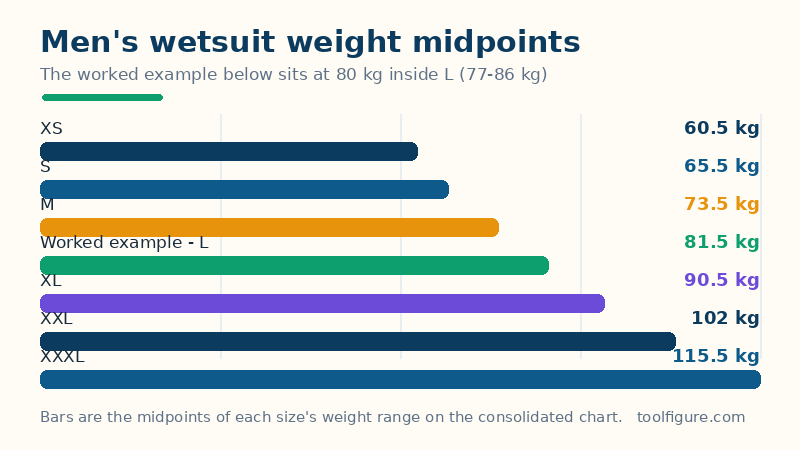
The calculation is a lookup with a stated tie-break, and the calculator shows which rule settled your size so the answer can be checked by hand. Step 1, convert to centimetres and kilograms: height in inches times 2.54 gives height in centimetres, and weight in pounds times 0.45359237 gives weight in kilograms. Step 2, match both measurements against the table: a size fits when height falls inside its height range and weight falls inside its weight range. Step 3, settle the disagreements in the open: if two sizes both fit, the larger wins — the published between-sizes rule, since brands themselves say to size up when in between. If height and weight point at different sizes, the larger of the two wins, for the same reason: a suit that is too tight restricts movement and flushing, while a slightly loose suit still insulates. If only one measurement fits any range, the size follows that measurement, and the calculator says so rather than hiding it. The consolidated men's table, built from the major brands' published men's charts, is:
| Men's size | Height (cm) | Weight (kg) | Height (in) | Weight (lb) |
|---|---|---|---|---|
| XS | 163–173 | 57–64 | 5'4"–5'8" | 125–141 |
| S | 168–178 | 61–70 | 5'6"–5'10" | 135–155 |
| M | 173–180 | 70–77 | 5'8"–5'11" | 154–170 |
| L | 178–183 | 77–86 | 5'10"–6'0" | 170–190 |
| XL | 180–188 | 86–95 | 5'11"–6'2" | 190–210 |
| XXL | 183–191 | 95–109 | 6'0"–6'3" | 210–240 |
| XXXL | 185–198 | 109–122 | 6'1"–6'6" | 240–270 |
The imperial columns are the metric ranges converted and rounded (70 kg is 154.3 lb, 77 kg is 169.8 lb), so the two unit systems describe the same table. The women's table, on the same rules, is:
| Women's size | Height (cm) | Weight (kg) | Height (in) | Weight (lb) |
|---|---|---|---|---|
| 2 | 150–157 | 40–45 | 4'11"–5'2" | 88–99 |
| 4 | 152–160 | 43–48 | 5'0"–5'3" | 95–106 |
| 6 | 155–163 | 48–54 | 5'1"–5'4" | 106–119 |
| 8 | 157–165 | 54–59 | 5'2"–5'5" | 119–130 |
| 10 | 160–168 | 59–64 | 5'3"–5'6" | 130–141 |
| 12 | 163–170 | 64–70 | 5'4"–5'7" | 141–154 |
| 14 | 165–173 | 70–77 | 5'5"–5'8" | 154–170 |
| 16 | 168–178 | 77–86 | 5'6"–5'10" | 170–190 |
Thickness follows the water temperature alone, on the standard surf guidance: 24 °C and up, a 2 mm shorty; 20–24 °C, a 2–3 mm full suit; 17–20 °C, a 3/2 mm full suit; 13–17 °C, a 4/3 mm full suit; 10–13 °C, a 5/4 mm full suit plus boots; below 10 °C, a 6/5 mm full suit plus hood, boots and gloves. A temperature exactly on a band boundary takes the warmer-water suit, as the calculator does. The two numbers in a thickness like 3/2 mm are the torso and limb thicknesses — the torso gets the thicker neoprene because that is where warmth matters most.
Worked example: man, 178 cm, 80 kg, 18 °C water
Take a man who is 178 cm (70.08 in) tall and weighs 80 kg (176.4 lb), surfing in 18 °C (64.4 °F) water. Step 1: no conversion is needed. Step 2: height 178 cm falls inside both the M range (173–180 cm) and the L range (178–183 cm), but weight 80 kg falls outside M (70–77 kg) and inside L (77–86 kg), so only L fits both measurements — the recommendation is size L. Step 3, thickness: 18 °C falls in the 17–20 °C band, so the suit is a 3/2 mm full suit. The same answer comes out of the imperial inputs: 70 in × 2.54 = 177.8 cm and 176 lb × 0.45359237 = 79.8 kg, both still inside L's ranges, so the two unit systems can never disagree by more than rounding. Other bodies on the same tables read:
| Person | Result | Why |
|---|---|---|
| Woman, 165 cm, 62 kg | Size 10 | Only size 10 fits both (160–168 cm, 59–64 kg) |
| Woman, 165 cm, 70 kg | Size 14 | Fits both 12 and 14 — between sizes, the larger wins |
| Man, 175 cm, 90 kg | Size XL | Split case: height alone reads M, weight alone reads XL — larger wins |
| Man, 180 cm, 70 kg | Size M | Only M fits both (173–180 cm, 70–77 kg) |
| Woman, 160 cm, 55 kg | Size 8 | Only size 8 fits both (157–165 cm, 54–59 kg) |
| Woman, 170 cm, 80 kg | Size 16 | Only size 16 fits both (168–178 cm, 77–86 kg) |
Thickness cross-checks on the same rule: 25 °C (77.0 °F) → 2 mm shorty; 22 °C (71.6 °F) → 2–3 mm full suit; 15 °C (59.0 °F) → 4/3 mm full suit; 11 °C (51.8 °F) → 5/4 mm full suit plus boots; 8 °C (46.4 °F) → 6/5 mm full suit plus hood, boots and gloves.
How to read your result, and its limits
Three checks before buying. First, chest, waist and hips can move the size this page gives: this calculator uses height and weight because those are the two measurements every brand chart shares, but a broad chest or long torso can push a paddler up a size even when height and weight agree — if your chest or waist sits at the top of a brand's range for your size, size up. Second, a new suit should feel snug, not comfortable: neoprene stretches a little with use, so a suit that feels perfect in the shop will feel loose in the water after a few sessions; the between-sizes rule above already leans larger, so do not add another size on top of it for comfort. Third, thickness is guidance, not a safety rating: cold water punishes inexperience faster than any suit compensates, and children need a separate kids chart rather than the small end of this adult one — and brands genuinely vary by a size around this consolidated table, so check the brand's own chart before ordering. For the rest of the kit, the swimsuit size converter sizes swimwear from bust, waist and hip, and the surfboard volume calculator sizes a board from weight and skill.
Related tools: Ski Size Calculator — A recommended ski length range from your height, ability level and skiing style, with the full ability table.
Frequently asked questions
What size wetsuit do I need?
As a starting point, match height and weight against the table above: a man at 178 cm and 80 kg reads size L, and a woman at 165 cm and 62 kg reads size 10. Enter your own measurements above and the calculator applies the between-sizes rule for you.
What if I am between two wetsuit sizes?
Take the larger one: brands themselves advise sizing up when in between, because a suit that is too tight restricts movement more than a slightly loose one, and neoprene stretches a little with use.
What thickness wetsuit do I need for 18 °C water?
A 3/2 mm full suit: 18 °C falls in the 17–20 °C band. Warmer water needs less — 24 °C and up is a 2 mm shorty — and colder water needs more, up to a 6/5 mm suit with hood, boots and gloves below 10 °C.
Do wetsuit sizes vary between brands?
Yes, by about a size around this consolidated chart, which is why the page says so plainly: use this result to narrow the choice, then check the brand's own chart — and its chest and waist ranges — before ordering.
