What electrical resistivity is
Electrical resistivity says how strongly a material itself resists electric current, regardless of the shape it happens to be in: a low resistivity means a good conductor, a high resistivity means an insulator. It is the number behind every wire, grounding and heating-element calculation. The science world quotes ohm metre (Ω·m); metal datasheets quote microhm centimetre (μΩ·cm), because copper at 1.68e-08 Ω·m is easier to read as 1.68 μΩ·cm; and grounding reports quote ohm metre again, for soils that run to hundreds of Ω·m — and all of them measure the same quantity, so a material that is 100 Ω·m in one report is 10,000 Ω·cm in another. This page restates any electrical resistivity in all ten units at once, worked through Ω·m with every factor defined, and answers the question the conversion alone cannot: what conductivity does this resistivity mean, and what resistance does a wire of it actually have?
The formula
Ω·m = value × (Ω·m in one "from" unit)
answer = Ω·m ÷ (Ω·m in one "to" unit)
conductivity σ = 1 ÷ resistivity
wire resistance R = resistivity × length ÷ area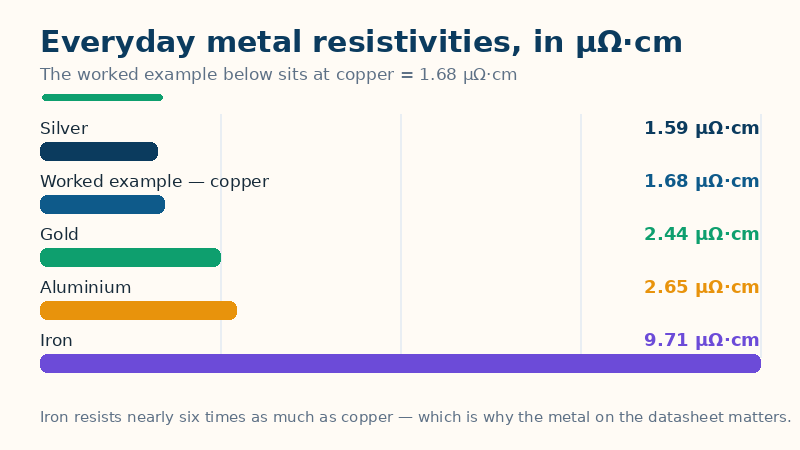
Four terms, all visible on the page. value is the number you enter. Ω·m in one "from" unit is the definition of the unit you are converting from: 1 for the ohm metre itself, 0.01 for the ohm centimetre, 0.001 for the ohm millimetre, 0.00000001 for the microhm centimetre, 0.000001 for the microhm metre, 0.000000001 for the nanoohm metre, 0.0254 for the ohm inch, 0.3048 for the ohm foot, 1,000 for the kiloohm metre and 1,000,000 for the megaohm metre. answer is the result in the unit you asked for. conductivity σ is the reciprocal of the resistivity, in siemens per metre, and wire resistance R is the resistivity times the wire length you enter divided by the cross-section you enter (converted from square millimetres to square metres), in ohms, so the datasheet figure turns into the resistance of a real piece of wire.
Worked example
Convert copper, 1.68 μΩ·cm, to ohm metre — the unit jump every copper datasheet forces on a textbook reader — the way the tool does it.
Step 1 — get to Ω·m. One μΩ·cm is 0.00000001 Ω·m, so 1.68 × 0.00000001 = 1.68e-08 Ω·m.
Step 2 — read the display. The headline reads 1.68e-08 Ω·m, and the detail line shows the working: 1.68 μΩ·cm = 1.68e-08 Ω·m — worked through Ω·m: 1.68e-08 Ω·m ÷ the Ohm metre factor. The full table for this example reads: 1.68e-08 Ω·m, 1.68e-06 Ω·cm, 1.68e-05 Ω·mm, 1.68 μΩ·cm, 0.0168 μΩ·m, 16.8 nΩ·m, 6.61e-07 Ω·in, 5.51e-08 Ω·ft, 1.68e-11 kΩ·m and 1.68e-14 MΩ·m. The extra line, at the default wire of 10 m and 3 mm², reads: Conductivity 59,523,809.52 S/m (59.52 MS/m). A wire 10 m long with a 3 mm² cross-section has a resistance of 0.056 Ω.
Check it. Multiplying back, 1.68e-08 Ω·m ÷ 0.00000001 = 1.68 μΩ·cm exactly, and the extra line checks two ways: 59,523,809.52 S/m × 1.68e-08 Ω·m = 1, the reciprocal identity, and 0.056 Ω × 3 mm² ÷ 10 m = 1.68e-08 Ω·m, the wire formula run backwards (3 mm² is 0.000003 m², so 0.056 × 0.000003 ÷ 10 = 1.68e-08).
Conversion table
The conversions metal datasheets, textbooks and grounding reports reach for most, each one the same two steps as the example:
| From | To |
|---|---|
| Soil, 100 Ω·m | 10,000 Ω·cm, 3,937.01 Ω·in, 328.08 Ω·ft — conductivity 0.01 S/m |
| 1 Ω·m | 100 Ω·cm, 39.37 Ω·in, 3.2808 Ω·ft |
| Silver, 1.59 μΩ·cm | 1.59e-08 Ω·m |
| Gold, 2.44 μΩ·cm | 2.44e-08 Ω·m |
| Aluminium, 2.65 μΩ·cm | 2.65e-08 Ω·m — a 10 m, 3 mm² wire is 0.0883 Ω |
| Iron, 9.71 μΩ·cm | 9.71e-08 Ω·m |
| 1 Ω·ft | 0.3048 Ω·m |
| 1 kΩ·m | 100,000 Ω·cm |
Three everyday cross-checks for the scale, each one the same two steps: silver, the best ordinary conductor, beats copper only slightly — 1.59 against 1.68 μΩ·cm — which is why copper, not silver, wires the world; iron, at 9.71 μΩ·cm, is nearly six times as resistive as copper, which is why iron wire runs hot where copper wire stays cool; and a soil at 100 Ω·m is ten thousand times as resistive as a 0.01 Ω·m clay, which is why a grounding design that works in wet clay fails in dry sand.
Reading the result, and its limits
Four distinctions keep this page honest. First, resistivity is not resistance: resistance, in ohms, depends on the shape — a long thin wire has more of it than a short fat one of the same metal — while resistivity, in ohm metre, is the material alone, and the two must never be swapped: the resistance converter on this site answers the shape question, this page answers the material question. Second, resistivity depends on temperature and purity: the metal figures here are the usual room-temperature values near 20 °C, copper rising about 0.39% per degree Celsius, so a hot motor winding reads higher than its cold datasheet figure. Third, the wire line assumes a uniform, straight, direct-current wire: alternating current crowds to the surface (the skin effect), stranded and bent wire differ slightly, and a real installation adds connections and temperature rise on top. Fourth, soil resistivity is a field value, not a material constant: a grounding report's ohm metre comes from electrodes in layered, wet-or-dry ground, so it guides an electrode design rather than describing a pure substance.
Related tools: Resistance Converter — Ohms to kiloohms, megaohms, milliohms and more — every answer in all eight units; Conductance Converter — Siemens to millisiemens, microsiemens, mhos and more — every answer in all eight units; Voltage Converter — V to kV, mV, µV, nV, MV and statV — every answer in all ten units.
Frequently asked questions
How do I convert Ω·m to Ω·cm?
Multiply by 100. A soil at 100 Ω·m is 10,000 Ω·cm, and the worked example's copper at 1.68e-08 Ω·m is 1.68e-06 Ω·cm. To go the other way, divide by 100.
What is the difference between resistance and resistivity?
Resistance, in ohms, belongs to one particular piece of wire and grows with its length and shrinks with its cross-section (R = ρL/A). Resistivity, in ohm metre, belongs to the material alone and never changes with the shape. Convert a shape's resistance on the resistance converter; convert a material's resistivity here.
Why is copper quoted in μΩ·cm instead of Ω·m?
Because the ohm metre figure is unreadably small: 1.68e-08 Ω·m against 1.68 μΩ·cm for the same copper. The microhm centimetre puts everyday metals between 1 and 100, which is why datasheets use it — and why this page restates it in all ten units at once.
Does resistivity change with temperature?
Yes, for metals it rises as they warm — copper by about 0.39% per degree Celsius near room temperature — and it also depends on purity and alloying, which is why the figures here are the usual room-temperature values and a hot winding always reads higher than its cold datasheet figure.
