What thermal diffusivity is
Thermal diffusivity says how fast heat spreads through a material: a high value means a temperature disturbance races through it, a low value means the material soaks heat up slowly and holds a temperature gradient for a long time. It is the number behind transient heating — how quickly a wall warms through, how fast a quench cools a part, how deep a daily temperature wave reaches into soil. Materials tables quote square millimetres per second (mm²/s) because most solids sit between 0.05 and 200 in those units; textbooks quote square metres per second (m²/s); and American engineering quotes square feet per second (ft²/s) and square feet per hour (ft²/h) — and all of them measure the same quantity, so copper at 111 mm²/s in one table is 1.11e-04 m²/s in the textbook it came from. This page restates any thermal diffusivity in all ten units at once, worked through m²/s with every factor defined, and answers the question the conversion alone cannot: what diffusivity do a conductivity, density and specific heat you enter actually imply?
The formula
m²/s = value × (m²/s in one "from" unit)
answer = m²/s ÷ (m²/s in one "to" unit)
diffusivity α = k ÷ (ρ × c)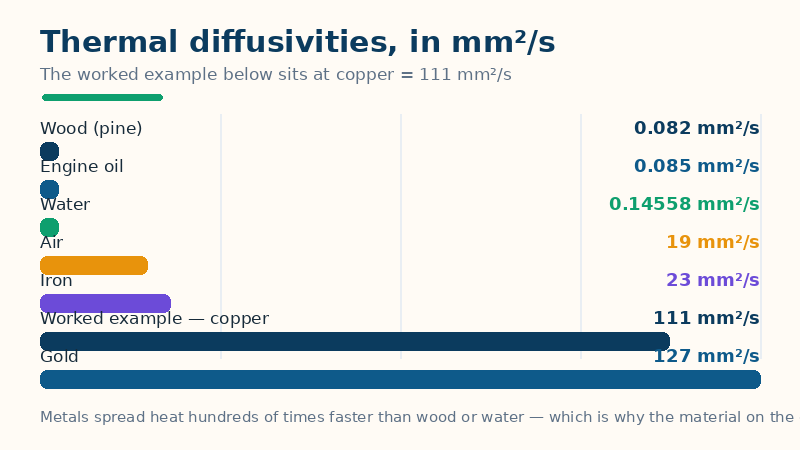
Three terms, all visible on the page. value is the number you enter. m²/s in one "from" unit is the definition of the unit you are converting from: 1 for the square metre per second itself, 0.000001 for the square millimetre per second and for the centistokes, 0.0001 for the square centimetre per second and for the stokes, 1/3,600 for the square metre per hour, 0.09290304 for the square foot per second, 0.0000258064 for the square foot per hour, 0.00064516 for the square inch per second, and 0.0000001792111111111111 for the square inch per hour. answer is the result in the unit you asked for. diffusivity α is the thermal conductivity k you enter divided by the density ρ times the specific heat c you enter, in square metres per second, so a set of material properties turns into the spreading rate they imply.
Worked example
Convert 111 mm²/s (copper) to square metres per second — the unit jump every materials table forces on a textbook reader — the way the tool does it.
Step 1 — get to m²/s. One mm²/s is 0.000001 m²/s, so 111 × 0.000001 = 1.11e-04 m²/s.
Step 2 — read the display. The headline reads 1.11e-04 m²/s, and the detail line shows the working: 111 mm²/s = 1.11e-04 m²/s — worked through m²/s: 1.11e-04 m²/s ÷ the Square metre per second factor. The full table for this example reads: 1.11e-04 m²/s, 111 mm²/s, 1.11 cm²/s, 0.3996 m²/h, 0.0012 ft²/s, 4.3013 ft²/h, 0.1721 in²/s, 619.38 in²/h, 111 cSt and 1.11 St. The extra line, at the default conductivity of 1.4 W/(m·K), density of 2,300 kg/m³ and specific heat of 880 J/(kg·K), reads: From k ÷ (ρ × c): 1.4 ÷ (2,300 × 880) = 6.92e-07 m²/s (0.6917 mm²/s).
Check it. Multiplying back, 1.11e-04 m²/s ÷ 0.000001 = 111 mm²/s exactly, and the diffusivity line checks the same way: 1.4 ÷ (2,300 × 880) = 1.4 ÷ 2,024,000 = 6.92e-07 m²/s as displayed.
Conversion table
The conversions materials tables, textbooks and American reports reach for most, each one the same two steps as the example:
| From | To |
|---|---|
| 1 ft²/s | 0.0929 m²/s |
| Gold, 127 mm²/s | 1.27e-04 m²/s |
| Iron, 23 mm²/s | 2.30e-05 m²/s |
| Air, 19 mm²/s | 1.90e-05 m²/s |
| Water, 0.14558 mm²/s | 1.46e-07 m²/s |
| Wood (pine), 0.082 mm²/s | 8.20e-08 m²/s |
| Engine oil, 0.085 mm²/s | 8.50e-08 m²/s |
Three everyday cross-checks for the scale, each one the same two steps: one square foot per second is 92,903.04 mm²/s, which is why American tables quote feet and hours while metric tables quote millimetres and seconds — the same spread, six orders apart; one square metre per second is 1,000,000 mm²/s, so copper's 111 mm²/s is barely a ten-thousandth of a square metre per second; and silver, gold and copper cluster at the top of the table while wood, oil and water sit hundreds of times lower, which is why a metal pan evens its temperature out while a wooden handle stays cool at one end.
Reading the result, and its limits
Four distinctions keep this page honest. First, diffusivity is not conductivity: conductivity says how much heat flows under a temperature gradient, while diffusivity says how fast a temperature disturbance spreads — a material can conduct well yet diffuse slowly if it also stores a great deal of heat per unit volume, which is exactly what the ρ × c denominator captures. Second, centistokes and stokes share the dimension but not the quantity: they are kinematic-viscosity units that happen to be area per time, so the numbers convert exactly but a viscosity must never be read as a diffusivity. Third, the values are temperature-dependent: conductivity, density and specific heat all drift with temperature, so a diffusivity quoted at room temperature is an approximation at furnace temperatures. Fourth, α = k ÷ (ρ × c) assumes one homogeneous material with constant properties: layered walls, composites and phase-changing materials need more than a single diffusivity, which this page does not claim to supply.
Related tools: Thermal Conductivity Converter — W/m·K to Btu/h·ft·°F, Btu·in/h·ft²·°F, cal/s·cm·°C and more — every answer in all ten units; Specific Heat Capacity Converter — Specific heat J/(kg·K) to Btu/(lb·°F), cal/(g·°C) and CHU — every answer in all ten units; Heat Transfer Coefficient Converter — U-value W/(m²·K) to Btu/(h·ft²·°F), kcal and cal — every answer in all ten units.
Frequently asked questions
How do I convert mm²/s to m²/s?
Multiply by 0.000001. Copper at 111 mm²/s is 111 × 0.000001 = 1.11e-04 m²/s. To go the other way, divide by 0.000001 — or multiply by 1,000,000, which is why 1 m²/s is 1,000,000 mm²/s.
What is the difference between thermal diffusivity and thermal conductivity?
Conductivity (W/(m·K)) says how much heat flows under a temperature gradient; diffusivity (m²/s) says how fast a temperature disturbance spreads, and equals conductivity divided by density times specific heat. A material that stores a lot of heat per unit volume can conduct well yet diffuse slowly.
Why do some tables quote ft²/h and others mm²/s?
Because the same spread looks like a convenient number in different units: 111 mm²/s is 0.0012 ft²/s but 4.3013 ft²/h, and 1 ft²/s is 92,903.04 mm²/s. The per-hour American unit and the per-second metric unit differ by a factor of 3,600 on top of the area factor.
Can I use centistokes for thermal diffusivity?
The numbers convert exactly — 111 mm²/s is 111 cSt — because both are area per time. But centistokes measure kinematic viscosity, a different physical quantity, so the converted number is only meaningful when the starting value really is a diffusivity.
