Three steps: average watts, print hours, prints a week
The whole calculation is one multiplication repeated, and the average watts are the one people get wrong. Average watts divided by 1,000 is kilowatts; kilowatts times the print hours is the energy of one print; one print times the prints a week times 52 is the year's energy and money. The month is the year divided by 12, not the week times 4 — the two differ by about sixteen cents on a 3D printer, and the year-divided-by-12 figure is the one this page uses, so it agrees with the yearly total exactly:
energy per print (kWh) = average watts ÷ 1,000 × print hours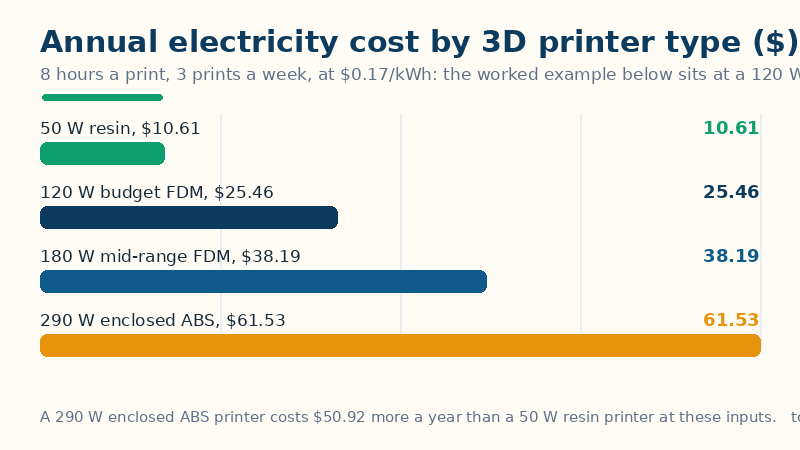
annual cost ($) = energy per print × prints a week × 52 × electricity priceThe nameplate rating is the heat-up peak, not the steady draw: a 350 W FDM printer typically draws 100 to 150 W once the bed is up to temperature, and resin printers use even less, 45 to 70 W, since they only power an LCD and an LED array — the heated bed is the biggest electricity consumer in an FDM printer, and it cycles off once it reaches temperature. What matters is the average draw while printing: a plug-in power meter on the printer for one print gives the real figure, and 120 W is the usual starting estimate for a budget FDM printer.
Worked example: 120 W average, 8 hours a print, 3 prints a week, $0.17/kWh
A 120 W printer running an 8-hour print uses 0.12 × 8 = 0.960 kWh a print, costing $0.16. Three prints a week is 0.960 × 3 = 2.880 kWh, costing $0.49. A month is 149.76 ÷ 12 = 12.5 kWh, costing $2.12. A year is 2.880 × 52 = 149.8 kWh, costing $25.46. The table above shows the same maths for the other printer types at 8 hours a print, 3 prints a week and $0.17/kWh: a 50 W resin printer uses 0.400 kWh a print, costing $0.07 a print and $10.61 a year, the worked example's 120 W budget FDM printer uses 0.960 kWh a print, costing $0.16 a print and $25.46 a year, a 180 W mid-range FDM printer uses 1.440 kWh a print, costing $0.24 a print and $38.19 a year, and a 290 W enclosed ABS printer uses 2.320 kWh a print, costing $0.39 a print and $61.53 a year. One printing hour costs 2.0¢; 156 prints a year; ten years at this pace costs $254.59. Five published cross-checks reproduce exactly: filamentcalcs' 3D printer electricity cost calculator at 110 W average over 12 hours and $0.18 gives 1.32 kWh and $0.24 — this page gives the same 1.32 kWh and $0.24. onlycalculators' 3D printing cost calculator at 120 W for 3 hours and $0.15 gives $0.05 of electricity — this page gives the same $0.05. uscalculators' 3D print cost calculator at 120 W for 8 hours and the US average of $0.1844 gives about $0.18 of electricity — this page gives the same $0.18 — and their state rows match exactly too, $0.50 in Hawaii at $0.52 and $0.12 in Idaho at $0.1235. 3dcostify's Bambu Lab X1C at 290 W for 8 hours and $0.17 gives 2.32 kWh and $0.39 — this page gives the same 2.32 kWh and $0.39. And layermath's 150 W printer for a 6-hour print at £0.24 gives £0.22 of electricity — this page gives the same £0.22 — and their 5-hour row matches exactly at £0.18.
How to read your result, and its limits
Four cautions keep the number honest. First, the nameplate rating is not the draw: at the worked example's inputs a 120 W average costs $0.16 a print, but the same printer's 350 W nameplate priced as if it drew 350 W the whole print would cost $0.48 a print — three times the real bill. Enter the average draw, and measure it with a plug-in power meter if you want the number exact. Second, the electricity is the small half of the print: at the worked example's inputs the electricity is $0.16 a print, but a 100 g print at $20 a kilo is $2.00 of filament — the material costs several times the electricity, so the print's real cost is mostly filament, not power. Third, the month is not four weeks: the week times 4 gives $1.96 a month at the worked example's inputs, while the year divided by 12 gives $2.12 — use the year-divided-by-12 figure, which is the one that adds up. Fourth, this page prices electricity only: the filament or resin, the printer itself and failed prints are separate lines, and the electricity price is the all-in rate, the total on the bill divided by the kilowatt-hours on the bill. For the cost of running the computer that slices the models, the gaming PC cost calculator prices it by gaming and idle watts; for the cost of running anything else, the electricity cost calculator prices any appliance by watts and hours.
Common mistakes
- Entering the nameplate rating as the average watts. A 350 W FDM printer does not draw 350 W while printing — it averages about 120 W once the bed is up to temperature, and a resin printer about 50 W. Enter the average draw, not the nameplate.
- Pricing one print and stopping there. A print is $0.16, but three prints a week for a year is $25.46 — the frequency is half the calculation. Count the prints.
- Multiplying the weekly cost by 4 for the month. Four weeks is not a twelfth of a year: the week times 4 gives $1.96 a month at the worked example's inputs, while the year divided by 12 gives $2.12. Use the year-divided-by-12 figure, which is the one that adds up.
- Forgetting that a failed print still costs electricity. A print that fails halfway still used the power for the hours it ran — about $0.08 at the worked example's inputs for a 4-hour failure. Count the hours printed, not the prints that worked.
- Adding the standing charge to every print. The daily supply charge is payable whether the printer runs or not. Only the per-kWh rate belongs in the per-print maths — the fixed charge is a separate line on the bill.
Related tools: Solar Panel Calculator — How many panels your roof needs — system size, panel count, roof area, cost and payback from your monthly use and local sun.
Frequently asked questions
How much electricity does a 3D printer use per print?
At the worked example's inputs — a 120 W average over an 8-hour print — a 3D printer uses 0.960 kWh a print, costing $0.16 at $0.17 per kWh. A 50 W resin printer uses 0.400 kWh a print and a 290 W enclosed ABS printer 2.320 kWh a print at the same hours and rate.
How much does it cost to run a 3D printer per month?
At the worked example's inputs — 120 W, 8 hours a print, 3 prints a week — a 3D printer costs $2.12 a month and $25.46 a year at $0.17 per kWh. One print a week costs $0.71 a month, and printing every day costs $4.95 a month at the same watts, hours and rate.
Is a 3D printer's wattage the nameplate rating?
No. A 350 W FDM printer typically draws 100 to 150 W once the bed is up to temperature, and resin printers use 45 to 70 W — the nameplate is the heat-up peak, not the steady draw. Priced at the nameplate, the worked example's print would cost $0.48 instead of the real $0.16.
What costs more — the electricity or the filament?
The filament, usually several times over. At the worked example's inputs the electricity is $0.16 a print, while a 100 g print at $20 a kilo is $2.00 of filament. The electricity is the small half of a print's cost; the material, the machine and failed prints are the lines that matter.