The formula: round the hand measurement to the nearest eighth of an inch
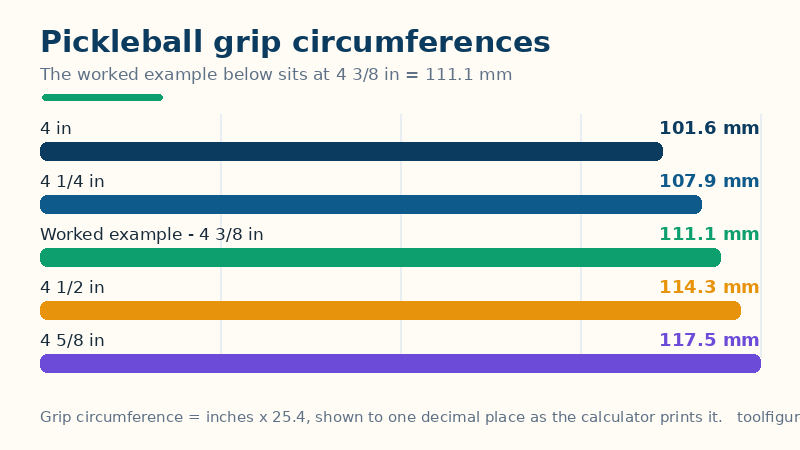
The calculation has three independent parts, and the calculator shows each one so the answer can be checked by hand. Step 1, convert to inches: a measurement in centimetres divided by 2.54 gives inches — the unit the grip tables are published in. Step 2, round to the nearest eighth: grip sizes step in eighths of an inch (4, 4 1/8, 4 1/4, 4 3/8, 4 1/2, 4 5/8), so the measurement is rounded to the nearest step, and a measurement landing exactly halfway between two steps takes the smaller one — the published between-sizes advice, because an overgrip adds about 1/16 in per layer and a grip can always be built up but never shrunk. In millimetres, the six sizes are inches times 25.4, shown to one decimal place as the calculator prints them:
| Grip size | Inches | Millimetres (inches × 25.4) |
|---|---|---|
| 4 in | 4.000 | 101.6 |
| 4 1/8 in | 4.125 | 104.8 |
| 4 1/4 in | 4.250 | 107.9 |
| 4 3/8 in | 4.375 | 111.1 |
| 4 1/2 in | 4.500 | 114.3 |
| 4 5/8 in | 4.625 | 117.5 |
Step 3, weight and shape follow the style: the published weight classes are lightweight under 7.3 oz, midweight 7.3–8.4 oz and heavyweight 8.5 oz and up. Control and finesse play points to lightweight and a widebody shape, whose wider face gives the largest sweet spot; all-round play points to midweight and the standard shape, the balanced choice; power play points to heavyweight and an elongated shape, whose longer face gives extra reach at the cost of sweet-spot size. Weight is the one part of the answer that is genuinely a preference — two paddles of the same weight can feel different because of where the weight sits — so treat the class as a starting point, not a verdict.
Worked example: 4.375 in hand, all-round play
Take a player whose ruler test reads 4.375 in and who plays an all-round game. Step 1: no conversion is needed. Step 2: 4.375 in is already exactly a grip step, so the grip is 4 3/8 in (111.1 mm). Step 3: all-round play gives midweight, 7.3–8.4 oz (207–238 g) and the standard shape. The same answer comes out of the centimetre input: 11.1 cm ÷ 2.54 = 4.37 in, which rounds to the same 4 3/8 in step, so the two units can never disagree by more than rounding. Other hands on the same rule read:
| Hand measurement | Grip size | Why |
|---|---|---|
| 4.250 in | 4 1/4 in (107.9 mm) | Exact step |
| 4.500 in | 4 1/2 in (114.3 mm) | Exact step |
| 4.4375 in | 4 3/8 in (111.1 mm) | Exactly halfway — the smaller size wins |
| 11.1 cm (4.37 in) | 4 3/8 in (111.1 mm) | Nearest step |
| 10.2 cm (4.02 in) | 4 in (101.6 mm) | Nearest step |
| 11.7 cm (4.61 in) | 4 5/8 in (117.5 mm) | Nearest step |
| 4.125 in | 4 1/8 in (104.8 mm) | Exact step |
And the style table, for any hand, reads: control / finesse → lightweight under 7.3 oz, widebody; all-round → midweight 7.3–8.4 oz, standard; power → heavyweight 8.5 oz and up, elongated.
How to read your result, and its limits
Three checks before buying. First, measure twice, with the hitting hand: the ruler test is only as good as the crease you start from — the bottom lateral crease of the palm, not the wrist — and the two hands often differ by an eighth, which is exactly one grip size. Second, the grip test beats the ruler when a paddle is in hand: hold the paddle in a normal grip and slide the index finger of the other hand between your fingertips and the heel of your palm; a snug fit confirms the size, no room means too small, and a gap means too large. Third, fit is not legality: the official rules cap a paddle at 17 in long with length plus width at most 24 in, and most paddles sit well inside those limits at 15–16 in long and 7–8 in wide — but a custom or novelty paddle can break them while still feeling right, so check the dimensions before tournament play. For the rest of the kit, the tennis grip size converter uses the same eighth-inch ladder for racquets, and the wetsuit size calculator sizes a suit from height and weight.
Related tools: Ski Size Calculator — A recommended ski length range from your height, ability level and skiing style, with the full ability table.
Frequently asked questions
How do I measure my pickleball grip size?
Hold your hitting hand flat with the fingers together and measure with a ruler from the bottom lateral crease of the palm to the tip of the ring finger. That distance in inches, rounded to the nearest eighth, is your grip size — 4.375 in reads 4 3/8 in.
What if my hand measurement falls between two grip sizes?
Take the smaller one: the published advice is to size down between grips, because one layer of overgrip adds about 1/16 in and a grip can always be built up but never shrunk.
What weight pickleball paddle should I choose?
As a starting point: lightweight under 7.3 oz for control and finesse, midweight 7.3–8.4 oz for all-round play, and heavyweight 8.5 oz and up for power. Weight is a preference — try before buying, since balance changes how a weight feels.
What pickleball paddle shape should I choose?
Standard is the balanced choice, widebody gives the largest sweet spot for control players, and elongated gives extra reach and power with a smaller sweet spot. Tournament paddles must also be at most 17 in long with length plus width at most 24 in.
