What thermal resistance is
Thermal resistance says how hard heat finds it to get through something, per square metre of it: a high resistance means a well-insulated wall, a low resistance means a leaky window. It is the number behind every insulation label. Europe and the building-science world quote the RSI value in square metre kelvin per watt (m²·K/W); the United States quotes the R-value in square foot hour degree Fahrenheit per Btu (ft²·°F·h/Btu); clothing uses the clo and bedding uses the tog — and all of them measure the same quantity, so a wall that is 3.5 m²·K/W in one catalogue is R-19.87 on the bag it arrives in. This page restates any thermal resistance in all ten units at once, worked through m²·K/W with every factor defined, and answers the question the conversion alone cannot: what U-value does this resistance mean, and how much heat crosses it at a temperature difference you enter?
The formula
answer = m²·K/W ÷ (m²·K/W in one "to" unit)
U-value = 1 ÷ resistance
heat flux = temperature difference ÷ resistance
Four terms, all visible on the page. value is the number you enter. m²·K/W in one "from" unit is the definition of the unit you are converting from: 1 for the square metre kelvin per watt itself and for the square metre degree Celsius per watt, 0.0001 for the square centimetre kelvin per watt, 0.1761101837 for the square foot hour degree Fahrenheit per Btu(IT), 0.1762280837 for the Btu(th) version, 0.0029351697 for the minute version, 0.0000489195 for the second version, 0.0012229874 for the square inch version, 0.155 for the clo and 0.1 for the tog. answer is the result in the unit you asked for. U-value is the reciprocal of the resistance, and heat flux is the temperature difference you enter divided by the resistance, in watts per square metre, so the insulation figure on the bag turns into the heat actually leaking through the wall.
Worked example
Convert 3.5 m²·K/W to the US R-value — a well-insulated wall, restated for an American insulation bag — the way the tool does it.
Step 1 — get to m²·K/W. The input is already in m²·K/W, so the base value is 3.5 m²·K/W itself.
Step 2 — divide by the target factor. One ft²·°F·h/Btu(IT) is 0.1761101837 m²·K/W, so 3.5 ÷ 0.1761101837 = 19.87.
Step 3 — read the display. The headline reads 19.87 ft²·°F·h/Btu(IT), and the detail line shows the working: 3.5 m²·K/W = 19.87 ft²·°F·h/Btu(IT) — worked through m²·K/W: 3.5 m²·K/W ÷ the Square foot hour degree Fahrenheit per Btu(IT) factor. The full table for this example reads: 3.5 m²·K/W, 3.5 m²·°C/W, 35,000 cm²·K/W, 19.87 ft²·°F·h/Btu(IT), 19.86 ft²·°F·h/Btu(th), 1,192.44 ft²·°F·min/Btu(IT), 71,546.12 ft²·°F·s/Btu(IT), 2,861.84 in²·°F·h/Btu(IT), 22.58 clo and 35 tog. The extra line, at the default temperature difference of 20 K, reads: U-value 0.2857 W/(m²·K) (0.0503 Btu(IT)/(h·ft²·°F)); at a temperature difference of 20 K, the heat flux through it is 5.7143 W/m².
Check it. Multiplying back, 19.87 ft²·°F·h/Btu(IT) × 0.1761101837 = 3.5 m²·K/W to the displayed rounding — the exact value multiplies back to 3.5 exactly, because the Btu(IT) definition is exact. The extra line checks the same way: 0.2857 W/(m²·K) × 3.5 m²·K/W = 1, the reciprocal identity, and 5.7143 W/m² × 3.5 m²·K/W = 20 K, the temperature difference we started from.
Conversion table
The conversions insulation bags, datasheets and clothing labels reach for most, each one the same two steps as the example:
| From | To |
|---|---|
| 1 m²·K/W | 5.6783 ft²·°F·h/Btu(IT) |
| 2.5 m²·K/W | 14.2 ft²·°F·h/Btu(IT) |
| R-13 (US) | 2.2894 m²·K/W |
| R-19 (US) | 3.3461 m²·K/W |
| R-30 (US) | 5.2833 m²·K/W |
| 1 clo | 0.155 m²·K/W |
| 1 clo | 0.8801 ft²·°F·h/Btu(IT) |
| 1 tog | 0.1 m²·K/W |
| 1 tog | 0.5678 ft²·°F·h/Btu(IT) |
| 1 ft²·°F·h/Btu(IT) | 0.1761 m²·K/W |
| 1 in²·°F·h/Btu(IT) | 0.0012 m²·K/W |
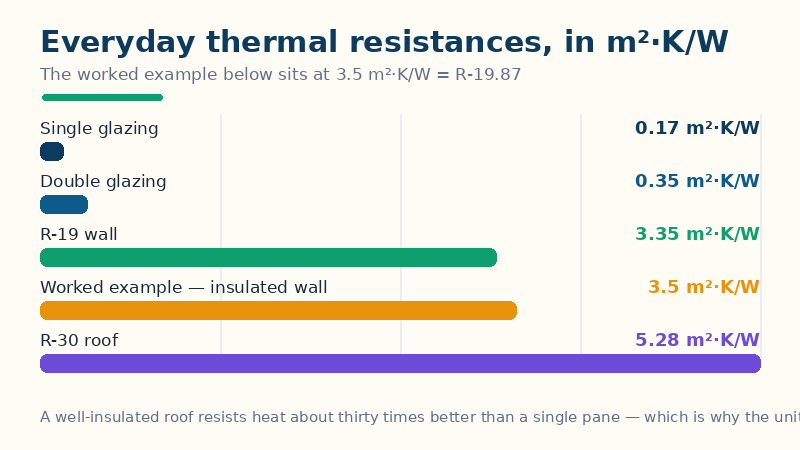
Three everyday cross-checks for the scale, each one the same two steps: a 2.5 m²·K/W wall is 16.13 clo — warmer than any suit, which is why buildings and clothing sit on different parts of the scale; the same wall has a U-value of 0.4 W/(m²·K), since 1 ÷ 2.5 = 0.4; and an R-19 bag, the commonest US wall batt, is 3.3461 m²·K/W, just under the worked example's 3.5.
Reading the result, and its limits
Four distinctions keep this page honest. First, R-value and RSI are the same quantity in different units: RSI is the metric R-value, and the US R-value is its imperial twin — 1 m²·K/W = 5.6783 ft²·°F·h/Btu(IT) — so a wall does not get better insulated by crossing the Atlantic, only relabelled. Second, R-value is the inverse of U-value, not its opposite: doubling the resistance halves the U-value, so R-30 is not twice as good as R-15 in heat saved, it is half the heat flow, and the extra line exists so that trade-off is visible. Third, this page converts per-area resistance, not whole-object resistance: a heat sink quoted as 2 K/W is a different quantity — temperature rise per watt through the whole part, with no area in it — and it must never be fed into this converter as if it were an R-value. Fourth, the heat flux line assumes steady, one-dimensional flow: real walls have studs, gaps and corners that leak heat around the insulation, so 5.7143 W/m² is the flux through the insulated area itself, not the average over a whole built wall.
Related tools: Thermal Conductivity Converter — W/m·K to Btu/h·ft·°F, Btu·in/h·ft²·°F, cal/s·cm·°C and more — every answer in all ten units; Heat Flux Converter — W/m² to Btu/h·ft², kcal/h·ft², W/in² and more — every answer in all ten units; Heat Transfer Coefficient Converter — U-value W/(m²·K) to Btu/(h·ft²·°F), kcal and cal — every answer in all ten units.
Frequently asked questions
How do I convert an R-value to RSI?
Divide the US R-value by 5.6783. An R-19 batt is 19 ÷ 5.6783 = 3.3461 m²·K/W, the RSI value. To go the other way, multiply the RSI value by 5.6783 — the worked example's 3.5 m²·K/W is R-19.87.
What is the difference between R-value and U-value?
They are reciprocals: U = 1 ÷ R. A wall at 3.5 m²·K/W has a U-value of 0.2857 W/(m²·K). Higher R means better insulation; lower U means the same thing, and the extra line on this page gives you both.
Why are there IT and th versions of the Btu unit?
Because the Btu itself has two definitions: the International Table Btu is 1,055.05585262 joules and the thermochemical Btu is 1,054.35 joules. The difference is only about 0.07%, but a table that does not say which one it means cannot be checked — so this page carries both, separately.
Is a K/W heat-sink rating the same as an R-value?
No. K/W is the temperature rise per watt through one whole object, with no area in it; m²·K/W is resistance per square metre of a layer. They share the kelvin-per-watt shape but differ by an area, so a heat-sink figure must never be entered here as an R-value.
