The formula: 10% of body weight, then skill, then the cap
The calculation has three steps, and the calculator shows all three so the answer can be checked by hand. Step 1, the base: ball weight starts at 10% of body weight, so base = body weight in pounds × 0.10. Step 2, the skill adjustment: beginners subtract 1 lb, intermediates add nothing, advanced bowlers add 1 lb — the adjustment is small on purpose, because a ball a pound too heavy costs more control than a ball a pound too light costs power. Step 3, the cap and floor: approved bowling balls run from 6 lb to 16 lb, so a raw figure above 16 lb is capped at 16 lb and a raw figure below 6 lb is floored at 6 lb, and the calculator says so whenever either limit changed the answer. Step 4, rounding: balls are sold in whole pounds, so the final figure is the raw figure rounded to the nearest whole pound, with its kilogram equivalent beside it (pounds × 0.45359237, to one decimal place).
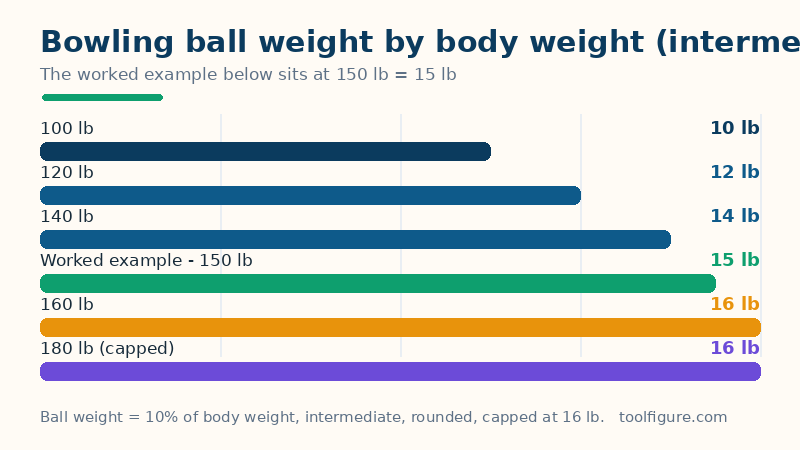
Worked example: 150 lb, intermediate
Take a bowler who weighs 150 lb and bowls at intermediate level. Step 1: 150 × 0.10 = 15.0 lb base. Step 2: intermediate adds nothing, so the raw figure stays 15.0 lb. Step 3: 15.0 lb is inside the 6–16 lb range, so neither limit bites. Step 4: already whole, so the recommendation is 15 lb (6.8 kg). The same answer comes out of the kilograms input: 68 kg × 2.20462 = 149.91 lb, 10% of that is 14.99 lb, intermediate adds nothing, and 14.99 lb rounds to 15 lb (6.8 kg). The calculator converts kilograms to pounds first and then uses the same steps, so the two units can never disagree. Other weights on the same steps read:
| Body weight | Beginner | Intermediate | Advanced |
|---|---|---|---|
| 100 lb | 9 lb | 10 lb | 11 lb |
| 120 lb | 11 lb | 12 lb | 13 lb |
| 140 lb | 13 lb | 14 lb | 15 lb |
| 160 lb | 15 lb | 16 lb | 16 lb (capped) |
| 180 lb | 16 lb (capped) | 16 lb (capped) | 16 lb (capped) |
Notice what the cap does to the table: at 160 lb the advanced figure (16 + 1 = 17 lb) is already capped to 16 lb, and at 180 lb every skill level caps to 16 lb, because 10% of 180 lb is 18 lb before any adjustment. A heavier bowler does not need a heavier ball than the maximum — they need the maximum ball they can control.
How to read your result, and its limits
Three checks before buying. First, the percentage is a starting point, not a prescription: strength, wrist condition, delivery style and the fit of the finger holes all move the right weight by a pound or two, and the honest test is throwing a few games — if the swing pulls your arm or you squeeze the ball to hold it, drop 1–2 lb whatever the table says. Second, seniors and juniors sit outside the table's middle: the skill adjustment already pulls beginners down a pound, but older bowlers and young juniors commonly go lighter still, and the published age guides put adult beginners at 10–14 lb and seniors at 10–14 lb regardless of what 10% gives. Third, weight is not the whole ball: coverstock, core and drilling change how a ball of the right weight actually hooks, so use this page to settle the weight and a pro shop to settle the rest. For the rest of the kit, the boxing glove size calculator sizes gloves from body weight and purpose, and the cricket bat size calculator sizes a bat from height alone.
Related tools: Skateboard Size Calculator — Recommended skateboard deck width from your shoe size and riding style, and deck length from your height, with the adjustment shown openly.
Frequently asked questions
What weight bowling ball should I use?
Start at 10% of your body weight, adjusted for skill and capped at 16 lb: 150 lb intermediate is 15 lb (6.8 kg). Enter your weight and skill above and the calculator shows every step.
Why is 16 lb the maximum bowling ball weight?
Approved bowling balls may not exceed 16 lb under the equipment specification, so any 10% figure above 16 lb — 180 lb body weight gives 18 lb before adjustment — is capped at 16 lb, and heavier bowlers choose by control, not by weight.
Should a beginner use a lighter bowling ball?
Yes, by about a pound: the calculator subtracts 1 lb for beginners, so a 140 lb beginner reads 13 lb where an intermediate reads 14 lb. Most adult beginners land at 11–14 lb, and comfort and a relaxed swing outrank the percentage.
Is a heavier bowling ball always better?
No: a heavier ball carries more power into the pins, but a ball you cannot swing smoothly costs control, form and, over time, your wrist, elbow or shoulder. If the ball feels heavy on the swing, drop 1–2 lb.
