One flow, three dialects
A flow rate says how much fluid passes a point in a given time — litres per minute on a pump box, gallons per minute in an American plumbing guide, cubic feet per minute in an HVAC table, cubic metres per hour on an industrial datasheet. They are all the same quantity, volume divided by time, and the only thing standing between them is the definition of the volume unit and the definition of the time unit. This page restates any volume flow rate in all eleven units at once, worked through the cubic metre per second with every factor defined, so a figure in any dialect can be read in any other. It also answers the question people actually ask next: at this flow, how long does a tank of a stated size take to fill? That line needs a volume you enter, because a flow rate alone cannot know what it is filling.
The formula
answer = cubic metres per second ÷ (cubic metres per second in one "to" unit)
Two terms, both visible on the page. value is the number you enter. cubic metres per second in one "from" unit is the definition of the unit you are converting from: 1 for the cubic metre per second itself, 1/3,600 for the cubic metre per hour, 0.001 for the litre per second, 1/60,000 for the litre per minute, 1/3,600,000 for the litre per hour, 0.003785411784/60 for the US gallon per minute, 0.003785411784/3,600 for the US gallon per hour, 0.028316846592 for the cubic foot per second, that figure divided by 60 for the cubic foot per minute and by 3,600 for the cubic foot per hour, and 0.00454609/60 for the imperial gallon per minute. answer is the result in the unit you asked for. The US gallon is 231 cubic inches exactly, which is where 0.003785411784 comes from; the imperial gallon is 4.54609 litres exactly, by definition, not by measurement.
Worked example
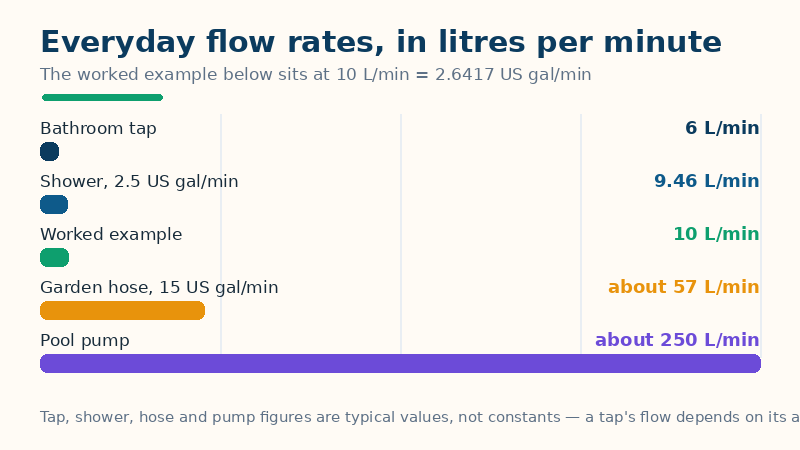
Convert 10 litres per minute to US gallons per minute — a bathroom tap running well, or a small pump at an easy pace — the way the tool does it.
Step 1 — get to cubic metres per second. One litre per minute is 1/60,000 m³/s, so 10 × 1/60,000 = 0.00016667 m³/s, which the page prints as 0.000167 at its six-decimal step.
Step 2 — divide by the target factor. One US gallon per minute is 0.003785411784/60 m³/s, so 0.00016667 ÷ 0.0000630901964 = 2.6417.
Step 3 — read the display. The page prints six decimals below 0.001, four below 10 and two above, so the headline reads 2.6417 US gal/min, and the detail line shows the working: 10 L/min = 2.6417 US gal/min — worked through cubic metres per second: 0.000167 m³/s ÷ the US gallon per minute factor.
Check it. Multiplying back, 2.6417 × 3.7854 = 10.00 litres per minute, allowing for the rounding the display already shows. The table underneath restates the same flow in all eleven units (0.000167 m³/s, 0.6 m³/h, 0.1667 L/s, 10 L/min, 600 L/h, 2.6417 US gal/min, 158.5 US gal/h, 0.0059 ft³/s, 0.3531 ft³/min, 21.19 ft³/h, 2.1997 imp gal/min), so the from/to choice only changes which row is the headline. And the fill line finishes the job for this flow: at the default 100 litres, that 10 L/min fills the tank in exactly 10 minutes — 100 ÷ 10, with no unit work at all, because both figures are already in litres and minutes.
Conversions worth memorising
Every row below is the tool's own output, checked figure by figure:
| From | To | Result |
|---|---|---|
| 1 L/min | US gallons per minute | 0.2642 US gal/min |
| 1 US gal/min | litres per minute | 3.7854 L/min |
| 10 L/min | cubic metres per hour | 0.6 m³/h |
| 100 L/min | cubic feet per minute | 3.5315 ft³/min |
| 1 m³/s | litres per minute | 60,000 L/min |
| 1 ft³/min | litres per minute | 28.32 L/min |
| 5 US gal/min | litres per minute | 18.93 L/min |
| 50 L/min | litres per second | 0.8333 L/s |
| 1 imp gal/min | litres per minute | 4.5461 L/min |
| 10 m³/h | litres per minute | 166.67 L/min |
| 2.5 US gal/min (a shower) | litres per minute | 9.4635 L/min |
| 60 L/min | US gallons per minute | 15.85 US gal/min |
Three rows deserve a second look. The first two are the same conversion in both directions, and they are the pair that matters most in practice: divide litres per minute by 3.7854 to get US gallons per minute, multiply to go back — and the often-quoted 0.2642 is simply 1 ÷ 3.7854, not a second fact to memorise. The shower row is the reality check on a household figure: an American shower rated at 2.5 GPM is 9.4635 L/min, so a 150-litre bath at that shower's flow takes 15.85 minutes — the fill line's own arithmetic, and a useful sense of how long "just a quick shower" really runs. And the imperial row is the warning: 1 imperial gallon per minute is 4.5461 L/min, a full 20% more than the US gallon's 3.7854, so a British pump figure read as American understates the flow by a fifth — the same trap as reading a British gallon on a car's fuel economy, wearing flow-rate clothes.
Three traps worth knowing
US gallons and imperial gallons are different gallons. The US liquid gallon is 231 cubic inches (3.785411784 litres); the imperial gallon is 4.54609 litres by definition. Every "GPM" figure needs its gallon named, and this page names it in every row: US gal/min and imp gal/min are separate units here, never a bare "GPM" that could be either. If a datasheet says only "GPM", check where it was published — American sources mean US gallons, British and older Commonwealth sources mean imperial.
A flow rate is not a velocity. Flow is volume per time; velocity is distance per time, and the two are related only through the pipe's cross-section: flow = velocity × area. A flow of 10 L/min through a narrow hose is a fast jet; the same 10 L/min through a wide pipe is a slow crawl. This page converts the flow figure, and it cannot tell you the velocity without the pipe size — anyone quoting a flow as a speed, or a speed as a flow, is skipping the area.
Tiny figures hit the display floor in the big units. The page prints six decimals below 0.001, so 10 L/min reads as 0.000167 m³/s — the 0.00016667 underneath is rounded away in the headline, and the litre row is the readable one. The same floor applies in reverse: a cubic-metre-per-second figure for a household tap would be a long string of zeros before any meaningful digit. Read the row on the flow's own scale: the factor is exact, and the readable row is the one near the flow's own size.
How to read your result, and the limits
Results show six decimals below 0.001, four below 10 and two above — more precision than any flow meter justifies, so round to the instrument for real use. Four limits belong with the page. Negative values are refused: a negative flow gets a clear error, because this page converts sizes, and a minus sign here would mean nothing physical (a reversed flow is a direction, not a negative size, and it belongs in the plumbing description, not in the conversion). Empty input clears quietly; type and the table rebuilds, delete and the page waits. Anything past a trillion in any unit gets a clear error instead of a meaningless digit string. And this page converts volume flow, not mass flow and not air at pressure: a cubic foot per minute of air at a compressor's pressure is not the same mass of air as a cubic foot per minute at atmospheric pressure, and a litre per minute of oil is not the same mass per minute as a litre per minute of water — for those, you need the density or the pressure conditions beside the figure, and this page will at least help you read its units correctly.
Related tools: Volume Converter — Convert US cups, gallons, litres, millilitres and spoons — every answer in all ten units, through the exact US customary definitions; Pressure Converter — Convert PSI, bar, kPa, atmospheres and the mercury and water columns — every answer in all ten units, gauge-vs-absolute explained; Speed Converter — Convert mph, km/h, m/s, ft/s, knots and Mach — every answer in all six units.
Frequently asked questions
How many litres per minute are in a US gallon per minute?
Exactly 3.7854 L/min, from the US gallon's definition of 231 cubic inches (3.785411784 litres). So 1 US gal/min is 3.7854 L/min, 10 L/min is 2.6417 US gal/min, and 2.5 US gal/min — a standard American shower — is 9.4635 L/min. The imperial gallon is different: 1 imp gal/min is 4.5461 L/min.
How do I convert litres per minute to cubic feet per minute (CFM)?
Divide litres per minute by 28.32. One cubic foot is 28.316846592 litres, so 1 ft³/min is 28.32 L/min and 100 L/min is 3.5315 ft³/min. CFM is the unit HVAC and compressor tables use, and it is a volume flow — the same quantity as L/min, only in cubic feet.
What is the difference between flow rate and velocity?
Flow rate is volume per time (L/min, GPM, m³/h); velocity is distance per time (m/s, ft/s). They are related through the pipe's cross-section: flow = velocity × area. The same 10 L/min is a fast jet in a narrow hose and a slow crawl in a wide pipe. This page converts flow figures; velocity needs the pipe size as well.
How long does it take to fill a tank at a given flow rate?
Divide the tank's volume by the flow rate in matching units: time = volume ÷ flow. At 10 L/min, a 100-litre tank takes 10 minutes, and a 150-litre bath at a 2.5 GPM shower (9.4635 L/min) takes 15.85 minutes. Enter the tank size on this page and the fill line works it out for any flow.
