One scale, shifted by four and by thirty-two — and one exception
Women's dress sizes are a scale, not a measurement: the number on the label tells you where a garment sits in a sequence, and the sequence is shifted between countries. The United Kingdom runs four above the United States (UK = US + 4) and Europe runs thirty-two above it (EU = US + 32), while Australia uses the United Kingdom's numbers (AU = UK). So a US 8 is a UK 12, an EU 40 and an AU 12. There is exactly one size that breaks both rules: US 00, which is a UK 2 and an EU 30 — not a UK 4 and an EU 32, as the rules would give — because the scale was extended below zero when smaller sizes were added, rather than renumbered from the start. The letter sizes sit on top of the numbers: XXS covers US 00 alone, XS covers US 0–2, S covers US 4–6, M covers US 8–10, L covers US 12–14, XL covers US 16–18 and XXL covers US 20–22. Every row also carries the body it was built for — bust, waist and hip in centimetres — because the number alone cannot tell you whether a garment will fit a body that does not sit neatly in the middle of a row.
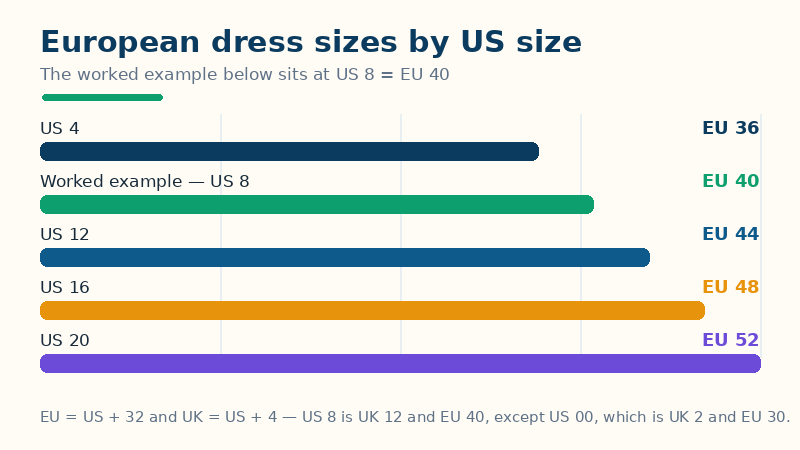
Worked example: a US 8
Take a US 8. The rules give UK 12 (8 + 4) and EU 40 (8 + 32), Australia matches the UK at AU 12, and the letter is M. The measurements behind the row are a bust of 90–93 cm, a waist of 73–77 cm and hips of 98–101 cm — a body inside all three ranges is the body this size was cut for, and a body outside any one of them should check the neighbouring row before ordering. Two more rows prove both rules hold across the table: an EU 42 is a US 10 (42 − 32) and a UK 14 (10 + 4), letter M, with a bust of 94–97 cm, a waist of 78–81 cm and hips of 102–104 cm; and a UK 16 is a US 12 (16 − 4) and an EU 44 (12 + 32), letter L, with a bust of 98–102 cm, a waist of 82–85 cm and hips of 105–108 cm. A letter works the same way in reverse: L spans US 12–14, UK 16–18 and EU 44–46, with a bust of 98–107 cm, a waist of 82–90 cm and hips of 105–112 cm — the full range across both of its rows, not a single size pretending to be two.
Women's dress size table
| US | UK | EU | AU | Letter | Bust (cm) | Waist (cm) | Hip (cm) |
|---|---|---|---|---|---|---|---|
| 00 | 2 | 30 | 2 | XXS | 74 | 58 | 80 |
| 0 | 4 | 32 | 4 | XS | 74–77 | 58–61 | 80–84 |
| 2 | 6 | 34 | 6 | XS | 78–81 | 62–64 | 85–89 |
| 4 | 8 | 36 | 8 | S | 82–85 | 65–68 | 90–94 |
| 6 | 10 | 38 | 10 | S | 86–89 | 69–72 | 95–97 |
| 8 | 12 | 40 | 12 | M | 90–93 | 73–77 | 98–101 |
| 10 | 14 | 42 | 14 | M | 94–97 | 78–81 | 102–104 |
| 12 | 16 | 44 | 16 | L | 98–102 | 82–85 | 105–108 |
| 14 | 18 | 46 | 18 | L | 103–107 | 86–90 | 109–112 |
| 16 | 20 | 48 | 20 | XL | 108–113 | 91–95 | 113–116 |
| 18 | 22 | 50 | 22 | XL | 114–119 | 96–102 | 117–121 |
| 20 | 24 | 52 | 24 | XXL | 120–125 | 103–108 | 123–128 |
| 22 | 26 | 54 | 26 | XXL | 126–131 | 109–114 | 129–134 |
How to read your result, and its limits
Three checks before ordering. First, measure the body, not the dress you already own: bust at the fullest point, waist at the natural waistline (usually just above the belly button, not where jeans sit), hips at the fullest point, tape level and snug but not tight, standing relaxed. A dress measured flat and doubled will not match a body measured standing. Second, when measurements straddle two rows, let the garment decide: a fitted, structured or non-stretch dress should go to the larger size, because a dress can be taken in but rarely let out; a loose, flowing or high-stretch dress can go to the smaller. Third, this is the published standard conversion, and brands are the exception that proves it: vanity sizing, petite and tall lines, and French and Italian makers who cut to their own charts all move a size by a full step around this table, so the brand's own bust-waist-hip chart is the final word — and the measurement columns on this page are there precisely so that comparison can be made in centimetres, where no label can lie.
Related tools: Clothing Size Converter — Men's and women's clothing sizes between US, UK and EU — with the measurements behind them; Pants Size Converter — Men's and women's pants sizes — US, UK and EU, with inseam; Bra Size Converter — Bra sizes — US, UK, EU, French, AU & Japanese, with sister sizes.
Frequently asked questions
What is a US 8 in UK and EU dress sizes?
A US 8 is a UK 12 (8 + 4) and an EU 40 (8 + 32), and an AU 12, since Australia uses UK numbers. The letter size is M, and the row is built for a bust of 90–93 cm, a waist of 73–77 cm and hips of 98–101 cm.
Why is US 00 a UK 2 and not a UK 4?
Size 00 breaks both conversion rules: UK = US + 4 would give 4 and EU = US + 32 would give 32, but the published table gives UK 2 and EU 30. The scale was extended below zero when smaller sizes were added, instead of being renumbered — so 00 has to be looked up, not calculated.
How do I measure myself for a dress size?
Bust at the fullest point, waist at the natural waistline just above the belly button, and hips at the fullest point, with the tape level, snug but not tight, standing relaxed. Compare all three measurements to the table — if they straddle two rows, size up for a fitted dress and down only for a loose or stretch style.
Do dress sizes differ between brands?
Yes, often by a full size: vanity sizing, petite and tall lines, and French and Italian makers with their own charts all shift around the standard table. That is why this page prints the bust, waist and hip measurements behind every size — compare your measurements to the brand's own chart in centimetres before ordering.
