What a decibel is — and why it comes in two families
A decibel is not a unit of sound, power or voltage; it is a unit of a ratio, and that one fact explains every decibel confusion on the internet. A relative level says how many times bigger one thing is than another, with no reference stated: 60 dB means a power ratio of one million, whatever the two powers are. An absolute level says how big a power is against a fixed reference: 30 dBm means one watt, because dBm is measured against one milliwatt. The relative family is the bel (B), the decibel (dB), the centibel (cB), the millibel (mB), the neper (Np) and the decineper (dNp); the absolute family is dBm (against 1 mW), dBW (against 1 W) and dBk (against 1 kW). Converting a dB figure straight into dBm, as if the units were interchangeable, is the single most common decibel error — it invents a reference nobody stated. This page converts exactly within each family and refuses a cross-family conversion with a clear error, while the extra line keeps the ratio behind every figure visible.
The formula
relative base (dB) = value × (dB in one "from" unit)
answer = relative base ÷ (dB in one "to" unit)
absolute base (dBm) = value + (dBm offset of the "from" unit)
answer = absolute base − (dBm offset of the "to" unit)
power ratio = 10 ^ (dB ÷ 10)    amplitude ratio = 10 ^ (dB ÷ 20)
watts = 10 ^ ((dBm − 30) ÷ 10)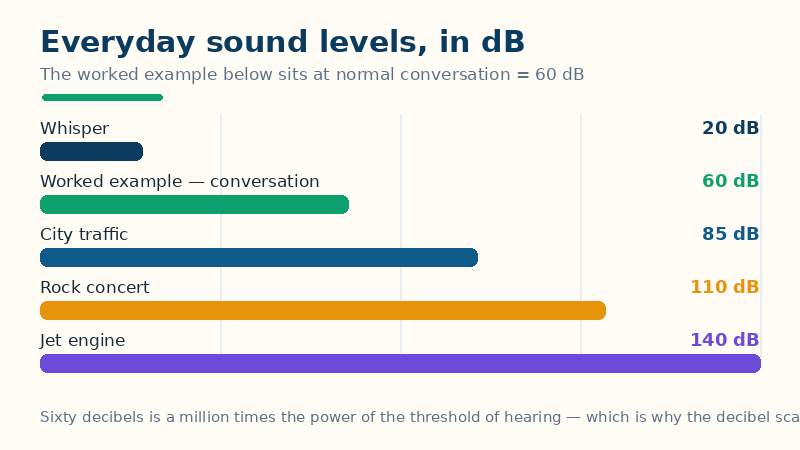
Six terms, all visible on the page. value is the number you enter. dB in one "from" unit is the definition of the relative unit you are converting from: 10 for the bel, 1 for the decibel itself, 0.1 for the centibel, 0.01 for the millibel, 8.685889638 for the neper and 0.8685889638 for the decineper — the neper figure is 20 ÷ ln(10), because the neper is the natural-logarithm level and the decibel is the base-10 level. answer is the result in the unit you asked for, in the same family. dBm offset is the distance of an absolute unit from dBm: 0 for dBm itself, 30 for dBW and 60 for dBk, because a watt is a thousand milliwatts (30 dB) and a kilowatt is a million milliwatts (60 dB). power ratio is ten to the dB-over-ten, and amplitude ratio is ten to the dB-over-twenty — the factor of two between them is the whole reason a 3 dB step doubles power while a 6 dB step doubles voltage. watts is the absolute power behind a dBm figure, so a datasheet's dBm number turns back into the watts an engineer actually budgets.
Worked example
Convert 60 dB to nepers — the unit jump every acoustics table forces on a reader of signal-processing papers — the way the tool does it.
Step 1 — get to the family base. One decibel is 1 dB, so 60 × 1 = 60 dB.
Step 2 — read the display. The headline reads 6.9078 Np, and the detail line shows the working: 60 dB = 6.9078 Np — worked through Decibel: 60 dB. The full table for this example reads: 6 B, 60 dB, 600 cB, 6,000 mB, 6.9078 Np and 69.08 dNp. The extra line reads: Behind 60 dB: power ratio 1,000,000 (10 ^ (dB ÷ 10)) and amplitude ratio 1,000 (10 ^ (dB ÷ 20)) — so a 3 dB step nearly doubles power, and a 20 dB step multiplies amplitude by ten.
Check it. Multiplying back, 6.9078 Np × 8.685889638 = 60.00 dB to the displayed rounding, and the ratio line checks the same way: 10 ^ (60 ÷ 10) = 1,000,000 exactly, and 10 ^ (60 ÷ 20) = 1,000 exactly.
Conversion table
The conversions amplifier sheets, acoustics tables and radio datasheets reach for most, each one the same steps as the example, inside its own family:
| From | To |
|---|---|
| 0 dB | 0 B, 0 Np, power ratio 1, amplitude ratio 1 |
| 3 dB | power ratio 1.9953 — the "3 dB doubles power" rule, to the displayed rounding |
| 10 dB | 1 B, 1.1513 Np, power ratio 10 |
| 20 dB | 2 B, 2.3026 Np, amplitude ratio 10 |
| 1 Np | 8.6859 dB, 0.8686 B |
| 30 dBm | 0 dBW, 1 W |
| 0 dBm | 1 mW, −30 dBW |
| 40 dBm | 10 W |
| −3 dB | power ratio 0.5012 — a 3 dB loss halves power |
Three everyday cross-checks for the scale, each one the same steps: a whisper at 20 dB is 2.3026 Np, and a jet engine at 140 dB is 14 B and 16.12 Np — the bel scale makes the 120 dB between them read as twelve bels, which is why the bel was invented and why the decibel replaced it; a 10 dB step multiplies power by ten, so the 60 dB of normal conversation is a million times the power of the 0 dB threshold of hearing, not sixty times it; and a transmitter quoted at 30 dBm is one watt, while the same transmitter quoted at 40 dBm is ten watts, so a ten-step in dBm is a tenfold step in power, never an additive one.
Reading the result, and its limits
Four distinctions keep this page honest. First, 10 versus 20 is not a choice: power ratios use 10 × log and amplitude ratios use 20 × log, and using the wrong one squares or square-roots your answer — this page shows both, labelled, on every relative figure. Second, the neper is not a decibel with a different name: it is the natural-logarithm level, so 1 Np is 8.685889638 dB for both power and amplitude, and the 8.686 figure on quick-reference cards is that same number rounded. Third, negative levels are valid: −3 dB is a real loss that halves power, and −30 dBW is a real milliwatt — this page never errors on a negative level, because a level below its reference is ordinary engineering. Fourth, sound-pressure decibels are not on this page: dB SPL is an absolute level against 20 micropascals of pressure, and converting it needs that reference stated — the dBm/dBW/dBk family here is power only, so a microphone figure and a transmitter figure must never share a row.
Related tools: Frequency Converter — Hz to kHz, MHz, GHz, THz, RPM and rad/s — every answer in all seven units, through the exact definitions; Power Converter — Horsepower to kW, kW to hp, watts and tons of refrigeration — every answer in all eight units, through the exact definitions; Voltage Converter — V to kV, mV, µV, nV, MV and statV — every answer in all ten units.
Frequently asked questions
How do I convert dB to neper?
Divide by 8.685889638. The worked example's 60 dB is 60 ÷ 8.685889638 = 6.9078 Np. To go the other way, multiply by 8.685889638 — 1 Np is 8.6859 dB.
Why does 3 dB double the power?
Because the power ratio is 10 ^ (dB ÷ 10), and 10 ^ (3 ÷ 10) = 1.9953, which is 2 to the displayed rounding. A 10 dB step multiplies power by ten, and a 20 dB step multiplies amplitude by ten.
What is the difference between dB and dBm?
dB is a relative level — a ratio with no reference — while dBm is an absolute power level against 1 milliwatt. 0 dBm is 1 mW and 30 dBm is 1 W, which is why this page keeps the two families separate and refuses to convert between them.
How do I convert dBW to dBm?
Add 30. A watt is a thousand milliwatts, and 10 × log10(1,000) = 30, so 0 dBW is 30 dBm and 30 dBm is 0 dBW. For kilowatts, add 60 to dBk to reach dBm.
