Contents first, then divide by what is left after the ice
A cooler size is not the food it holds — it is the food plus the ice that keeps the food cold, and the ice takes a large share of the box. The calculation therefore runs in two steps. First, the contents: drinks at 0.355 litres per standard 12 oz can, times cans per person per day, times person-days; plus food in litres per person per day, times person-days. One person-day is one person for one day, so 4 people for 3 days is 12 person-days. Second, the box: the cooler volume is the contents divided by one minus the ice share, because the ice share is the part of the whole cooler taken by ice. At the usual 40% ice share, the divisor is 0.60, so the box is the contents divided by 0.60 — noticeably larger than the contents themselves. The result is shown in litres, quarts (1 litre = 1.05669 qt) and gallons (4 qt = 1 gallon), with the cooler class beside it: Personal up to 15 qt, Small 16–38 qt, Medium 39–50 qt, Large 51–100 qt, Extra large over 100 qt.
Person-days = people × days — Contents (L) = person-days × (cans × 0.355 + food litres) — Cooler (L) = contents ÷ (1 − ice share) — Cooler (qt) = litres × 1.05669 — Ice (L) = cooler − contents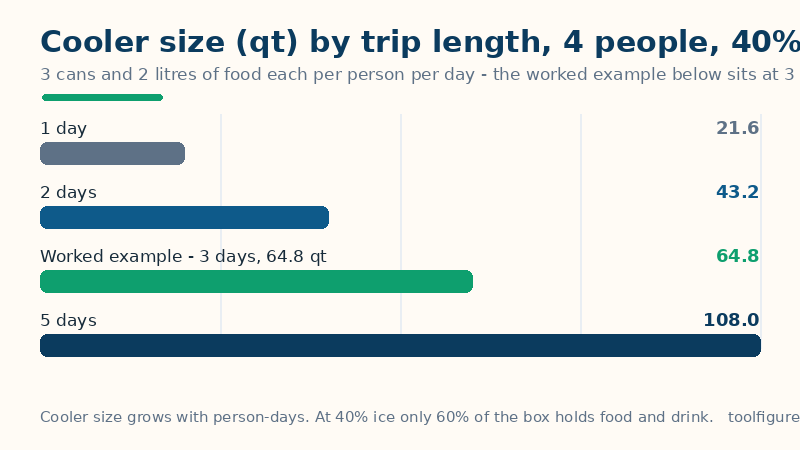
The ice share is the one input worth thinking about rather than accepting: 30% suits a short trip with pre-chilled food and a cooler kept shut, 40% is the everyday default, and 50% suits a long hot trip where the cooler is opened often. Raising the ice share raises the recommended box, not the food inside it — the food total does not change, only the ice around it.
Worked example: 4 people, 3 days, 3 cans and 2 litres of food each per day, 40% ice
A group of 4 people camping for 3 days, drinking 3 cans each per day and carrying 2 litres of food each per day, with 40% ice, needs a 65 qt cooler (64.8 qt, 61.3 litres, Large). The working: person-days = 4 × 3 = 12. Drinks = 12 × 3 × 0.355 = 12.78 litres. Food = 12 × 2 = 24 litres. Contents = 12.78 + 24 = 36.78 litres, shown as 36.8 litres. Cooler = 36.78 ÷ (1 − 0.40) = 36.78 ÷ 0.60 = 61.3 litres. In quarts, 61.3 × 1.05669 = 64.8 qt, which is 16.2 gallons — a Large cooler — and the standard size at or above 64.8 qt is 65 qt. The ice inside it is 61.3 − 36.8 = 24.5 litres. The same arithmetic at other group sizes shows the box growing with person-days:
| Group and trip | Contents | Cooler at 40% ice | Class | Buy |
|---|---|---|---|---|
| 2 people, 1 day | 6.1 L | 10.2 L (10.8 qt) | Personal | 12 qt |
| 2 people, 2 days | 12.3 L | 20.4 L (21.6 qt) | Small | 24 qt |
| 4 people, 2 days | 24.5 L | 40.9 L (43.2 qt) | Medium | 45 qt |
| 4 people, 3 days | 36.8 L | 61.3 L (64.8 qt) | Large | 65 qt |
| 6 people, 3 days | 55.2 L | 92.0 L (97.2 qt) | Large | 100 qt |
Notice the first and last rows together: doubling the group and tripling the days takes the box from 10.8 qt to 97.2 qt — nine times larger — because person-days, not people alone, drive the total. And notice the ice-share effect on the worked example: at 30% ice the same contents need only 52.5 litres (55.5 qt), while at 50% ice they need 73.6 litres (77.7 qt) — the same food, a different box, decided by how much ice the trip demands.
How to read your result, and its limits
Three checks before trusting the size. First, the box is bigger than the food: at 40% ice, only 60% of the quarts you buy hold food and drink — a 65 qt cooler holds about 39 qt of contents, and shoppers who buy by food volume alone end up short. Second, cans are counted at 0.355 litres each, but packing is not perfect: cans and containers leave gaps, and bulky packaging eats space the arithmetic does not charge for — round up to the next standard size when the answer sits close to a size boundary. Third, this is a capacity answer, not an ice-retention promise: how long the ice lasts depends on pre-chilling the cooler and its contents, keeping the lid shut, and keeping the box out of the sun — a bigger box opened constantly in the heat warms faster than a smaller box kept shut in the shade. Past 150 qt, the honest answer is two coolers, not one giant box: one for drinks opened all day, one for food opened rarely.
Common mistakes
- Buying by food volume alone. Forgetting the ice share is the classic error: the food total is only 60% of the box at 40% ice, so a box sized to the food alone runs out of room for the ice itself.
- Counting dry goods as cooler contents. Bread, snacks and cans kept at ambient temperature do not belong in the total — counting them inflates the box for no reason.
- Using one giant cooler for a long trip. Past 150 qt, split the load: a drinks cooler opened all day and a food cooler opened rarely keeps the food colder than one box opened constantly.
- Leaving the cooler in the sun with the lid up. Capacity cannot rescue bad habits: pre-chill the box and its contents, keep it shut, and keep it shaded, or the ice share in the calculation will not survive the first afternoon.
Related tools: Tent Size Calculator — Your tent size from sleepers and comfort — the floor area you need and the rating that covers it — with the packs-inside allowance; Backpack Size Calculator — Your backpack size in two parts: frame size from torso length, and litres from trip length, packing style and season; Hammock Size Calculator — Your hammock size from height — the minimum length, the 10, 11 or 12 ft size to buy, the width and the hanging distance.
Frequently asked questions
What size cooler do I need for camping?
It comes from person-days, drinks and food, then the ice share: contents in litres divided by one minus the ice share. For example, 4 people for 3 days at 3 cans and 2 litres of food each per day with 40% ice need 61.3 litres (64.8 qt) — a 65 qt Large cooler.
How much of a cooler should be ice?
30 to 50% of the whole cooler is the usual range, 40% the everyday default. At 40% ice, only 60% of the box holds food and drink — a 65 qt cooler holds about 39 qt of contents, not 65.
How many cans fit in a cooler?
At 0.355 litres per standard 12 oz can, the can count follows the contents, not the box: the worked example's 12 person-days at 3 cans each is 36 cans taking 12.78 litres, before food and before ice. Packaging gaps mean the real count runs slightly below the arithmetic.
Is one big cooler or two small coolers better?
Past 150 qt, two coolers win: one for drinks opened all day, one for food opened rarely. One giant box opened constantly warms the food every time it opens, while a rarely opened food cooler stays cold.
