The formula: none — an age ladder, stated in full
American football sizing has no formula to solve, because the ball is matched to the player's age and hand development, not to a measurement. The published guides agree on four steps, and the table below is that ladder with the lengths, weights and diameters the guides publish for each step. Note the numbering: there is no size 8 in this ladder — the steps run 5, 6, 7 and then jump to 9, because size 9 is the long-established official number and the youth steps were numbered below it.
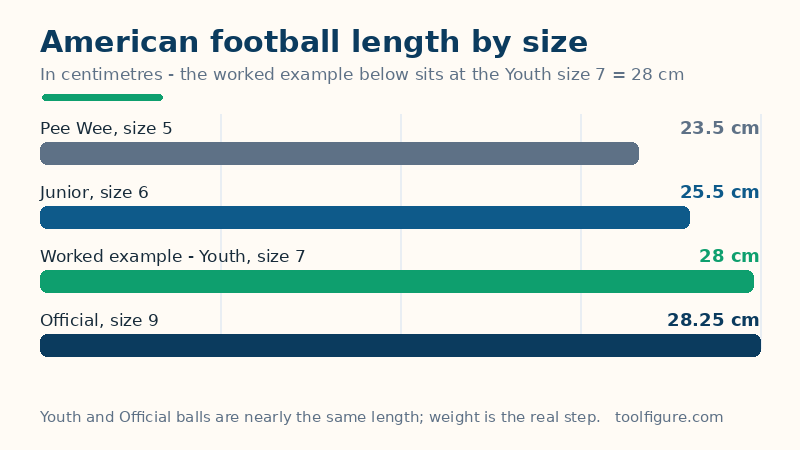
| Size | Ages | Length | Weight | Diameter |
|---|---|---|---|---|
| Pee Wee (5) | 9 and under | 23–24 cm | 285–310 g | 13–14.2 cm |
| Junior (6) | 10–11 | 25–26 cm | 320–350 g | 14.5–15.5 cm |
| Youth (7) | 12–13 | 28 cm | 350–380 g | 15–16 cm |
| Official (9) | 14 and over | 28–28.5 cm | 397–425 g | 16.5–17.2 cm |
Spot checks against the table: age 8 is Pee Wee size 5 at 23–24 cm and 285–310 g (10.1–10.9 oz); age 11 is Junior size 6 at 25–26 cm and 320–350 g (11.3–12.3 oz); age 16 is Official size 9 at 28–28.5 cm and 397–425 g, which is exactly 14.0–15.0 oz — the NFL's 14–15 oz specification. Two ages sit on boundaries where the guides disagree: some put a 12-year-old in Junior and a 14-year-old in Youth, while the majority ladder above moves a player to Youth at 12 and to Official at 14. This calculator follows the majority ladder and flags both boundary ages, because league rules, not this page, settle those two cases.
Worked example: age 13
A 13-year-old takes the Youth size 7: 28 cm long (11.02 in), 350–380 g (12.3–13.4 oz), about 15–16 cm across. That length is already the full-size length — the Youth ball is 28 cm and the Official ball is 28–28.5 cm — but the weight is not: the Youth ball at 350–380 g is a full 47 g lighter at the bottom of the range than the Official ball's 397 g, and that lighter weight is the whole point of the step, because a ball a young hand cannot grip and throw properly teaches bad mechanics. The next step up is Official size 9 at age 14, when the player moves to the 397–425 g ball with its 28–28.5 in long circumference and 21–21.25 in short circumference.
How to read your result, and its limits
Three checks before buying. First, check the league, not just the age: youth leagues publish their own ball rules, and a league that mandates size 6 for its 12-year-olds overrules any guide. Second, watch the jump from Youth to Official: it is the biggest weight jump on the ladder (up to 75 g from the top of Youth to the top of Official), so a player moving up should handle the heavier ball in practice before it matters in a game. Third, remember that brands vary slightly: the figures above are the published guide ranges, and an individual ball's label is the final word — compare length and weight on the product before buying, especially at the boundary ages. Mini and novelty balls below size 5 exist for the youngest children, but they are practice toys, not league balls, and they are not on this ladder.
Common mistakes
- Buying the official ball too early. A 14–15 oz ball in hands that are not ready for it teaches a pushing throw instead of a spiral; the ladder exists so each step is grippable.
- Assuming size 8 exists. The ladder jumps from Youth size 7 to Official size 9 — there is no size 8 step, and a listing that claims one is using a different maker's numbering.
- Judging by length alone. Youth and Official balls are nearly the same length (28 cm against 28–28.5 cm); the real difference is weight and circumference, which is why the table gives all three numbers.
- Ignoring the boundary ages. Ages 12 and 14 are genuinely disputed between guides — buying without checking the league's rule is the one sizing error this calculator cannot settle for you.
Related tools: Soccer Ball Size Calculator — The right soccer ball size from the player's age: league sizes 3, 4 and 5, plus skills balls 1 and 2; Rugby Ball Size Calculator — The right rugby ball size from age and game type: mini, sizes 3, 4, 4.5 and 5, with length, girth and weight; Basketball Size Calculator — The right basketball size from age and gender: sizes 1 to 7 with circumference, weight and diameter.
Frequently asked questions
What size football does a 12-year-old need?
Youth size 7 on the majority ladder — 28 cm, 350–380 g. But 12 is a boundary age: some guides still put 12-year-olds in Junior size 6, so check your league's rules before buying.
What is the official American football size?
Size 9: 11–11.25 in (28–28.5 cm) long, 28–28.5 in long circumference, 21–21.25 in short circumference, 14–15 oz (397–425 g). It is the ball used in high school, college and the NFL.
What is the difference between a Youth and an Official football?
Mostly weight and girth, not length: Youth size 7 is 28 cm and 350–380 g, while Official size 9 is 28–28.5 cm and 397–425 g with a 21–21.25 in short circumference. The heavier, fatter official ball is what makes the step up demanding.
Can adults use a youth football?
For casual throwing and training, yes — a lighter ball is easier on the arm. For league play, no: high school, college and adult leagues all mandate the Official size 9.
