The Guild Factor, stated plainly
Former pro surfer John Whitney Guild popularised the rule the guides still use: multiply body weight in kilograms by a factor for your level, and the answer is the board volume in litres that will float you properly. Volume is measured in litres because it is the one number that captures float whatever the board's shape — a long thin board and a short fat board can share a length and still float very differently, which is why length alone is a poor way to shop.
Target volume (L) = body weight (kg) × Guild Factor — Beginner 1.0, Intermediate 0.55, Advanced 0.38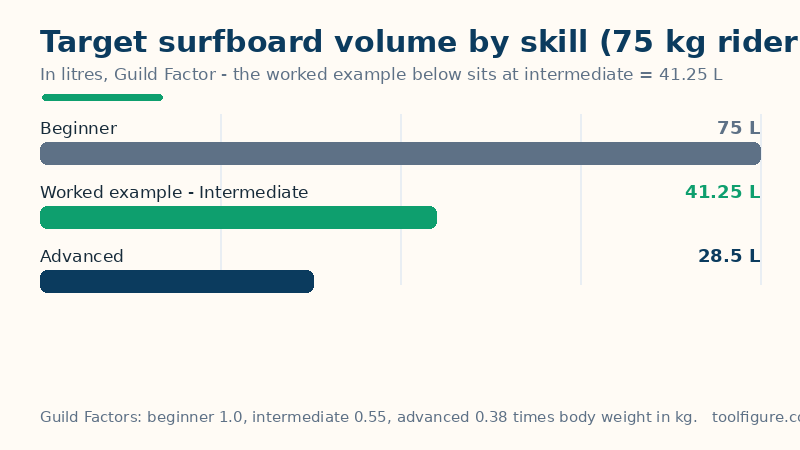
| Level | Guild Factor | Board type | Length range |
|---|---|---|---|
| Beginner | 1.0 | Soft-top foamie / funboard | 8 ft 0 in – 9 ft 6 in (244–290 cm) |
| Intermediate | 0.55 | Funboard / mid-length | 6 ft 6 in – 8 ft 6 in (198–259 cm) |
| Advanced | 0.38 | Shortboard or fish | 5 ft 6 in – 6 ft 6 in (168–198 cm) |
The length conversions are exact: 8 ft 0 in is 96 × 2.54 = 243.84 cm (shown as 244 cm), 9 ft 6 in is 114 × 2.54 = 289.56 cm (290 cm), 6 ft 6 in is 78 × 2.54 = 198.12 cm (198 cm), 8 ft 6 in is 102 × 2.54 = 259.08 cm (259 cm), 5 ft 6 in is 66 × 2.54 = 167.64 cm (168 cm), and 6 ft 6 in is 198.12 cm (198 cm). Within a range, taller and heavier riders take the longer end; the volume target, not the length, is what settles the choice.
Worked example: 75 kg, intermediate
A 75 kg intermediate surfer takes a funboard / mid-length, 6 ft 6 in – 8 ft 6 in (198–259 cm), at 75 × 0.55 = 41.25 litres. That point target sits inside the intermediate range the guides quote (0.50–0.70 × weight, which for 75 kg is 37.5–52.5 L), so it agrees with the volume calculator on this site rather than contradicting it — that page checks a specific board's litres from its length, width and thickness, while this page picks the target to shop for. Three more spot checks from the same rule: a 60 kg beginner takes 60 × 1.0 = 60 L on a soft-top 8 ft 0 in – 9 ft 6 in; a 90 kg advanced surfer takes 90 × 0.38 = 34.2 L on a shortboard 5 ft 6 in – 6 ft 6 in; and a 75 kg beginner takes 75 × 1.0 = 75 L while a 75 kg advanced surfer takes 75 × 0.38 = 28.5 L — the same rider, nearly three times less foam, purely from skill.
How to read your result, and its limits
Three checks before buying. First, board type moves the factor: a fish carries more volume than a shortboard at the same level — roughly 0.85–1.0 × weight for a beginner, 0.65–0.75 for an intermediate and 0.50–0.60 for an advanced rider — so a 75 kg intermediate on a fish shops around 49–56 L, not 41.25 L. Second, construction moves the target a little: epoxy (EPS) boards float about 2–3 L more efficiently than traditional polyurethane (PU) boards, so an epoxy board can sit 2–3 L below the target. Third, when in doubt, take the extra volume: the guides say so plainly, because a board with too little float is hard to paddle and harder to stand on, while a board with a few litres too many still catches waves. Height is not in the formula — it only nudges the choice inside the length range — and wave size is not either: bigger, weaker waves argue for the top of the volume range, not for a different rule.
Common mistakes
- Buying a shortboard first. A beginner on a 28 L shortboard is the classic first-board mistake: it looks right and paddles wrong. Start near the full weight-times-1.0 volume.
- Shopping by length alone. Two 7 ft boards can differ by 15 L of foam. Check the litres printed on the board against the target before checking anything else.
- Using the shortboard factor for a fish. A fish at 0.38 × weight is under-volumed by design; fish factors run about a third higher at every level.
- Sizing down too fast. The guides say to size down only once most waves are caught and ridden to the end — dropping volume early stalls progression rather than speeding it.
Related tools: Surfboard Volume Calculator — A recommended surfboard volume in litres from your weight and skill level, with the full skill and weight tables; Paddleboard Size Calculator — The right stand-up paddleboard from your weight, use and skill: minimum volume, length range and width from one published rule, shown openly; Wakeboard Size Calculator — The right wakeboard length from your weight and ability: the published weight-band chart as a calculator, with the pick inside each band shown.
Frequently asked questions
What surfboard volume does an 80 kg beginner need?
80 × 1.0 = 80 litres, on a soft-top foamie or funboard 8 ft 0 in – 9 ft 6 in (244–290 cm). A first board near the full weight-times-1.0 volume paddles and catches waves; a shortboard at half that volume mostly does not.
Is board length or volume more important?
Volume. Two boards the same length can feel completely different if one carries far less foam, which is why the guides size by litres first and treat length as the range that follows from your level.
What volume should a fish surfboard be?
Higher than a shortboard at the same level: roughly 0.85–1.0 × weight for a beginner, 0.65–0.75 for an intermediate and 0.50–0.60 for an advanced rider. A 75 kg intermediate on a fish shops around 49–56 L, against the 41.25 L shortboard target.
What if I am between two boards?
Take the extra volume — the guides say so plainly. A board with a few litres too many still catches waves; a board with too little float is hard to paddle and harder to stand on. An epoxy (EPS) board is the one exception: it can sit 2–3 L below the target.
