Three steps: watts, cycle hours, heating duty
The whole calculation is four multiplications, and the heating duty is the one people get wrong. Watts divided by 1,000 is kilowatts; kilowatts times the cycle hours times the heating duty divided by 100 is the energy of one loaf; the energy per loaf times the loaves a week times 52 weeks is the year's energy; the year's energy times the price is the year's money. The month is the year divided by 12, not the week times 4 — the two differ by a few cents, and the year-divided-by-12 figure is the one this page uses, so it agrees with the yearly total exactly:
energy per loaf (kWh) = watts ÷ 1,000 × cycle hours × heating duty ÷ 100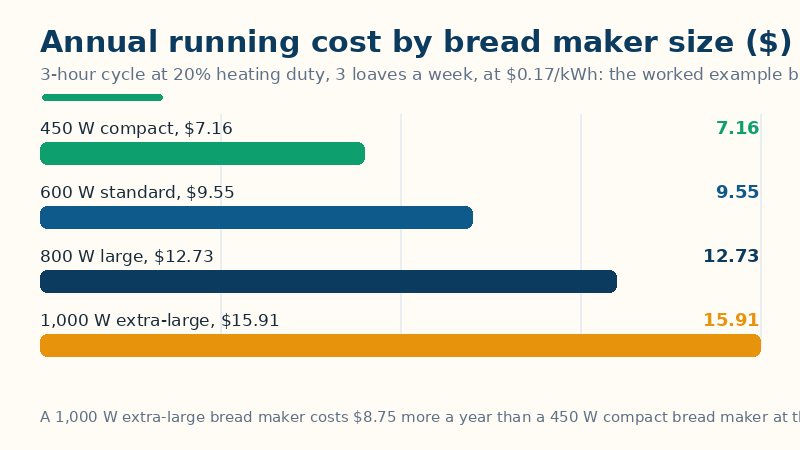
energy per week (kWh) = energy per loaf × loaves a weekannual cost ($) = energy per week × 52 × electricity priceThe watts on the label are the heating element's maximum draw, and the element does not run for the whole cycle. A bread maker spends most of a 3-hour cycle kneading and proving, when the motor draws about 100 W or the machine draws almost nothing, and only the baking phase runs the heater — and even then the thermostat cycles it on and off. Measured loaves use 0.35 to 0.4 kWh, which is a 600 W machine at about 20% duty over 3 hours, so the 20% default is the measured average, not a guess. At 100% duty the same machine would use 1.8 kWh a loaf: that is the ceiling, and it is what the published cost guides quote when they multiply watts by hours without a duty factor.
Worked example: 600 W, 3-hour cycle, 20% heating duty, 3 loaves a week, $0.17/kWh
A 600 W bread maker on a 3-hour cycle at 20% heating duty uses 0.6 × 3 × 20 ÷ 100 = 0.360 kWh a loaf, costing 6.1¢. A week is 0.360 × 3 = 1.080 kWh, costing $0.18. A month is 56.2 ÷ 12 = 4.7 kWh, costing $0.80. A year is 1.080 × 52 = 56.2 kWh, costing $9.55. The table above shows the same maths for the other bread maker sizes at a 3-hour cycle, 20% duty and 3 loaves a week: a 450 W compact bread maker costs 4.6¢ a loaf and $7.16 a year, an 800 W large bread maker costs 8.2¢ a loaf and $12.73 a year, and a 1,000 W extra-large bread maker costs 10.2¢ a loaf and $15.91 a year. One hour at full power uses 0.60 kWh and costs 10.2¢ at these settings, and ten years of baking at this pace costs $95.47. A 2-hour cycle costs $6.36 a year and a 4-hour cycle $12.73; baking every day costs $22.28 a year, once a week $3.18. Five published cross-checks reproduce exactly. The full-power ceiling: wattcostcalc's 600 W bread maker at 3 hours a day and 17.5 cents costs $0.105 an hour, $0.315 a day, $9.45 a month and $114.98 a year — this page reproduces them at 100% duty: the same $0.105 an hour and $0.315 a loaf, $9.55 a month on the year-divided-by-12 month against their $9.45 day-times-30 month, and $114.66 a year on the week-times-52 year against their $114.98 day-times-365 year. Costtorun's 550 W bread maker at 1 hour a day and 15 cents costs $0.08 an hour, $0.08 a day, $2.48 a month and $30.11 a year — this page reproduces them at 100% duty and 7 loaves a week: the same $0.08 an hour and $0.08 a day, $2.50 a month on the year-divided-by-12 month against their $2.48 day-times-30 month, and $30.03 a year on the week-times-52 year against their $30.11 day-times-365 year. Shungrill's 500 W machine over a 3-hour cycle is 1.5 kWh at full power — this page gives the same 1.500 kWh a loaf at 100% duty. And the measured reality: thefinancialwilderness puts a loaf at 0.35 to 0.4 kWh and about 11p at 28p a kWh, and sixgorillas measured 0.4 kWh for a loaf on a power meter — this page's worked example is 0.360 kWh a loaf at 20% duty, inside that band, which is 10.1p at 28p, and at 22% duty the tool gives 0.396 kWh a loaf, the measured 0.4 kWh near enough.
How to read your result, and its limits
Four cautions keep the number honest. First, the heating duty is an average, not a measurement: 20% is the measured average across published loaf tests, but a machine with a longer bake phase or a colder kitchen draws more, and a short quick cycle draws less — if you own a plug-in meter, measure one loaf and set the duty so the tool matches it. Second, the cycle hours are the whole cycle: kneading, rising and baking together, so a 4-hour wholemeal cycle is not 4 hours of heating — it is 4 hours at 20% duty, which is why the 4-hour cycle costs $12.73 a year and not $63.65. Third, the loaves a week are the count, not the days: 3 loaves a week is 156 loaves a year, so the year is the week times 52 — 56.2 kWh and $9.55 — while multiplying one loaf by 365 days would give $22.34, as if the year had 365 bakes instead of 156. Fourth, the electricity price is the all-in rate: the total on the bill divided by the kilowatt-hours on the bill, including delivery charges. For a loaf baked in a full oven instead, the oven cost calculator prices the bake by watts and hours — a 2,400 W oven for an hour is 2.400 kWh and about 41¢, against this page's 0.360 kWh and 6.1¢ a loaf; for the dough mixed before it goes in the machine, the stand mixer cost calculator prices the mix by watts, minutes and mixes a week — a 300 W mixer for 15 minutes is 0.075 kWh and 1.3¢; and for the cost of running anything else in the house, the electricity cost calculator prices any appliance by watts and hours.
Common mistakes
- Pricing the ceiling as the real loaf. 600 W × 3 hours is 1.8 kWh and 30.6¢, but the heater only runs about a fifth of the cycle — the real loaf is 0.360 kWh and 6.1¢. Price the duty, not the label.
- Multiplying one loaf by 365 days. Three loaves a week is 156 loaves a year, not 365: one loaf costs $0.061, and $0.061 × 365 gives $22.27, while the real year is $9.55. Count the loaves a week, then multiply by 52.
- Comparing bread makers on watts. A 450 W compact machine and a 1,000 W extra-large machine look far apart on watts, but the loaf is 3 hours at 20% duty either way: 0.270 kWh against 0.600 kWh, 4.6¢ against 10.2¢ — and the bigger machine may bake the same loaf on the same cycle, so the cost per loaf can be closer still. Compare kilowatt-hours per loaf, not watts.
- Forgetting the keep-warm hour. Some machines hold the loaf warm for an hour after the cycle at low power. If yours does, add that hour to the cycle hours — a 3-hour cycle plus 1 hour of keep-warm is a 4-hour cycle at the same duty, $12.73 a year instead of $9.55.
- Adding the standing charge to every loaf. The daily supply charge is payable whether the bread maker runs or not. Only the per-kWh rate belongs in the per-loaf maths — the fixed charge is a separate line on the bill.
Frequently asked questions
How much electricity does a bread maker use per loaf?
About 0.360 kWh at the worked example's inputs — a 600 W machine on a 3-hour cycle at 20% heating duty — costing 6.1¢ at $0.17 per kWh. Published loaf tests measure 0.35 to 0.4 kWh a loaf; the 1.8 kWh figure is the full-power ceiling, not the real loaf.
How much does it cost to run a bread maker for a year?
Three loaves a week costs 56.2 kWh and $9.55 a year at the worked example's inputs. Baking a loaf every day costs $22.28 a year, and once a week $3.18 — the electricity is a few dollars a year either way.
Is a bread maker cheaper than buying bread?
The electricity is the smallest part: one loaf costs 6.1¢ of electricity at the worked example's inputs, against 80p for a supermarket loaf. Whether home baking saves money is decided by the flour and the ingredients, not the power — one published comparison puts a homemade basic loaf at 84p against 80p bought, and a premium seeded loaf at £1.14 against £1.60 bought.
What size bread maker should I get?
Choose on loaf size, not watts: 450 W compact, 600 W standard, 800 to 1,000 W large. The electricity per loaf runs 4.6¢ to 10.2¢ across that range, so the machine size barely moves the bill — the loaf size and the cycle you use decide it.