The formula: height, plus ability, plus style, rounded to a sold length
Recommended centre length = height + ability offset + style offset, rounded to the nearest 5 cm, with a recommended range of centre ± 5 cm. The ability offsets are beginner −20 cm, intermediate −10 cm, advanced −3 cm, expert +3 cm; the style offsets are park & freestyle −5 cm, groomed & carving −2 cm, all-mountain 0 cm, powder & freeride +8 cm. The shape of those numbers is the chin-to-head rule made arithmetic: a beginner's ski stands near chin height, well below the top of the head, while an expert's ski stands at or above head height — and powder skis run long because float needs length, while park skis run short because spins and rails need control. This is ToolFigure's own convention, built from that rule and from published height-and-ability charts, and it is labelled as such: no brand publishes one universal formula, and a brand's own chart for the exact model you are buying gets the last word.
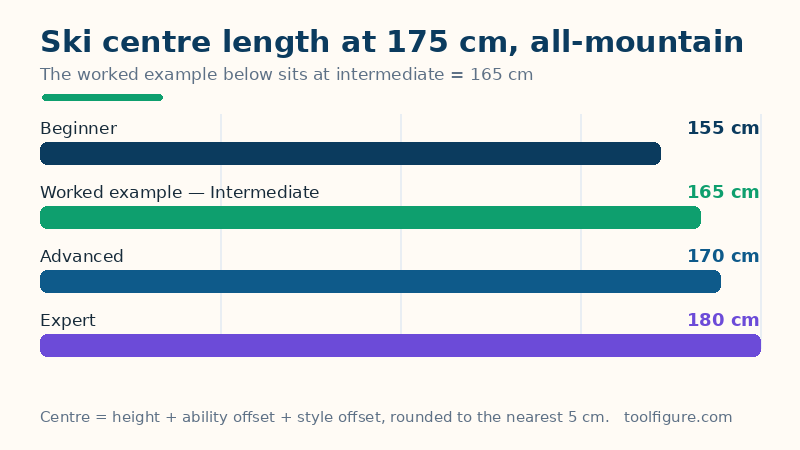
Worked example: 175 cm, intermediate, all-mountain
Take a skier who is 175 cm tall, an intermediate, skiing all-mountain. The arithmetic is 175 − 10 + 0 = 165 cm, already on a 5 cm step, so the recommendation is 165 cm, range 160–170 cm — a ski that stands 10 cm below the top of the skier's head, between chin and nose, exactly where an intermediate's all-mountain ski belongs. The same skier at every ability level, all-mountain, reads: beginner 155 cm (150–160), intermediate 165 cm (160–170), advanced 170 cm (165–175) — 175 − 3 = 172, rounded to the nearest 5 cm step — and expert 180 cm (175–185) — 175 + 3 = 178, rounded to 180. The same intermediate skier in every style reads: park & freestyle 160 cm (155–165), groomed & carving 165 cm (160–170) — 175 − 10 − 2 = 163, rounded to 165 — all-mountain 165 cm (160–170) and powder & freeride 175 cm (170–180) — 175 − 10 + 8 = 173, rounded to 175.
More heights, intermediate, all-mountain
| Height | Centre length | Recommended range |
|---|---|---|
| 160 cm | 150 cm | 145–155 cm |
| 170 cm | 160 cm | 155–165 cm |
| 180 cm | 170 cm | 165–175 cm |
| 190 cm | 180 cm | 175–185 cm |
How to read your result, and its limits
Three checks before buying. First, weight moves you inside the range: where height and weight point to different rows, follow weight — a light skier on skis sized purely by height will struggle to flex them, and a heavier skier on short skis will overpower them, so heavy for your height means the top of the range and light means the bottom. Second, children are a different chart: this calculator covers adults from 140 to 210 cm, and a child's first-season ski stands between the chest and the chin, not between chin and head — age, height and weight together set a junior length, and junior skis are sold in shorter steps. Third, length is not the whole purchase: bindings must be set by a trained technician using calibrated equipment — release settings follow the ISO 11088 standard and take weight, height, age, boot sole length and ability together, and that is not a calculation to do at home — and the ski's width, flex and construction matter as much as its length once the length is roughly right. Demo the recommended length when you can; a morning on snow settles what a chart can only suggest. For the rest of the kit, the helmet size converter sizes head protection from a tape measure, and the bike frame size calculator sizes the other seasonal machine from an inseam.
Related tools: Height Converter — Convert feet and inches to cm — and cm back — with the exact factor and a worked example.
Frequently asked questions
What length skis do I need at 175 cm as an intermediate?
165 cm, range 160–170 cm: 175 − 10 (intermediate) + 0 (all-mountain) = 165 cm, already on a 5 cm step. The same skier as a beginner takes 155 cm and as an expert takes 180 cm.
Should beginners buy shorter skis?
Yes. Shorter skis are easier to control, make turns more easily and respond more quickly, which is why beginners take the chin-height end of the scale — a −20 cm offset here — while advanced skiers take longer skis for stability at speed.
Does my weight change the recommended ski length?
It moves you inside the range rather than changing the centre: if you are heavy for your height, take the top of the range, and if you are light, take the bottom. A light skier on skis sized purely by height will struggle to flex them, and a heavier skier on short skis will overpower them.
Can children use this ski size calculator?
No — it covers adult heights from 140 to 210 cm. A child's first-season ski should stand between the chest and the chin, and junior lengths are set by age, height and weight together on a kids ski chart, not by this formula.
