Watts are the speed, watt-hours are the distance
Power station guides agree on the method even when they round the allowances differently: daily watt-hours = the sum of each device's watts × its hours, trip watt-hours = daily × days, and required capacity = trip ÷ inverter efficiency × reserve. This page uses 0.85 for inverter efficiency and 1.20 for reserve — the same pair the dedicated camping power calculators use — because a station is not 100 percent efficient at turning stored energy into mains power, and a battery run to zero on the last night is a battery with no margin for the morning. The result is then read off against the standard sizes stations are actually sold in: 300, 500, 1,000, 1,500, 2,000 and 3,000 Wh. The ladder matters because the honest answer to "what size do I need" is a size you can buy, not a number like 1,463 Wh that no shop stocks.
Device energy (Wh) = watts × hours per day — Daily energy (Wh) = sum of device energies — Trip energy (Wh) = daily × days — Required capacity (Wh) = trip ÷ 0.85 × 1.20 — Buy = smallest standard size (300, 500, 1,000, 1,500, 2,000, 3,000 Wh) at or above required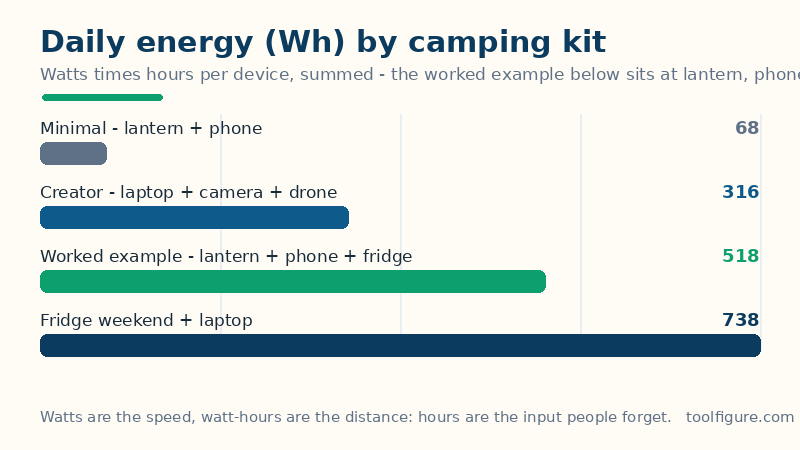
Two traps sit inside the inputs, and both are stated rather than hidden. First, fridge hours are compressor-on equivalent hours, not 24: a portable fridge rated 45 W that cycles half the time uses 45 × 12 = 540 Wh in a day, not 45 × 24 = 1,080 — enter the hours the compressor actually runs, or halve the day. Second, capacity and inverter rating are separate specifications: a 1,000 Wh station with a 300 W inverter runs a 63 W kit all weekend but will not start an 800 W kettle, whatever the watt-hours say — check the inverter against everything running at once, which the result states beside the capacity.
Worked example: lantern, phone and fridge for 2 days
A kit of an 8 W LED lantern for 6 hours, phone charging at 10 W for 2 hours and a 45 W portable fridge for 10 compressor-on hours, used for 2 days, needs a 1,500 Wh station — required capacity 1,463 Wh. The working: daily energy = 8 × 6 + 10 × 2 + 45 × 10 = 48 + 20 + 450 = 518 Wh. Trip energy = 518 × 2 = 1,036 Wh. Required capacity = 1,036 ÷ 0.85 × 1.20 = 1,462.59 Wh, shown as 1,463 Wh. The smallest standard size at or above 1,463 Wh is 1,500 Wh. Everything running at once draws 8 + 10 + 45 = 63 W, so any station with a 300 W inverter covers the kit — the capacity, not the inverter, is the binding constraint here. The same arithmetic on other kits:
| Kit | Daily Wh | Trip Wh | Required | Buy |
|---|---|---|---|---|
| Minimal — lantern 8 W × 6 h + phone 10 W × 2 h, 1 day | 68 Wh | 68 Wh | 96 Wh | 300 Wh |
| Creator — laptop 60 W × 4 h + camera charger 18 W × 2 h + drone charger 40 W × 1 h, 1 day | 316 Wh | 316 Wh | 446 Wh | 500 Wh |
| Worked example — lantern + phone + fridge, 2 days | 518 Wh | 1,036 Wh | 1,463 Wh | 1,500 Wh |
| Fridge weekend — fridge 45 W × 10 h + laptop 60 W × 4 h + lantern 8 W × 6 h, 2 days | 738 Wh | 1,476 Wh | 2,084 Wh | 3,000 Wh |
Check the creator row by hand: 60 × 4 + 18 × 2 + 40 × 1 = 240 + 36 + 40 = 316 Wh for the day, and 316 ÷ 0.85 × 1.20 = 446.12 Wh, shown as 446 Wh — the smallest standard size covering it is 500 Wh. And check the fridge-weekend row: daily 450 + 240 + 48 = 738 Wh, trip 738 × 2 = 1,476 Wh, required 1,476 ÷ 0.85 × 1.20 = 2,083.76 Wh, shown as 2,084 Wh — past the 2,000 Wh size, so the buy is 3,000 Wh, and the gap between 2,084 and 3,000 is the price of a fridge on a weekend, stated rather than smoothed over.
How to read your result, and its limits
Three checks before trusting the figure. First, the wattages are planning figures, not measurements: a phone charges at 10 to 30 W depending on the charger, a laptop at 40 to 100 W depending on the model and the load, a CPAP at 30 to 70 W — measure your own gear with a plug-in meter where the trip depends on it, and the result moves with the inputs. Second, solar is not counted: a 100 W panel in strong sun can add back a few hundred watt-hours a day and stretch a station across a longer trip, but weather makes that a bonus, not a plan — size for the nights without it. Third, the reserve is a choice, not a law: 20 percent keeps the battery out of its bottom fifth and covers a day that runs long, but a trip with a charging stop every night can run a smaller station honestly — the required figure without the reserve is the trip figure divided by 0.85 alone, which the worked example's arithmetic lets you recover in one step.
Common mistakes
- Matching watts instead of watt-hours. A station that can run a fridge says nothing about how many nights it runs it for — energy is watts times hours, and hours are the input people forget.
- Counting a fridge at 24 hours. A cycling fridge runs its compressor part of the day — enter compressor-on equivalent hours, or the answer doubles for no reason.
- Forgetting the inverter. Capacity in watt-hours and inverter rating in watts are separate specifications — a kettle needs its own inverter check whatever the watt-hours say.
- Buying the exact required figure. No shop stocks a 1,463 Wh station — buy the next standard size up, and treat the gap as the margin that covers the day that runs long.
Related tools: Camp Stove Fuel Calculator — Your camp stove fuel from group, days and stove type — grams and whole canisters for canister stoves, fluid ounces for white gas, cold and wind included; Camping Food Calculator — How much food to pack from trip days, group size and daily calories — total weight, per-person weight and per-day weight, with a safety buffer for delays; Hiking Water Calculator — Your hiking water from hours, heat and effort — litres to carry, 1-litre bottles and the pack weight, with a delay hour and camp water included.
Frequently asked questions
What size power station do I need for camping?
It depends on the kit and the nights: a minimal lantern-and-phone kit for a night needs about 96 Wh of capacity, so a 300 Wh station; a lantern, phone and fridge for 2 days needs 1,463 Wh, so a 1,500 Wh station; a fridge weekend with a laptop needs 2,084 Wh, so a 3,000 Wh station. Add up watts times hours per device, multiply by the days, divide by 0.85 and add a 20 percent reserve.
What is the difference between watts and watt-hours?
Watts measure power right now, like speed; watt-hours measure energy over time, like distance. A 45 W fridge running 10 hours uses 450 Wh. A station's watt-hour rating tells you how long it lasts; its inverter wattage tells you which appliances it can run at once.
How many hours a day does a camping fridge use?
Count compressor-on equivalent hours, not 24. A 45 W fridge that cycles half the time uses 45 × 12 = 540 Wh in a day, not 45 × 24 = 1,080 Wh. Enter the hours the compressor actually runs, or halve the day.
Does solar change the size I need?
It stretches a station but should not shrink the plan: a 100 W panel in strong sun adds back a few hundred watt-hours a day, which helps on a longer trip, but weather makes it a bonus. Size for the nights without sun, and treat solar as the margin.
