The one clothing scale with an exact number in it
European baby sizes are not arbitrary: the number is the height in centimetres the garment is cut for. An EU 80 fits a child up to 80 cm (31.5 in) tall, an EU 56 fits a child up to 56 cm (22.0 in), and so on up the ladder in steps of 6 cm — 50, 56, 62, 68, 74, 80, 86, 92, 98, 104, 110. The American labels and the ages are only typical values hung on that ladder, and the published tables do not fully agree on them: one table's US 12-month row is another's 9–12 months, and a single label's stated upper weight varies by pounds from brand to brand. So the honest way to use this page is height first and label second: find the row for the child's measured height, and treat the US label, the UK age and the age range as a check, not as the answer. A child taller than the row's height should move up a size even if the birthday still matches the row — children do not grow to a timetable, and a garment cut for 80 cm does not stretch to 84.
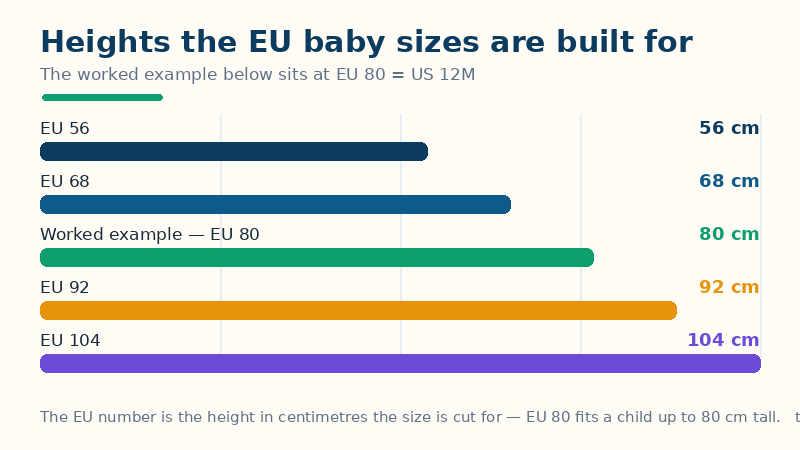
Worked example: an EU 80
Take an EU 80. The row gives US 12M, UK 9–12 months, about 9–12 months old, up to 80 cm (31.5 in) tall — the height is the exact figure, the rest typical. Two more rows prove the ladder holds across the systems: a US 18M is EU 86, UK 12–18 months, about 12–18 months old, up to 86 cm (33.9 in); and a child of 5 months falls in the 4–6 month row, giving EU 68, US 3–6M, UK 3–6 months, up to 68 cm (26.8 in). Age boundaries follow the half-open rule stated on the tool: 12 months is the first month of the 12–18 month row, not the last month of the 9–12 month row, so a 12-month-old who is already 84 cm tall belongs in EU 86 on height, whatever the label on the last outfit said.
Baby and toddler size table
| EU | US | UK | Age | Height (cm) | Height (in) |
|---|---|---|---|---|---|
| 50 | Preemie | Newborn | 0–1 month | 50 | 19.7 |
| 56 | Newborn | 0–3 months | 0–3 months | 56 | 22.0 |
| 62 | 0–3M | 3–6 months | 2–4 months | 62 | 24.4 |
| 68 | 3–6M | 3–6 months | 4–6 months | 68 | 26.8 |
| 74 | 6–9M | 6–9 months | 7–9 months | 74 | 29.1 |
| 80 | 12M | 9–12 months | 9–12 months | 80 | 31.5 |
| 86 | 18M | 12–18 months | 12–18 months | 86 | 33.9 |
| 92 | 2T | 18–24 months | 18–24 months | 92 | 36.2 |
| 98 | 3T | 2–3 years | 2–3 years | 98 | 38.6 |
| 104 | 4T | 3–4 years | 3–4 years | 104 | 40.9 |
| 110 | 5 | 4–5 years | 4–5 years | 110 | 43.3 |
How to read your result, and its limits
Three checks before ordering. First, measure height, not age: lying down for a baby who cannot stand yet, standing barefoot against a wall for a toddler, and take the row whose height the child has not yet passed — a child at 81 cm is an EU 86 child, even on the day they turn 10 months. Second, expect the brands to disagree: the US label, UK age and age range on this page are the published typical values, and any one brand may place a label a step either side of them, so the brand's own height chart is the final word for that brand. Third, this table ends at age 5: beyond EU 110 the children's scales split into the boys' and girls' tables with different chest, waist and hip measurements, and a height-only conversion stops being enough — for older children, use a kids' clothing chart with full measurements, not this ladder.
Related tools: Clothing Size Converter — Men's and women's clothing sizes between US, UK and EU — with the measurements behind them; Shoe Size Converter — US, UK, EU and Japan shoe sizes — every system at once, men and women; Sock Size Converter — Men's & women's sock sizes — US, UK & EU shoe sizes into the XS–XXL sock letter.
Frequently asked questions
What is EU 80 in US baby sizes?
EU 80 is US 12M, UK 9–12 months, for a child about 9–12 months old and up to 80 cm (31.5 in) tall. The height is the exact figure; the US label and age are typical values that brands move by a step.
What does the EU number mean in baby clothes?
It is the height in centimetres the garment is cut for: EU 80 fits a child up to 80 cm tall, EU 86 up to 86 cm, and so on in steps of 6 cm from EU 50 to 110.
My baby is 12 months old but 84 cm tall — which size?
EU 86, on height: 12 months is the first month of the 12–18 month row (EU 86, US 18M), and a child taller than 80 cm has already outgrown EU 80 whatever the age says. Measure height first and treat age as a check.
Why do baby size charts disagree between brands?
Because only the EU height number is exact; the US labels, UK ages and age ranges are typical values, and brands place them a step either side. Published comparisons find a single label's stated upper weight varying by pounds across brands — so always check the brand's own height chart.
