The three clearances, and why each one is a different bear
The PCT hang is taught as three numbers because a bear attacks a hang three ways: standing up from the ground, leaning out from the trunk, and reaching down from the branch above. The height rule answers the first bear: a standing black bear reaches roughly 10 feet, so the bottom of the bag must sit at least 12 feet up, with margin. The trunk rule answers the second: at least 6 feet from the trunk, so a bear climbing the trunk cannot lean out and hook the bag. The drop rule answers the third: at least 6 feet below the branch, so a bear out on the branch cannot reach down and grab it. A hang that passes two of the three is still a failed hang — each rule guards a different approach, and a bear only needs one of them to be wrong.
Branch height (feet) = bag height + drop below the branch — Minimum rope (feet) = 2 × branch height — Pass needs: height at least 12 ft AND trunk distance at least 6 ft AND drop at least 6 ft — Tent distance: 200 ft recommended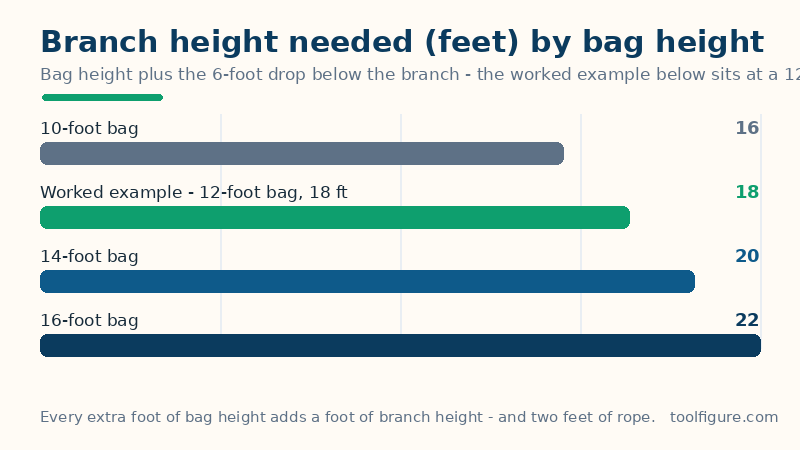
Every variable in that box is an input on this page. The rope formula is geometry, not guidance: the rope runs from the ground up to the branch and back down again, so twice the branch height is the least rope that can make the hang at all, and the working slack — the length you hold, tie and adjust with — sits on top of it. That is why a 50-foot line is the standard carry: it covers every branch up to 25 feet with nothing to spare, and it covers the worked example's 18-foot branch with 14 feet to spare.
Worked example: 12 feet high, 6 feet from the trunk, 6 feet below the branch, 200 feet from camp
Height 12 feet meets the 12-foot minimum exactly (3.66 m), trunk distance 6 feet meets the 6-foot minimum exactly (1.83 m), and drop 6 feet meets the 6-foot minimum exactly (1.83 m) — all three clearances pass, so the hang passes. Branch height = 12 + 6 = 18 feet (5.49 m), so the branch you throw over must be at least 18 feet up. Minimum rope = 2 × 18 = 36 feet (10.97 m), and a standard 50-foot line (15.24 m) covers it with slack to spare. Tent distance 200 feet (60.96 m) meets the widely taught 200-foot recommendation for keeping food storage away from where you sleep. The same checks on hangs that fail:
| Hang | Result | Why |
|---|---|---|
| 9 ft high, 6 ft out, 6 ft drop | Fails | Height 9 ft is below the 12 ft minimum — inside a standing bear's reach |
| 12 ft high, 3 ft out, 6 ft drop | Fails | Trunk distance 3 ft is below the 6 ft minimum — a bear on the trunk can lean out to it |
| 12 ft high, 6 ft out, 2 ft drop | Fails | Drop 2 ft is below the 6 ft minimum — a bear on the branch can reach down to it |
| 12 ft high, 6 ft out, 6 ft drop, tent 100 ft away | Clearances pass | All three clearances pass, but 100 ft is short of the 200 ft camp recommendation |
| 14 ft high, 8 ft out, 8 ft drop | Passes | Branch 22 ft, rope at least 44 ft — still inside a 50 ft line |
Check the last row by hand: branch height = 14 + 8 = 22 feet, minimum rope = 2 × 22 = 44 feet, and 44 is less than 50, so the standard line still covers it. The row also shows the honest trade of going higher: every extra foot of bag height or drop adds two feet of rope, so a hang on a 25-foot branch already needs the whole 50-foot line before any slack.
How to read your result, and its limits
Three limits decide whether a passing result is enough. First, different sources state the numbers slightly differently — some guides teach 10 to 12 feet high and 4 feet from the trunk, others the stricter 12 feet and 6 feet used here — and this page deliberately uses the stricter, most widely taught form, so a hang that passes here passes the looser forms too; a hang that fails here may still pass a looser local standard, which is why the failing clearance is named, not just the verdict. Second, the hang is only as good as the branch: dead branches snap, branches thick enough for a bear to walk on defeat the whole method, and a branch with neighbouring limbs a bear can climb onto is a different hang from the one measured. Third, some places do not allow hangs at all: where canisters are required, or where the trees will not hold a hang, the correct answer is the canister, not a better hang — and in grizzly country, local guidance often asks for more height than the 12-foot standard here. A pass on this page means the geometry is right; it does not mean the site, the branch or the local rules agree.
Common mistakes
- Measuring to the top of the bag. The clearance that matters is the bottom of the bag — the lowest point a bear can reach — not the top.
- Eyeballing 12 feet. The most common failed hang is a bag the hiker believed was at 12 feet and was actually at 8 or 9. Pace it, measure it, or mark your rope.
- Tying off to the trunk. A rope tied to the trunk is a rope a bear can bite through at ground level. The PCT method's toggle exists precisely to avoid that tie-off.
- Hanging the food where you sleep. Food storage 200 feet from camp keeps a bear that finds the bag away from the tent. A perfect hang beside the tent is still the wrong campsite.
Related tools: Bear Canister Size Calculator — How big a bear canister your trip needs, from group size and trip days — volume in cubic inches and litres, and the smallest standard canister that covers it; Camping Food Calculator — How much food to pack from trip days, group size and daily calories — total weight, per-person weight and per-day weight, with a safety buffer for delays; Tent Size Calculator — Your tent size from sleepers and comfort — the floor area you need and the rating that covers it — with the packs-inside allowance.
Frequently asked questions
How high should a bear bag hang?
At least 12 feet off the ground, measured to the bottom of the bag — above the roughly 10-foot reach of a standing black bear. Some guides accept 10 to 12 feet, but this page uses the stricter 12-foot figure, so a hang that passes here passes the looser forms too.
How far from the trunk should a bear bag hang?
At least 6 feet from the trunk, and at least 6 feet below the branch it hangs from: 6 feet out stops a bear leaning from the trunk, and 6 feet down stops a bear reaching from the branch above. A hang needs all three clearances — height, trunk distance and drop — not just one.
How much rope do I need for a bear hang?
At least twice the branch height: the rope runs from the ground up over the branch and back down again. For the worked example's 18-foot branch that is 36 feet minimum, which a standard 50-foot line covers with slack to spare — and a hang on a 25-foot branch already needs the whole 50-foot line.
Can I hang food instead of using a bear canister?
Only where hangs are allowed. Where a land manager requires a canister, a hang does not substitute for it, and in grizzly country local guidance often asks for more height than the 12-foot standard used here. Check the local rule before choosing a hang over a canister.
