The method: a chart lookup, not a formula
There is no formula on this page, and saying so is the honest part: glove sizing is a published chart, not arithmetic. The calculator looks up one cell in the age-by-position chart below — the player's age group down the side, their position across the top — and reports that cell's range exactly as published. Two measurement rules sit behind the chart and explain its one oddity. Fielders' gloves (infield, outfield, pitcher, first base) are measured from the top of the index finger, down through the pocket, to the heel of the glove, so their sizes run from about 8 in for the youngest infielders to 13 in for adult outfielders. Catcher's mitts are measured around the circumference instead, which is why their sizes run from 29.5 in to 34.5 in — a different unit on the same chart, not a glove three times the size. The chart used here is one consistent published guide's table, stated on the page so a shop's chart can be compared against it cell by cell rather than trusted wholesale.
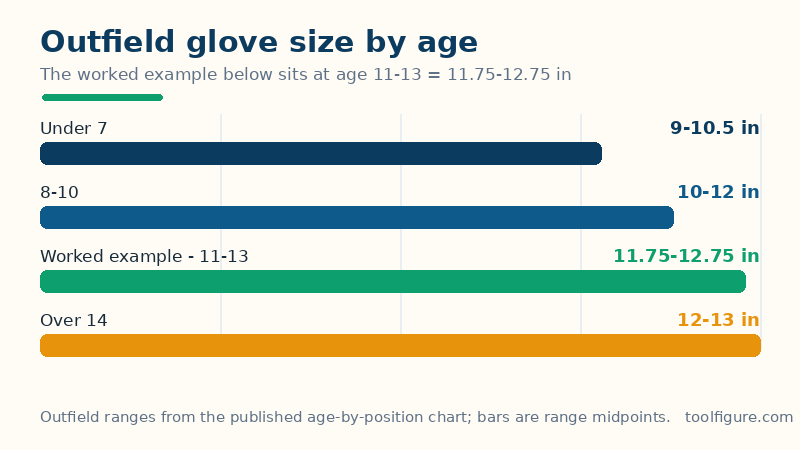
Worked example: age 11–13, outfield
Take a 12-year-old outfielder. The age group is 11–13 and the position is Outfield, so the cell reads 11.75–12.75 in — the recommendation is that range, not a single figure, because brands cut slightly differently at the same stated inches and the player should try gloves inside the range. The same lookup for other combinations reads:
| Age | 2B / SS | 3rd base | Pitcher | Outfield | 1st base | Catcher |
|---|---|---|---|---|---|---|
| Under 7 | 8–10.5 in | 8–10.5 in | 8–10.5 in | 9–10.5 in | 11.5 in | 29.5–30 in |
| 8–10 | 10.5–11.25 in | 10.5–11.5 in | 10.5–11.5 in | 10–12 in | 11.5–12 in | 30–31 in |
| 11–13 | 11–11.5 in | 11–11.75 in | 11.5–12 in | 11.75–12.75 in | 11.5–12 in | 30–32.5 in |
| Over 14 | 11.25–11.5 in | 11.5–12 in | 11.5–12 in | 12–13 in | 12–13 in | 32–34.5 in |
Notice the shape of the table: infielders stay the smallest at every age because a small glove transfers the ball faster, outfielders stay the largest because a deeper pocket catches fly balls, and first base and catcher sit apart from the rest because their mitts are built differently — first base mitts are longer, catcher's mitts are measured around. A 12-year-old infielder at 11–11.5 in and the same player's outfield range of 11.75–12.75 in differ by nearly an inch, which is the whole point of asking the position.
How to read your result, and its limits
Three checks before buying. First, young players should not buy position-specific gloves: children rotate through positions, so an under-10 player is better served by a general fielding glove inside their age range than by the exact cell for one position — the position columns earn their keep from about age 11 upward. Second, try the glove on, with the hand that wears it: the size is stamped on the thumb or little finger of most gloves, but two brands' 12 in gloves can feel different, and a glove that is hard to close is the wrong glove whatever the chart says — youth models are also built to break in more easily, which matters more than half an inch. Third, softball is a different chart: softball gloves run larger than baseball gloves at the same age and position, so do not carry a number from this page onto a softball diamond. For the rest of the kit, the cricket bat size calculator sizes a bat from height alone, and the boxing glove size calculator sizes gloves from body weight and purpose.
Related tools: Bowling Ball Weight Calculator — The right bowling ball weight from the 10% rule: body weight times 10%, adjusted for skill and capped at the 16 lb competition maximum.
Frequently asked questions
What size baseball glove does a 12-year-old need?
It depends on position: a 12-year-old (age group 11–13) reads 11–11.5 in at second base or shortstop, 11.75–12.75 in in the outfield, 11.5–12 in at first base or pitcher, and 30–32.5 in (circumference) as catcher. Pick the age group and position above for the exact range.
Why are catcher's mitt sizes so much bigger?
They are measured differently: catcher's mitts are measured around the circumference, giving numbers near 30–34 in, while fielders' gloves are measured from the top of the index finger to the heel, giving numbers near 8–13 in. The two scales are not comparable.
Should a young player buy a position-specific glove?
Usually not: younger players rotate through positions, so a general fielding glove inside their age range is the honest buy, and the position columns earn their keep from about age 11 upward.
Where is the size marked on a baseball glove?
On the thumb or the little finger of most gloves, stamped in inches. If a glove has no size marked, measure with a flexible tape from the top of the index finger, down through the pocket, to the heel.
