Two halves, two different conversion rules
A bra size is a band number plus a cup letter, and the two halves do not convert the same way. The band is a length: the US and UK bands are the same number, Europe counts the same band in centimetres rounded to a five-step scale, France counts fifteen higher than Europe, Australia counts twenty-two lower than the US, and Japan counts the same number as Europe. The rules, for a US band B, are EU = 60 + (B − 28) × 2.5, FR = EU + 15, AU = B − 22 and JP = EU. So a US 34 is an EU 75 (60 + 6 × 2.5), a FR 90, an AU 12 and a JP 75. The cup is a position in a letter sequence, and the sequence itself changes between systems above DD: the US runs A, B, C, D, DD, DDD/F, G, H, I, J, K; the UK runs A, B, C, D, DD, E, F, FF, G, GG, H; Europe, France and Japan run A, B, C, D, E, F, G, H, I, J, K. A US DD is therefore a UK DD but a European E, and a US DDD/F is a UK E and a European F. The same letter on two labels is not the same cup once you pass DD — the position is what converts, never the letter alone.
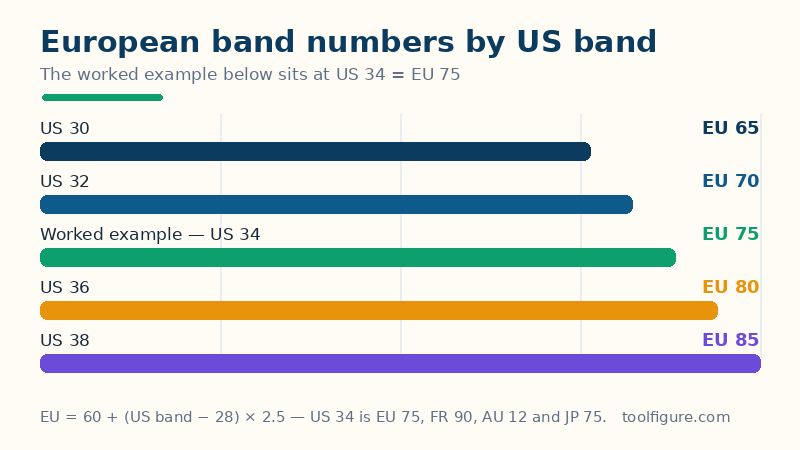
Worked example: a US 34C
Take a US 34C. The band rule gives EU 75 (60 + (34 − 28) × 2.5 = 60 + 15), FR 90 (75 + 15), AU 12 (34 − 22) and JP 75, and the cup C sits at the same position in every system, so the full conversion is UK 34C, EU 75C, FR 90C, AU 12C, JP 75C. The sister sizes keep the cup volume and change the band: one band down and one cup up gives 32D, and one band up and one cup down gives 36B — the same volume of cup on a tighter or looser band. The measurement behind the size explains why: the band is the underbust measurement rounded to the nearest even inch, and the cup is the bust-minus-underbust difference in inches — 1 inch is an A, 2 a B, 3 a C, 4 a D, 5 a DD and so on. An underbust of 30 inches with a bust of 33 inches is a difference of 3, so a 30C, which converts to EU 65C, FR 80C, AU 8C and JP 65C (30 − 22 = 8 for Australia). Note what this method is not: the old “add four inches to the underbust” rule belongs to the days of non-stretch bands, and on a modern elastic band it puts most wearers in a band too loose to support anything.
Common bra sizes across the systems
| US | UK | EU | FR | AU | JP | Sister sizes (US) |
|---|---|---|---|---|---|---|
| 32B | 32B | 70B | 85B | 10B | 70B | 30C, 34A |
| 34B | 34B | 75B | 90B | 12B | 75B | 32C, 36A |
| 34C | 34C | 75C | 90C | 12C | 75C | 32D, 36B |
| 36C | 36C | 80C | 95C | 14C | 80C | 34D, 38B |
| 38D | 38D | 85D | 100D | 16D | 85D | 36DD, 40C |
| 34DD | 34DD | 75E | 90E | 12DD | 75E | 32DDD/F (UK 32E), 36D |
Two more rows prove the cup-sequence rule where it matters most, above DD. A UK 34E is the fifth cup position past D, so it is a US 34DDD/F and a EU 75F — not a US 34E, because the US system has no plain E at that position. An EU 80F is a band 36 (80 − 60 = 20, 20 ÷ 2.5 = 8, 28 + 8 = 36) at the same fifth position, so it is a US 36DDD/F and a UK 36E. Read the row, not the raw letter: the same cup wears three different letters depending on which country's label you are holding.
How to read your result, and its limits
Three checks before ordering. First, measure the band where it sits, not where you wish it sat: snug around the ribcage directly under the bust, tape level, breathing out — and round to the nearest even inch, because bands are sold in even inches. A tape pulled over a padded bra adds a band size that is not in the body. Second, use sister sizes for band problems only: if the band rides up at the back, the band is too loose and a sister size down (32D for a 34C) is the fix; if the cups gap at the top or spill at the sides, the cup itself is wrong and the cup must change on the same band. Sister sizing cannot fix a wrong cup, and changing the cup cannot fix a wrong band. Third, brands vary around every table on this page, most of all above a D cup and between European makers, whose cup progressions differ by centimetre steps rather than inch steps — the table is the published standard conversion, and the brand's own chart is the final word when a size sits between two rows. This page converts labels; it does not fit a body, and no converter can replace trying the garment on.
Related tools: Clothing Size Converter — Men's and women's clothing sizes between US, UK and EU — with the measurements behind them; Pants Size Converter — Men's and women's pants sizes — US, UK and EU, with inseam; Shoe Size Converter — US, UK, EU and Japan shoe sizes — every system at once, men and women.
Frequently asked questions
Is a US 34C the same as a UK 34C?
Up to a D cup, yes — the US and UK bands are the same number and the cup letters match. Above DD they diverge: a US DD is a UK DD but a European E, and a US DDD/F is a UK E and a European F. The cup position converts, not the letter alone.
What are sister sizes?
Sizes with the same cup volume on a different band: go one band size down and one cup letter up, or one band up and one cup down. A 34C has the sister sizes 32D and 36B. Use them when the band fits badly but the cups fit well — never to fix a cup that gaps or spills.
How do I measure my bra size?
Measure the underbust snugly, directly under the bust, and round to the nearest even inch — that is the band. Measure the bust at its fullest, subtract the band, and each inch of difference is one cup step: 1 is A, 2 is B, 3 is C, 4 is D, 5 is DD. The old add-four-inches rule belongs to non-stretch bands and overstates the band on modern bras.
Why is a French bra size so much bigger than the European one?
It is the same band counted differently: France adds fifteen to the European number, so an EU 75 is a FR 90. The band itself has not changed — only the label has. The same trap applies in reverse to Australia, which subtracts twenty-two from the US band.
