The two equations behind the answer
Water boils when its vapour pressure equals the pressure of the air pushing down on it, so the boiling point is really a question about air pressure, answered in two steps. Step 1 turns elevation into pressure with the International Standard Atmosphere barometric formula for the troposphere:
P = 101,325 × (1 − 0.0000225577 × h)^5.25588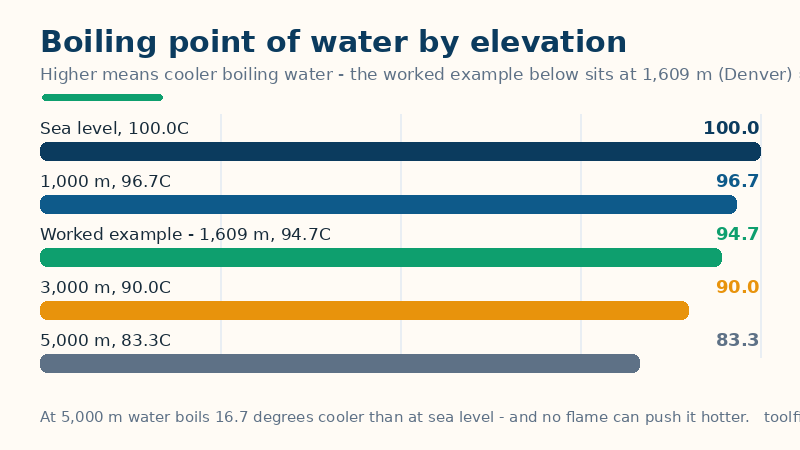
Here h is the elevation in metres and P is the pressure in pascals, starting from 101,325 Pa at sea level. Step 2 turns that pressure into a boiling point with the Antoine equation for water, using the NIST constants A = 8.07131, B = 1730.63 and C = 233.426, with pressure in millimetres of mercury:
T = B ÷ (A − log10(P)) − CHere T is the boiling point in degrees Celsius. The constants are fitted for water between 1°C and 100°C, which covers every elevation on Earth — even the summit of Everest, where the pressure is only about a third of sea level, still lands inside the range. The rule of thumb that falls out of both equations is about 1°C lost per 300 m near sea level, or about 2°F per 1,000 ft: close enough for a quick estimate, but the calculator runs the equations themselves, so its figures are exact to the standard atmosphere rather than to the rule of thumb.
Worked example: Denver, 1,609 m (5,280 ft)
Step 1, the pressure: 1 − 0.0000225577 × 1609 = 1 − 0.036295 = 0.963705, and 101,325 × 0.963705^5.25588 = 83,431 Pa = 834.3 hPa (24.64 inHg). Step 2, the boiling point: 83,431 Pa ÷ 133.322 = 625.79 mmHg, log10(625.79) = 2.7964, so T = 1730.63 ÷ (8.07131 − 2.7964) − 233.426 = 1730.63 ÷ 5.27491 − 233.426 = 328.09 − 233.426 = 94.66°C, shown as 94.7°C (202.4°F) — 5.3°C below sea level, matching the published Denver figure of about 94.7°C exactly. The cooking adjustment is about 10% per 1,000 m, so at 1,609 m add about 16% to boiled and simmered times — a 10-minute pasta becomes about 12 minutes. Disinfection stays at the lower CDC figure here: 1,609 m is below 2,000 m, so 1 minute at a rolling boil. The table on the calculator shows the same arithmetic up the mountain: 3,000 m gives 90.0°C, which is the altitude figure the camp stove boil time calculator already uses for its high-camp example, and 8,848 m gives 70.3°C — hot enough to scald, far too cool to cook rice properly, which is why high camps run pressure cookers.
How to read your result, and its limits
Four cautions keep the number honest. First, the pressure assumes a standard atmosphere: real weather moves local pressure up and down, shifting the true boiling point by a fraction of a degree either way — for a laboratory measurement, enter the measured pressure instead of the elevation. Second, the cooking adjustment is a planning rule, not a recipe: roughly 10% per 1,000 m applies to moist-heat cooking — boiling, simmering, braising, steaming — while oven roasting and baking follow different altitude rules and need no adjustment from this page. Third, boiling is not a thermometer at altitude: the most dangerous mistake a high-altitude cook makes is trusting a rolling boil to mean the food reached 100°C, when at 3,000 m it reached 90°C — use a food thermometer for doneness, especially for meat. Fourth, the formula stops at the top of the troposphere: above about 11,000 m the barometric formula no longer describes the atmosphere, so the calculator refuses elevations beyond it rather than printing a confident fiction.
Common mistakes
- Boiling longer instead of adjusting the expectation. Extra minutes at a rolling boil cannot push water past its boiling point: at altitude the water is cooler, not slower to heat, so the fix is a longer cook time and a thermometer, not a fiercer flame.
- Applying the adjustment to the oven. Dry-heat cooking is barely affected by the boiling point, because the oven air, not boiling water, carries the heat. Only moist-heat methods take the roughly 10% per 1,000 m.
- Trusting a rolling boil for safe drinking water. At altitude the CDC rule is time-based for exactly this reason: 1 minute at a rolling boil up to 2,000 m, 3 minutes above it, because the water disinfecting your bottle is cooler than the 100°C you picture.
- Using the mountain's height instead of the camp's. The boiling point follows the pressure where the pot sits. A camp at 2,000 m below a 4,000 m summit boils at the 2,000 m figure, not the summit's.
Related tools: Camp Stove Boil Time Calculator — How long your camp stove takes to boil water — from the physics, with altitude and efficiency, plus the safe-drinking hold; Camping Water Purification Calculator — The iodine dose for your camp water — drops or tablets per litre, and the wait before drinking, doubled for cloudy or cold water; Altitude Acclimatization Calculator — A safe ascent, day by day — sleeping altitudes, daily gains and rest days from the 500-metre rule.
Frequently asked questions
Why does water boil at a lower temperature on a mountain?
Because boiling happens when water's vapour pressure equals the surrounding air pressure. Higher up, less air sits above you, so the pressure is lower, and water molecules need less energy to escape as vapour — so boiling starts at a lower temperature, about 1°C lower per 300 m near sea level.
What is the boiling point of water in Denver?
About 94.7°C (202.4°F). Denver sits at 1,609 m (5,280 ft), where standard air pressure is 834.3 hPa instead of 1013.2 hPa, and the Antoine equation turns that pressure into 94.66°C — the figure this calculator returns for 1,609 m.
Does food really take longer to cook at altitude?
Boiled, simmered, braised and steamed food does: the water it cooks in is cooler, so plan roughly 10% longer per 1,000 m of elevation. Oven roasting is barely affected, because the oven air, not boiling water, carries the heat — and a pressure cooker restores sea-level temperatures by raising the pressure again.
How long must I boil water to make it safe at altitude?
The CDC guidance is 1 minute at a rolling boil up to 2,000 m (6,562 ft) and 3 minutes above that height. The longer time compensates for the lower boiling temperature: at 3,000 m the water is only about 90°C, so it needs longer at a rolling boil to disinfect.
