What voltage is
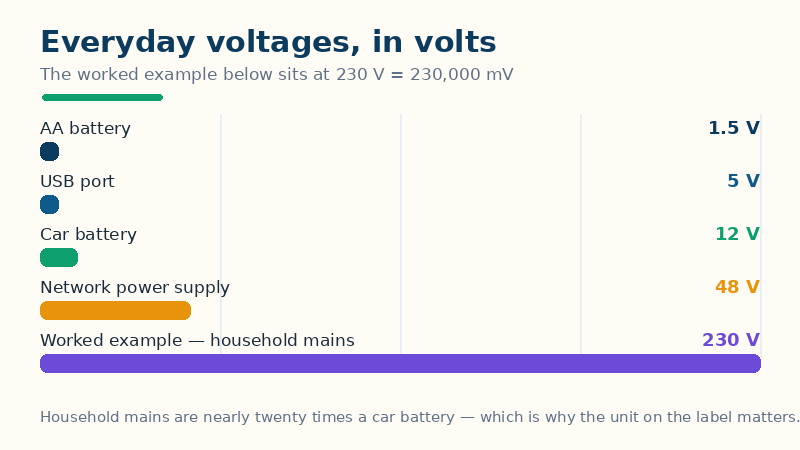
Voltage — electric potential difference — is the energy available per unit charge between two points, the push that drives current through a circuit. It is the quantity behind every battery label, sensor output and transmission rating: a nerve cell rests at about 70 mV, a USB port delivers 5 V, a car battery holds 12 V, household mains run at 120 V in North America and 230 V in much of the rest of the world, and transmission lines carry 110 kV to 765 kV. The SI unit is the volt, but sensor work quotes millivolts and microvolts, power work quotes kilovolts and megavolts, and old physics tables quote abvolts and statvolts, so the same potential difference arrives under half a dozen labels. This page restates any voltage in all ten units at once, worked through volts with every factor defined, and answers the question the conversion alone cannot: at a current you enter, how much power does this voltage deliver?
The formula
answer = volts ÷ (volts in one "to" unit)
power = volts × current
Three terms, all visible on the page. value is the number you enter. volts in one "from" unit is the definition of the unit you are converting from: 0.000000001 for the nanovolt, 0.000001 for the microvolt, 0.001 for the millivolt, 1 for the volt itself and for the watt per ampere, 1,000 for the kilovolt, 1,000,000 for the megavolt, 1,000,000,000 for the gigavolt, 0.00000001 for the abvolt, and 299.792458 for the statvolt. answer is the result in the unit you asked for. current is the current you enter in amperes, and the power line multiplies the voltage by it, because power = voltage × current, so the watts a supply, a sensor circuit or a transmission line actually delivers fall out of the voltage on the datasheet.
Worked example
Convert 230 volts to millivolts — European household mains, restated for a sensor datasheet — the way the tool does it.
Step 1 — get to volts. The input is already in volts, so the base value is 230 V itself.
Step 2 — divide by the target factor. One millivolt is 0.001 V, so 230 ÷ 0.001 = 230,000.
Step 3 — read the display. The headline reads 230,000 mV, and the detail line shows the working: 230 V = 230,000 mV — worked through volts: 230 V ÷ the Millivolt factor. The full table for this example reads: 230,000,000,000 nV, 230,000,000 µV, 230,000 mV, 230 V, 0.23 kV, 2.30e-04 MV, 2.30e-07 GV, 23,000,000,000 abV, 0.7672 statV and 230 W/A. The power line, at the default current of 2 A, reads 460 W (0.46 kW): 230 × 2 = 460 W, and 460 ÷ 1,000 = 0.46 kW.
Check it. Multiplying back, 230,000 mV × 0.001 = 230 V exactly, and 0.7672 statV × 299.792458 = 230 V to the displayed rounding — the exact value multiplies back to 230 exactly, because the statvolt definition is exact. The power line checks the same way: 460 W ÷ 2 A = 230 V, the voltage we started from.
Conversion table
The conversions electronics benches, car manuals and power tables reach for most, each one the same two steps as the example:
| From | To |
|---|---|
| 1 V | 1,000 mV |
| 1 V | 1,000,000 µV |
| 1 V | 0.001 kV |
| 5 V | 5,000 mV |
| 12 V | 12,000 mV |
| 120 V | 0.12 kV |
| 1 kV | 1,000 V |
| 11 kV | 11,000 V |
| 345 kV | 0.345 MV |
| 1.5 mV | 1,500 µV |
| 1 µV | 1,000 nV |
| 1 statV | 299.79 V |
| 1 abV | 10 nV |
Three everyday cross-checks for the scale, each one the same two steps: a USB port at 5 V is 5,000 mV and 0.005 kV; a car battery at 12 V is 12,000 mV and 12,000,000 µV; and a transmission line at 345 kV is 345,000 V and 0.345 MV — the same step that turns the worked example's 230 V into 0.23 kV.
Reading the result, and its limits
Four distinctions keep this page honest. First, voltage is not power: 12 V at 1 A is 12 W but 12 V at 10 A is 120 W, and the power line exists so that slip is visible. Second, voltage is not current: the volt measures the push per charge and the ampere measures the charges per second, and Ohm's law (voltage = current × resistance) is the bridge between them, not an identity. Third, abvolts and statvolts belong to different CGS systems: the abvolt comes from the electromagnetic system and the statvolt from the electrostatic system, so the two are not related by a power of ten — 1 statV is about 29,979,245,800 abV — and a table that mixes them without saying which system it means is unreadable. Fourth, the power line assumes direct current, or RMS values for alternating current: household mains quoted as 230 V mean 230 V RMS, and the peak of that wave is about 325 V, so peak and RMS figures must never be fed into the same multiplication.
Related tools: Electric Current Converter — Amps to milliamps, microamps and more — every answer in all eight units, plus the watts at your voltage; Ohm's Law Calculator — Enter any two of voltage, current, resistance and power — get the other two, with the working; Power Converter — Horsepower to kW, kW to hp, watts and tons of refrigeration — every answer in all eight units, through the exact definitions.
Frequently asked questions
How do I convert volts to millivolts?
Multiply by 1,000. A voltage of 230 V is 230 × 1,000 = 230,000 mV, the worked example on this page. To go the other way, divide millivolts by 1,000 to get volts.
How many volts are in a kilovolt?
1,000. A transmission line at 345 kV is 345,000 V, and a household supply at 230 V is 0.23 kV — the same step in both directions, through the volt definition.
What is a statvolt, and how is it different from an abvolt?
Both are CGS units of voltage, but from different systems: the statvolt comes from the electrostatic system (1 statV = 299.792458 V) and the abvolt from the electromagnetic system (1 abV = 0.00000001 V). They differ by a factor of about 29,979,245,800, so a table must say which one it means.
Does converting voltage tell me the power?
No — power also needs a current. Power = voltage × current, so 230 V at 2 A is 460 W. Enter any current in amperes and the power line on this page does that multiplication for you.