The formula: height times a style factor, then the 5 cm step
The calculation has two steps, and the calculator shows both so the answer can be checked by hand. Step 1, the exact figure: your height in centimetres multiplied by a factor for your skiing style — 0.70 for all-mountain and general skiing, 0.65 for park and freestyle, 0.75 for powder and backcountry. The 0.70 figure is the published rule used by makers such as Fischer, and it comes from the elbow geometry: a pole that puts your forearm level when planted on flat ground works out at roughly seventy percent of your height. Step 2, the buy size: poles are sold in 5 cm steps, so the exact figure is rounded to the nearest step, with an exact halfway figure rounding down to the shorter pole — a shorter pole is the safer miss, since a long pole drags timing more than a short one costs reach. The table is:
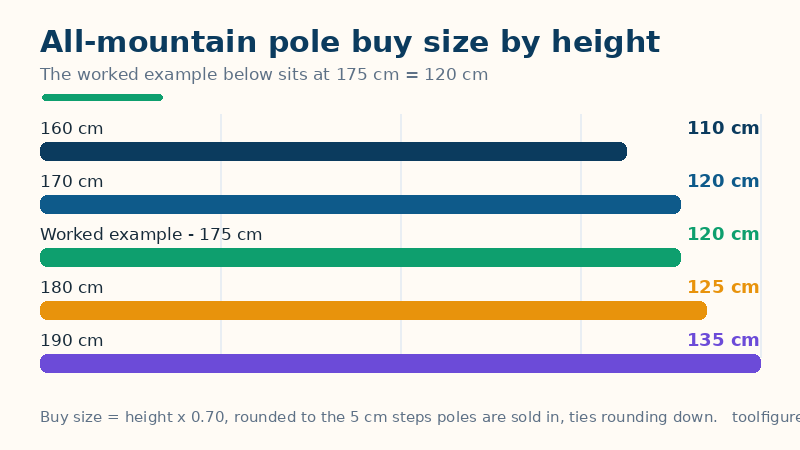
| Height | Exact (× 0.70) | Buy size | Buy size (in) |
|---|---|---|---|
| 150 cm | 105.0 cm | 105 cm | 41.3 in |
| 160 cm | 112.0 cm | 110 cm | 43.3 in |
| 170 cm | 119.0 cm | 120 cm | 47.2 in |
| 175 cm | 122.5 cm | 120 cm | 47.2 in |
| 180 cm | 126.0 cm | 125 cm | 49.2 in |
| 190 cm | 133.0 cm | 135 cm | 53.1 in |
Worked example: 175 cm, all-mountain
Take a skier who is 175 cm tall, skiing all-mountain. Step 1: 175 × 0.70 = 122.5 cm exact, which is 48.2 in. Step 2: 122.5 sits exactly halfway between the 120 cm and 125 cm steps, so the ties-round-down rule gives a buy size of 120 cm (47.2 in) — the same answer Fischer's own chart gives for a 175 cm skier. Note what the rounding costs and saves: the exact figure is 2.5 cm above the buy size, which is less than the length of a pole basket, and well inside what the elbow check tolerates.
Style changes the answer, and so does the unit
At the same 175 cm, the style factor moves the buy size by a full step in each direction: park and freestyle at × 0.65 gives a 115 cm buy size, because shorter poles stay out of the way on rails and jumps, while powder and backcountry at × 0.75 gives a 130 cm buy size, because the basket sinks in deep snow and the extra length restores the plant. The inch input agrees with the centimetre one: 70 in is 177.8 cm, and 177.8 × 0.70 = 124.5 cm exact, which rounds to a 125 cm buy size — one step above the 175 cm answer, because 70 in is genuinely taller than 175 cm, not because the units disagree. Touring poles are the exception to the whole table: they adjust, so buy them long and collapse them for the descent rather than fixing one length from this calculator.
How to read your result, and its limits
Three checks before buying. First, measure without boots: ski boots add a couple of centimetres of height, and feeding a booted measurement into a factor that already assumes a boot double-counts it. Second, run the elbow check: hold the pole upside down, grip on the ground, hand just below the basket, and look for a level forearm at about 90° — if the forearm slopes down the pole is long, if it slopes up the pole is short, and a pole that passes this test on flat ground is right even if it disagrees with the calculator by one step. Third, know what this tool does not cover: cross-country poles run much longer than alpine poles — classic poles sit around 83–85% of height and skate poles longer still — so use a dedicated cross-country chart for those, and children under 100 cm need a junior chart, not this one. For the rest of the kit, the ski size calculator sizes skis from height and ability, the ski boot size calculator turns a foot measurement into a Mondopoint size, and the snowboard size calculator sizes a board from height and weight.
Common mistakes
- Buying the exact figure. Shops do not stock a 122.5 cm pole. The buy size is the answer; the exact figure is only there so you can see which way the rounding went.
- Measuring in ski boots. A booted measurement adds a couple of centimetres and can push the buy size a full step long.
- Using one factor for every discipline. Park poles at the all-mountain factor snag, and powder poles at the all-mountain factor plant short in deep snow — the style factor is the whole point of the second input.
- Rounding halfway figures up. Between two steps, the shorter pole is the safer miss, which is why this calculator rounds ties down.
Frequently asked questions
What size ski poles do I need if I am 175 cm tall?
120 cm for all-mountain skiing: 175 × 0.70 = 122.5 cm exact, which sits halfway between the 120 cm and 125 cm steps and rounds down to 120 cm. Enter your own height and style above for your buy size.
Why multiply height by 0.70?
Because a pole that puts your forearm level when planted on flat ground — elbow at about 90° — works out at roughly seventy percent of your height, which is the published rule makers such as Fischer use for general skiing.
Should freestyle poles be shorter?
Yes: park and freestyle use a 0.65 factor, which at 175 cm gives a 115 cm buy size instead of 120 cm, because shorter poles stay out of the way on rails and jumps.
How do I check pole length without a calculator?
Hold the pole upside down, grip on the ground, hand just below the basket: your forearm should sit level, elbow at about 90°. Forearm sloping down means the pole is long; sloping up means it is short.
