Why one body gets three different labels
Clothing sizes are not measurements; they are labels that point at measurements, and every country chose a different label for the same range. For men the labels are the friendliest case: the US and UK share a number, and the EU number sits exactly 10 above it, so a men's M is a US/UK 38 and an EU 48, built for a chest of 38–40 inches. For women the labels diverge on both sides: UK sizes run 4 above US sizes and EU sizes run 32 above US sizes, so a women's US 8 is a UK 12 and an EU 40, built for a typical bust of 91 cm. The two lines must never be mixed: a men's US 38 is a chest measurement in inches, while a women's US 8 is an arbitrary dress number, and converting one line with the other's offset is the commonest cross-border ordering mistake. The tables below are the published standard conversions; the measurement columns (chest range for men, typical bust for women) are the cross-check that survives when a brand's labels drift.
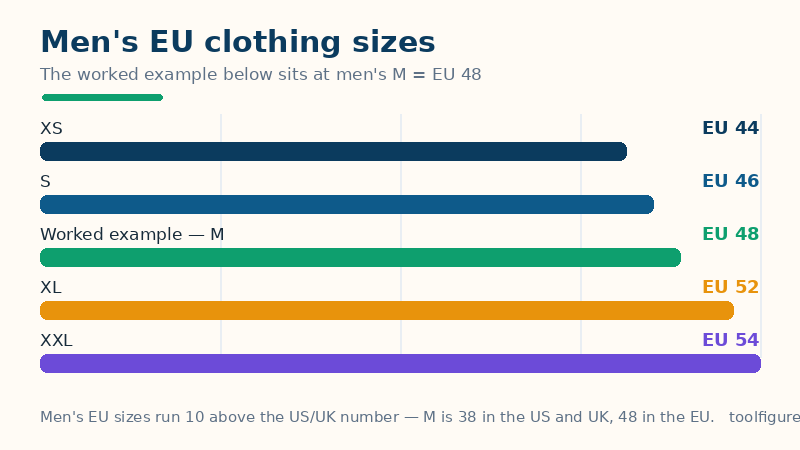
Worked example: a men's M and a women's US 8
Take a men's M. The men's row reads US/UK 38, EU 48, chest 38–40 inches — and the offset checks: 38 + 10 = 48, exactly the EU figure. Take a women's US 8. The women's row reads UK 12, EU 40, typical bust 91 cm — and both offsets check: 8 + 4 = 12 and 8 + 32 = 40. Two more rows prove the offsets hold across the tables rather than on one lucky row: a men's EU 52 is an XL, a US/UK 42, chest 42–44 inches (42 + 10 = 52), and a women's UK 16 is a US 12, an EU 44, typical bust 99 cm (12 + 4 = 16 and 12 + 32 = 44). A size with no row — a men's US/UK 39, or a women's EU 41 — is answered by naming the nearest rows (38 and 40; 40 and 42) instead of inventing a size between them.
Men's size table
| Letter | US/UK | EU | Chest (in) |
|---|---|---|---|
| XS | 34 | 44 | 34–36 |
| S | 36 | 46 | 36–38 |
| M | 38 | 48 | 38–40 |
| L | 40 | 50 | 40–42 |
| XL | 42 | 52 | 42–44 |
| XXL | 44 | 54 | 44–46 |
Women's size table
| US women | UK women | EU | Typical bust (cm) |
|---|---|---|---|
| 2 | 6 | 34 | 84 |
| 4 | 8 | 36 | 86 |
| 6 | 10 | 38 | 89 |
| 8 | 12 | 40 | 91 |
| 10 | 14 | 42 | 95 |
| 12 | 16 | 44 | 99 |
| 14 | 18 | 46 | 103 |
| 16 | 20 | 48 | 107 |
How to read your result, and its limits
Three checks before ordering. First, measure, don't remember: a tape around the fullest part of the chest (men) or bust (women), level and snug but not tight, beats any remembered label, because bodies change and labels do not. Second, brands move around the table: vanity sizing, different fit models and different garment categories (a brand's jeans, jackets and dresses can size differently under the same letter) mean the standard table is the starting point and the brand's own chart is the final word — a converted size that is right everywhere else can still be wrong for one maker. Third, one number never describes a garment: a men's 38 says chest only, not sleeve length, waist or shoulder width, and a women's 8 says bust only, not waist or hip, so tall, petite and plus ranges exist precisely because the single number runs out. Children's sizes are not covered here — children's scales restart their numbering by age and height and need their own table.
Related tools: Shoe Size Converter — US, UK, EU and Japan shoe sizes — every system at once, men and women; Ring Size Converter — US, UK, EU and Japan ring sizes — plus diameter and circumference lookup; Height Converter — Convert feet and inches to cm — and cm back — with the exact factor and a worked example.
Frequently asked questions
Are men's US and UK clothing sizes the same?
Yes, in the standard table: a men's US 38 is a UK 38, and only the EU number differs (EU 48, which is 10 above). Women's sizes are the opposite case — a women's US 8 is a UK 12 — so always convert within the right line, and never carry the men's rule into the women's table or vice versa.
How do I convert a women's US size to EU?
Add 32 across this table: US 8 + 32 = EU 40, US 12 + 32 = EU 44. The UK conversion is US + 4. Both offsets hold on every row of the women's table on this page, which is how the converter rebuilds the whole row from any one number.
What if my size falls between two rows?
Take the larger size, and check the brand's own chart. The converter names the nearest rows instead of inventing a size between them — a men's US/UK 39 sits between 38 and 40, and a women's EU 41 sits between 40 and 42 — because a guessed middle row would be wrong for most brands anyway.
Why does the same letter fit differently from two brands?
Because a letter is a label for a measurement range, and brands choose their own ranges, fit models and garment cuts. The chest and bust columns on this page are the measurement behind the label, so measuring yourself and comparing against the brand's chart is the only conversion that survives brand variation.
