What specific volume is
Specific volume says how much room one unit of mass of a substance takes up: a kilogram of air fills a large box, a kilogram of iron fills a thimble, and the same substance at two different temperatures has two different specific volumes. It is the number behind every steam table, every gas calculation and every buoyancy question — and it is simply the reciprocal of density, so a substance with a high density has a low specific volume and the other way round. Steam tables quote cubic metres per kilogram (m³/kg) because saturated steam sits between 0.001 and hundreds in those units; materials sheets quote cubic centimetres per gram (cm³/g); and American engineering quotes cubic feet per pound mass (ft³/lbm) — and all of them measure the same quantity, so air at 0.8 m³/kg in one table is 12.81 ft³/lbm in the report it arrived with. This page restates any specific volume in all ten units at once, worked through m³/kg with every factor defined, and answers the two questions the conversion alone cannot: what density does this specific volume mean, and what volume does a mass you enter actually occupy?
The formula
m³/kg = value × (m³/kg in one "from" unit)
answer = m³/kg ÷ (m³/kg in one "to" unit)
density ρ = 1 ÷ specific volume
volume V = specific volume × mass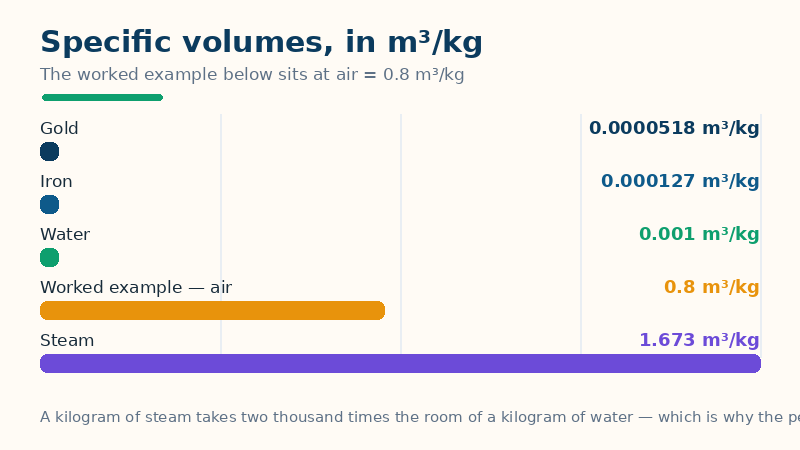
Four terms, all visible on the page. value is the number you enter. m³/kg in one "from" unit is the definition of the unit you are converting from: 1 for the cubic metre per kilogram itself, 0.001 for the litre per kilogram, for the cubic centimetre per gram and for the cubic metre per tonne, 0.000001 for the cubic centimetre per kilogram, 0.06242796057614461 for the cubic foot per pound mass, 0.00003612729200008369 for the cubic inch per pound mass, 0.008345404452019332 for the US gallon per pound mass, 0.010022412854960501 for the UK gallon per pound mass, and 0.13352647123230932 for the US gallon per ounce. answer is the result in the unit you asked for. density ρ is one divided by the specific volume, in kilograms per cubic metre, so the volume-per-mass figure turns back into the mass-per-volume figure density tables quote. volume V is the specific volume times the mass you enter, in cubic metres, so the per-kilogram figure turns into the room a real quantity actually needs.
Worked example
Convert 0.8 m³/kg (air at sea level) to cubic feet per pound mass — the unit jump every American report forces on a steam-table reader — the way the tool does it.
Step 1 — get to m³/kg. One m³/kg is 1 m³/kg, so 0.8 × 1 = 0.8 m³/kg.
Step 2 — read the display. The headline reads 12.81 ft³/lbm, and the detail line shows the working: 0.8 m³/kg = 12.81 ft³/lbm — worked through m³/kg: 0.8 m³/kg ÷ the Cubic foot per pound mass factor. The full table for this example reads: 0.8 m³/kg, 800 L/kg, 800 cm³/g, 800,000 cm³/kg, 800 m³/t, 12.81 ft³/lbm, 22,143.92 in³/lbm, 95.86 gal(US)/lbm, 79.82 gal(UK)/lbm and 5.9913 gal(US)/oz. The extra line, at the default mass of 2.5 kg, reads: Density from 1 ÷ specific volume: 1.25 kg/m³. Volume for 2.5 kg: 2 m³ — specific volume × mass.
Check it. Multiplying back, 12.81 ft³/lbm × 0.06242796057614461 = 0.7997 m³/kg, the 0.8 we started from to the displayed rounding, and the density line checks the same way: 1 ÷ 0.8 = 1.25 kg/m³, the mass of a cubic metre of air at sea level.
Conversion table
The conversions steam tables, materials sheets and American reports reach for most, each one the same two steps as the example:
| From | To |
|---|---|
| Water, 0.001 m³/kg | 1 L/kg, 1 cm³/g, 0.016 ft³/lbm |
| 1 m³/kg | 1,000 L/kg, 16.02 ft³/lbm, 99.78 gal(UK)/lbm |
| 0.001 m³/kg | 0.1198 gal(US)/lbm |
| Steam, 1.673 m³/kg | 1,673 L/kg, 26.8 ft³/lbm |
| Iron, 0.000127 m³/kg | 0.127 L/kg |
| 900 kg/m³ as a specific volume | 0.0011 m³/kg |
| Paper, 1.6 cm³/g | 0.0016 m³/kg, density 625 kg/m³ |
Three everyday cross-checks for the scale, each one the same two steps: one cubic metre per kilogram is 99.78 UK gallons per pound mass, which is why unit-converter tables carry the gallon rows at all — the imperial gallon pair differs from the US pair by exactly the gallon ratio, 0.00454609 ÷ 0.003785411784; a density of 900 kg/m³ becomes a specific volume of 0.0011 m³/kg as displayed, the reciprocal working in both directions; and paper at 1.6 cm³/g is 0.625 g/cm³ of density, so one kilogram of paper has a volume of 1.6 litres, the same reciprocal fact the density converter states from the other side.
Reading the result, and its limits
Four distinctions keep this page honest. First, specific volume is not specific weight: specific weight is weight per unit volume in newtons per cubic metre — density times gravity — while this page's quantity is volume per unit mass, and the two must never be swapped. Second, the gallon rows need their gallon named: a US gallon and a UK gallon differ by about 20%, so this page carries both, separately, on every row. Third, specific volume is an intensive property with a temperature habit: one kilogram and one tonne of water at the same conditions share the same specific volume, but heating a gas raises its specific volume sharply, which is why steam tables exist at all — a single figure is only true at its stated conditions. Fourth, the density line is exact arithmetic, not a measurement: 1 ÷ specific volume is exact, but a specific volume read from a table carries that table's rounding, so the density inherits it.
Related tools: Density Converter — kg/m³ to lb/ft³, g/cm³ to lb/in³, lb/gal and more — every answer in all nine units, through the exact definitions; Volume Converter — Convert US cups, gallons, litres, millilitres and spoons — every answer in all ten units, through the exact US customary definitions; Weight Converter — Kilograms to pounds, pounds to kg, ounces, stone and tonnes — every answer in all eight units, through the exact definitions.
Frequently asked questions
How do I convert m³/kg to ft³/lbm?
Divide by 0.06242796057614461. The worked example's 0.8 m³/kg is 0.8 ÷ 0.06242796057614461 = 12.81 ft³/lbm. To go the other way, multiply by 0.06242796057614461 — 1 m³/kg is 16.02 ft³/lbm.
What is the difference between specific volume and density?
They are reciprocals: specific volume is volume per unit mass (m³/kg) and density is mass per unit volume (kg/m³). Air at 0.8 m³/kg has a density of 1 ÷ 0.8 = 1.25 kg/m³, and a density of 900 kg/m³ is a specific volume of 0.0011 m³/kg.
Is cm³/g the same as L/kg?
Yes, numerically: 1 cm³/g is 0.001 m³/kg and 1 L/kg is 0.001 m³/kg, so the two units always read the same number. The worked example's 0.8 m³/kg is 800 in both.
Why are there US and UK gallons per pound?
Because the gallons differ: a US gallon is 0.003785411784 m³ and a UK gallon is 0.00454609 m³, about 20% larger. So 1 m³/kg is 119.83 US gal/lbm but 99.78 UK gal/lbm — the page carries both so a vendor manual can never be read in the wrong gallon.
