Two timelines, one gap
The calculation is two compoundings that run against each other. Your savings grow at the monthly return — the annual return divided by 12 — for every month until enrolment, and each college year is inflated forward to the year it is actually billed:
months = (college start age − current age) × 12 · monthly return = annual return ÷ 12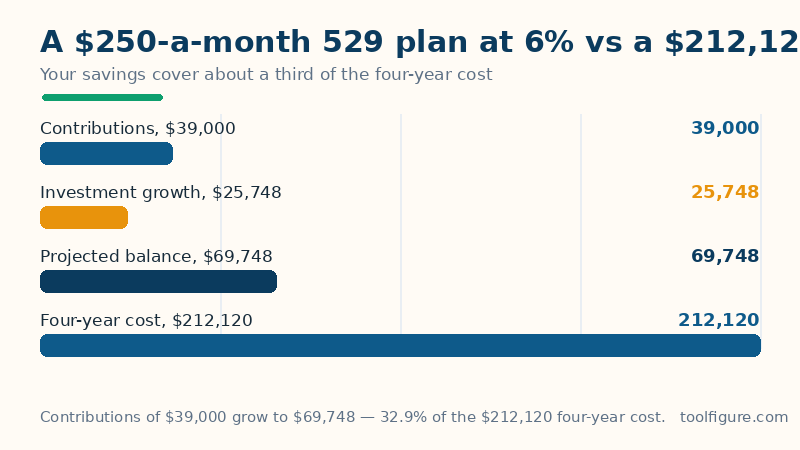
projected balance ($) = current balance × (1 + monthly return)^months + monthly contribution × [((1 + monthly return)^months − 1) ÷ monthly return]cost of college year k ($) = today's annual cost × (1 + inflation)^(years until enrolment + k) · total cost = the sum of the four yearsgap ($) = total cost − projected balance · coverage (%) = projected balance ÷ total cost × 100 · extra monthly ($) = gap ÷ the same annuity factor the contributions usedThe first formula is the future value of a lump sum plus the future value of an annuity — the same maths the future value calculator runs, with the monthly contribution as the payment. The cost side is deliberately conservative: it compares your balance on the first day of college against the full cost of all four years, even though in reality you withdraw one year at a time and the untouched remainder keeps growing through graduation.
Worked example: $250 a month from age 5 — $69,748.02 against a $212,120.24 degree
Thirteen years of saving is 156 months, and the monthly return at 6% a year is 0.5%. The $5,000 already saved grows to $10,886.18, and $250 a month grows to $58,861.83, for a projected balance of $69,748.02. You put in $39,000.00 and investment growth adds $25,748.02 — growth supplies over a third of the balance, which is what thirteen years of compounding buys. The four college years, inflated at 4%, cost $49,952.21 + $51,950.29 + $54,028.31 + $56,189.44 = $212,120.24, so the gap is $142,372.22 and the plan covers 32.9% of the bill. To close the gap takes an extra $604.69 a month — $854.69 a month in total from today. The milestones show the compounding doing its work late: by age 10 the balance is $24,186.76, by age 15 it is $50,066.82, and the last three years add $19,681.20 — more than the first five years added. Two published cross-checks reproduce. CompoundInterestCalc's college savings calculator runs the same savings inputs — a 5-year-old, $5,000 saved, $250 a month at 6% — with 5% college inflation, and reaches the same balance of $69,748, a first-year bill of $56,569 against this page's $56,569.47, a four-year cost of $243,822 against this page's $243,821.51, and a gap of $174,073 against this page's $174,073.49 — coverage of 28.6% at 5% inflation, against 32.9% at 4%. OnlyCalculators' 529 calculator inflates a $28,000 annual cost at 4% over 15 years to a four-year total of $214,134, against this page's $214,133.97 on the same inputs. A third example shows the other end of the range: $300 a month for 18 years at 7% is $64,800 of contributions, and the growth on top of it is what the return decides — at 7% the contributions alone grow to about $129,000, which is why starting at birth rather than at age 5 matters more than the monthly amount.
How to read your result, and its limits
Four cautions keep the number honest. First, full funding is a stretch goal, not a baseline: a 529 that covers a third of the bill has done its job — it turns a six-figure loan into a manageable one — so a gap of $142,372.22 is not a failure of the plan, it is the size of the bill. Second, time beats the monthly amount: the same $250 a month started at birth reaches $111,522.13 by age 18 at 6%, against $69,748.02 started at age 5, because the first five years are the cheapest compounding you will ever buy. Third, inflation is the bigger assumption: moving college inflation from 4% to 5% lifts the four-year cost from $212,120.24 to $243,821.51 — $31,701.27 on one percentage point — so the inflation rate deserves more attention than the return. Fourth, the return is an average, not a promise: real portfolios do not earn a steady 6% every month, and the balance at enrolment depends on the sequence of returns as well as their average. A 529 is a tax-advantaged education account: contributions grow tax-deferred and withdrawals for qualified expenses — tuition, fees, books, computers, room and board — are free of federal income tax, and up to $10,000 a year per student may be used for K-12 tuition. Under SECURE 2.0, up to $35,000 of unused 529 money per beneficiary may be rolled into a Roth IRA once the account has been open at least 15 years. For the saving habit behind the plan, the savings goal calculator prices any other target the same way; and for the loan the gap may become, the retirement calculator shows what borrowing against the future costs.
Common mistakes
- Saving against today's tuition. A school that costs $30,000 a year today bills $49,952.21 for the first year thirteen years from now at 4% inflation — and $56,569.47 at 5%. A plan built on today's price is short by the whole inflation gap.
- Counting the balance as the coverage. The $69,748.02 balance covers 32.9% of a $212,120.24 degree — not a third of one year's cost, a third of all four years. The coverage figure on this page is always against the full degree.
- Forgetting the money keeps growing during college. This page compares the balance on day one against all four years, which is conservative: in reality the untouched remainder keeps earning while you withdraw one year at a time, so the true shortfall is smaller than the gap shown.
- Treating the return as guaranteed. The 6% is an average over thirteen years. A bad sequence of returns in the last three years — when the balance is largest — moves the outcome far more than a bad first year, which is why 529 portfolios shift toward bonds as college nears.
- Ignoring the financial-aid angle. A parent-owned 529 counts as a parental asset, assessed at a maximum of 5.64% in the aid formula, while assets in the student's own name are assessed at 20% — so where the money sits matters as well as how much of it there is.
Frequently asked questions
What is a 529 plan?
A 529 plan is a tax-advantaged savings account designed specifically for education expenses. Contributions grow tax-deferred, and withdrawals for qualified expenses — tuition, mandatory fees, books, computers, and room and board — are completely free of federal income tax. Most US states sponsor at least one plan, and many offer a state income tax deduction or credit for contributions.
How much should I save each month for college?
It depends on the gap and the time left. In the worked example, $250 a month from age 5 at 6% reaches $69,748.02 by age 18 — 32.9% of a $212,120.24 four-year degree — and closing the whole gap takes $854.69 a month in total. Starting at birth instead of age 5, the same $250 a month reaches $111,522.13 by age 18, because the first five years are the cheapest compounding you will ever buy.
Does a 529 plan affect financial aid?
Yes, but gently. A parent-owned 529 counts as a parental asset in the aid formula, assessed at a maximum of 5.64%, while assets held in the student's own name are assessed at 20%. That is one reason 529s are usually held by the parent rather than the child.
What happens to 529 money if my child does not go to college?
It is not lost. You can change the beneficiary to another family member, use up to $10,000 a year per student for K-12 tuition, or — under SECURE 2.0 — roll up to $35,000 per beneficiary into a Roth IRA for the beneficiary, once the 529 has been open at least 15 years and subject to annual Roth contribution limits.