Three steps: watts, minutes, brews — plus the warming plate
The whole calculation is two multiplications and one addition. Watts divided by 1,000 is kilowatts; kilowatts times the brew time in hours is the energy of one brew; the brews a day times the energy per brew, plus the warming plate's energy, is the day's energy; the day's energy times 365 days is the year's energy; the year's energy times the price is the year's money. The month is the year divided by 12, not the day times 30 — the two differ by a few cents, and the year-divided-by-12 figure is the one this page uses, so it agrees with the yearly total exactly:
energy per brew (kWh) = watts ÷ 1,000 × minutes ÷ 60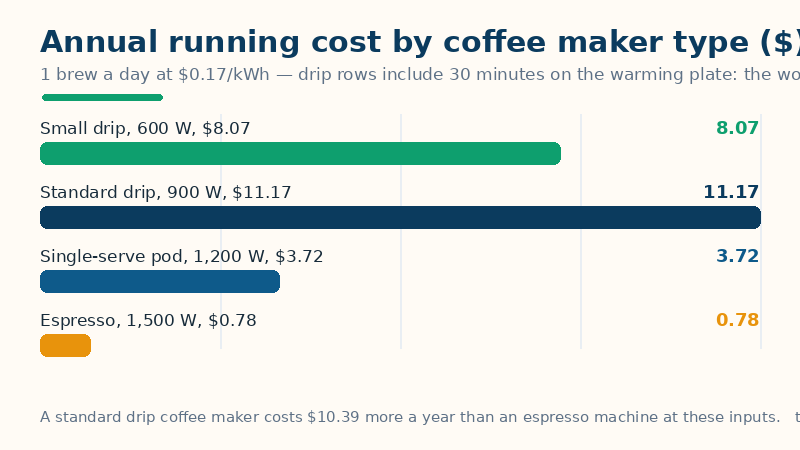
energy per day (kWh) = energy per brew × brews a day + 0.06 kW × warming minutes ÷ 60annual cost ($) = energy per day × 365 × electricity priceThe watts and the minutes both move a lot between machine types, which is why the page asks for both. A small 4-cup drip maker draws about 600 W and brews for about 10 minutes; a standard 10–12 cup drip maker draws about 900 W for the same 10 minutes; a single-serve pod machine draws 900 to 1,500 W but only for 2 to 3 minutes a cup; an espresso machine draws 1,000 to 1,500 W but only for 25 to 30 seconds a shot. The warming plate is the second half of the story: it draws about 60 W, and a pot left on it all morning draws that 60 W for hours — the plate, not the brew, is where a drip maker's cost quietly doubles.
Worked example: 900 W, 10 minutes, 1 brew a day, 30 minutes on the plate, $0.17/kWh
A 900 W drip maker brewing for 10 minutes uses 0.9 × 10 ÷ 60 = 0.15 kWh a brew, costing 2.6¢. The warming plate at 60 W for 30 minutes uses 0.06 × 0.5 = 0.03 kWh, costing 0.5¢. A day is 0.15 + 0.03 = 0.18 kWh, costing $0.03. A month is 65.7 ÷ 12 = 5.5 kWh, costing $0.93. A year is 0.18 × 365 = 65.7 kWh, costing $11.17. The table above shows the same maths for the other makers at 1 brew a day: a small 600 W drip maker costs 1.7¢ a brew and $8.07 a year with 30 minutes on the plate, a single-serve pod machine at 1,200 W for 3 minutes costs 1.0¢ a brew and $3.72 a year — pods have no warming plate — and an espresso machine at 1,500 W for 30 seconds costs 0.2¢ a shot and $0.78 a year. At 2 brews a day the worked example costs $20.48 a year, and with the plate switched off it costs $9.31. Three published cross-checks reproduce exactly: plugfacts' 600 W maker brewing 15 minutes a day at 18.16 cents uses 0.15 kWh a day, $0.83 a month and $9.94 a year — this page gives the same $9.94; a 1,200 W maker brewing 10 minutes uses 0.20 kWh, 3.6¢ at 18 cents, and $13.14 a year — dailybrewer's figures; and a 900 W maker brewing 10 minutes uses 0.15 kWh, $0.02 at 12 cents — thedrinksproject's figure.
How to read your result, and its limits
Four cautions keep the number honest. First, the month is the year divided by 12: 65.7 kWh a year is 5.5 kWh a month and $0.93, while the day times 30 would give 5.4 kWh and $0.92 — a one-cent difference that is only a convention, and the year-divided-by-12 figure is the one that adds up to the yearly total. Second, the warming plate is the hidden cost: $1.86 of the worked example's $11.17 a year — about a sixth — is the plate alone, and two hours on the plate is 0.12 kWh a day, 2.0¢ a day and $7.45 a year, so a thermal carafe or switching the plate off is the cheapest saving on the page. Third, watts are not the cost — kilowatt-hours per brew are: a pod machine draws 1,200 W against a drip maker's 900 W and still costs less per cup, 1.0¢ against 2.6¢, because it runs for 3 minutes instead of 10. Fourth, the electricity is the cheap part: about a cent or three per cup either way — the pods themselves cost far more than the power that brews them, and the electricity price is the all-in rate, the total on the bill divided by the kilowatt-hours on the bill, including delivery charges. For the water that goes with the coffee, the electric kettle cost calculator prices the boil by watts and minutes; for the minutes on the clock, the microwave cost calculator prices the watts drawn from the socket; and for the cost of running anything else in the house, the electricity cost calculator prices any appliance by watts and hours.
Common mistakes
- Pricing the rated watts for the whole morning. A 900 W maker for 10 minutes is 0.15 kWh and 2.6¢, but the pot left on the plate for two hours adds 0.12 kWh and 2.0¢ — nearly as much again. Price the brew and the plate as separate lines, as this page does.
- Putting minutes in as hours. Ten minutes is 0.167 hours, not 10 — entering 10 as the hours would price sixty pots. Divide the minutes by 60 first: 10 ÷ 60 = 0.167.
- Multiplying the daily cost by 30 for the month. Thirty days is not a twelfth of a year: the day times 30 gives $0.92 a month at the worked example's inputs, while the year divided by 12 gives $0.93. Use the year-divided-by-12 figure, which is the one that adds up.
- Comparing machines on watts instead of kilowatt-hours per brew. A 1,200 W pod machine at 3 minutes is 0.06 kWh and 1.0¢ a cup, while a 900 W drip maker at 10 minutes is 0.15 kWh and 2.6¢ a brew — the higher-wattage machine costs less per cup, because the minutes decide the energy, not the watts alone.
- Adding the standing charge to every brew. The daily supply charge is payable whether the coffee maker runs or not. Only the per-kWh rate belongs in the per-brew maths — the fixed charge is a separate line on the bill.
Frequently asked questions
How much does it cost to run a coffee maker per day?
A 900 W drip maker brewing one 10-minute pot a day and keeping it warm for 30 minutes at $0.17 per kWh uses 0.18 kWh a day and costs $0.03 — $0.93 a month and $11.17 a year. With the warming plate switched off, the same brewing costs $9.31 a year.
How much electricity does a coffee maker use per brew?
A 900 W drip maker brewing for 10 minutes uses 0.15 kWh a brew. A small 600 W drip maker uses 0.10 kWh, a single-serve pod machine at 1,200 W for 3 minutes uses 0.06 kWh, and an espresso machine at 1,500 W for 30 seconds uses 0.0125 kWh a shot.
Does leaving the coffee maker on the warming plate use much electricity?
More than the brewing, if the pot sits there long: the plate draws about 60 W, so 30 minutes is 0.03 kWh, 0.5¢ a day and $1.86 a year — about a sixth of the worked example's $11.17. Two hours on the plate is 0.12 kWh a day, 2.0¢ a day and $7.45 a year. A thermal carafe or switching the plate off removes that line entirely.
Is a single-serve pod machine cheaper to run than a drip coffee maker?
On electricity, yes: a pod cup at 1,200 W for 3 minutes is 0.06 kWh and 1.0¢, against 0.15 kWh and 2.6¢ for a 900 W drip brew — because the pod machine runs for 3 minutes instead of 10. But the electricity is about a cent a cup either way; the pods themselves cost far more than the power that brews them.