One capacitance, three labels
Capacitance is a component's ability to store electric charge for a given voltage — C = Q ÷ V, in farads, where one farad holds one coulomb per volt. The farad itself is far too large for ordinary electronics, so real capacitors are labelled in its thousandths: microfarads on American schematics, nanofarads on European parts lists, picofarads printed as a three-digit code on the component itself. This page restates any capacitance in all eight units at once, worked through the farad with every factor defined, so a figure in any dialect can be read in any other. It also answers the question the conversion alone cannot: at a voltage you enter, how much charge does this capacitance hold, and how much energy does that charge represent?
The formula
answer = farads ÷ (farads in one "to" unit)
Two terms, both visible on the page. value is the number you enter. farads in one "from" unit is the definition of the unit you are converting from: 1 for the farad itself, 10⁻³ for the millifarad, 10⁻⁶ for the microfarad, 10⁻⁹ for the nanofarad, 10⁻¹² for the picofarad, 10⁻¹⁵ for the femtofarad, 10⁹ for the abfarad, and approximately 1.1126500560536185 × 10⁻¹² for the statfarad. answer is the result in the unit you asked for. Every SI step is a factor of exactly a thousand — that is the whole conversion, and it is why the microfarad-to-nanofarad step never needs a calculator once the pattern is seen. The abfarad and statfarad are CGS units, kept here because they still appear in old tables; the statfarad's factor is approximate because it inherits the speed of light, while the abfarad's is exact within its own system.
Worked example
Convert 0.1 microfarads to nanofarads — the decoupling capacitor on almost every circuit board, and the component printed "104" — the way the tool does it.
Step 1 — get to farads. One microfarad is 10⁻⁶ F, so 0.1 × 10⁻⁶ = 0.0000001 F.
Step 2 — divide by the target factor. One nanofarad is 10⁻⁹ F, so 0.0000001 ÷ 0.000000001 = 100.
Step 3 — read the display. The page prints six decimals below 0.001, four below 10 and two above, so the headline reads 100 nF, and the detail line shows the working: 0.1 µF = 100 nF — worked through farads: 0 F ÷ the Nanofarad factor.
Check it. Multiplying back, 100 × 1,000 = 100,000 picofarads, and 100,000 pF ÷ 1,000,000 = 0.1 µF exactly — the chain closes in both directions. The table underneath restates the same capacitance in all eight units (0 F, 0.0001 mF, 0.1 µF, 100 nF, 100,000 pF, 100,000,000 fF, 0 abF, 89,875.52 statF), so the from/to choice only changes which row is the headline. And the energy line finishes the job for this capacitor: at the default 5 V, that 0.1 µF stores 0.5 µC of charge and 1.25 µJ of energy — Q = CV = 0.0000001 × 5, and E = ½CV² = 0.5 × 0.0000001 × 25.
Conversions worth memorising
Every row below is the tool's own output, checked figure by figure:
| From | To | Result |
|---|---|---|
| 1 µF | nanofarads | 1,000 nF |
| 1 µF | picofarads | 1,000,000 pF |
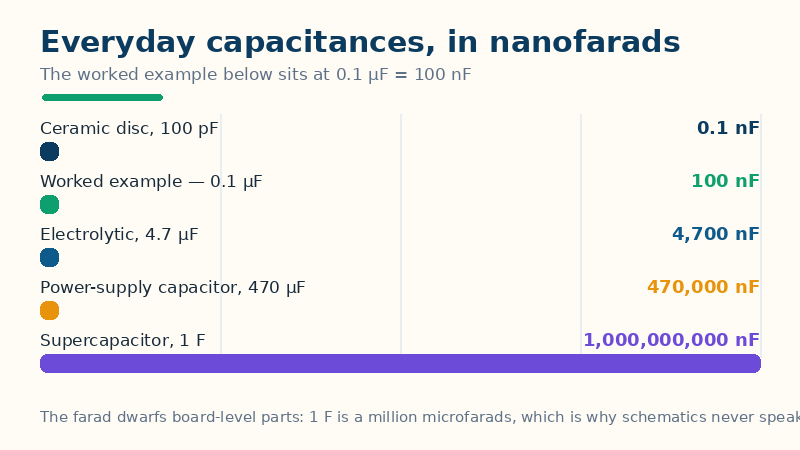
| 0.1 µF | nanofarads | 100 nF |
| 4.7 µF | nanofarads | 4,700 nF |
| 220 nF | microfarads | 0.22 µF |
| 3,300 pF | nanofarads | 3.3 nF |
| 1 F | microfarads | 1,000,000 µF |
| 1 mF | microfarads | 1,000 µF |
| 1 nF | picofarads | 1,000 pF |
| 100 pF | microfarads | 0.0001 µF |
| 100 nF | microfarads | 0.1 µF |
| 1 F | nanofarads | 1,000,000,000 nF |
Three rows deserve a second look. The first two are the whole subject in miniature: every SI step is a thousand, so moving one row in the table multiplies or divides by 1,000, and the only skill is counting how many steps you moved — 0.1 µF is one step above nanofarads, so it is 100 nF, and three steps above picofarads, so it is 100,000 pF. The 100 pF row is the component-code row: a ceramic disc printed "104" means 10 followed by four zeros in picofarads, which is 100,000 pF, which is 100 nF, which is 0.1 µF — the worked example wearing its factory label, and the reason a parts drawer sorted by code still sorts by value. And the 1 F row is the scale warning: one farad is a million microfarads, which is why ordinary electronics never speaks in farads at all — a 1 F component is a supercapacitor, not a board component, and a schematic that says "1 F" where it means "1 µF" is wrong by a factor of a million, not by a rounding.
Three traps worth knowing
MFD means microfarads, not millifarads. Motor and air-conditioner capacitors are often labelled "MFD", and that MFD is the old printing of µF — a 35 MFD run capacitor is 35 µF, not 35 mF. A millifarad is a thousand microfarads, so reading MFD as millifarads overstates the part by a thousand times, and fitting the wrong one can burn out a motor. If a label says MFD on a motor capacitor, read it as µF; if a datasheet says mF with a lowercase m, that one really is millifarads.
American schematics skip the nanofarad. US convention jumps from microfarads to picofarads — 0.001 µF where a European list would write 1 nF — while European convention uses nanofarads freely. Neither is wrong, but a parts order copied across conventions without converting will arrive a thousand times off: 0.001 µF ordered as 0.001 nF is a picofarad-scale part in a microfarad-scale hole. This page's table shows both rows side by side precisely so the jump cannot hide.
Tiny figures hit the display floor in the farad and abfarad rows. The page prints six decimals below 0.001, so 0.1 µF reads as 0 F and 0 abF — the true values, 0.0000001 F and 0.0000000001 abF, round to zero at six decimals. The nanofarad row is the readable one for board-level parts, and the farad row only becomes readable for supercapacitors. Read the row on the capacitor's own scale: the factor is exact, and the readable row is the one near the part's own size.
How to read your result, and the limits
Results show six decimals below 0.001, four below 10 and two above — more precision than any capacitor's tolerance justifies, so round to the part for real use: a ceramic capacitor rated ±20% makes the fourth decimal meaningless. Four limits belong with the page. Negative values are refused: a negative capacitance gets a clear error, because this page converts sizes. Empty input clears quietly; type and the table rebuilds, delete and the page waits. Anything past a trillion in any unit gets a clear error instead of a meaningless digit string. And this page converts units, not circuits: it will restate any capacitance in any unit and work out its charge and energy at your voltage, but it will not tell you whether that capacitor suits a circuit — its voltage rating, its tolerance, its temperature behaviour and its equivalent series resistance all live in the datasheet, and a correct conversion of the wrong part is still the wrong part.
Related tools: Electric Charge Converter — Coulombs to milliamp-hours, ampere-hours, faradays and more — every answer in all ten units; Electric Current Converter — Amps to milliamps, microamps and more — every answer in all eight units, plus the watts at your voltage; Ohm's Law Calculator — Enter any two of voltage, current, resistance and power — get the other two, with the working.
Frequently asked questions
How many nanofarads are in a microfarad?
Exactly 1,000. So 1 µF is 1,000 nF and 1,000,000 pF, 0.1 µF is 100 nF, and 4.7 µF is 4,700 nF. Every SI step is a factor of a thousand: farads to millifarads to microfarads to nanofarads to picofarads to femtofarads.
What does the code 104 on a capacitor mean?
It is a three-digit code in picofarads: the first two digits are the value and the third is the number of zeros that follow. So 104 means 10 followed by four zeros, which is 100,000 pF, which is 100 nF, which is 0.1 µF. Likewise 223 means 22,000 pF, which is 22 nF.
Does MFD mean millifarad or microfarad?
On motor and air-conditioner capacitors, MFD means microfarad — it is the old printing of µF. A 35 MFD run capacitor is 35 µF, not 35 mF; reading it as millifarads overstates the part a thousand times. A lowercase mF in a datasheet really is millifarads, which is a different unit.
How much energy does a capacitor store?
E = ½CV², with C in farads and V in volts giving joules. A 0.1 µF capacitor at 5 V stores 1.25 µJ and holds 0.5 µC of charge; a 4.7 µF capacitor at 12 V stores 338.4 µJ and holds 56.4 µC. Enter the voltage on this page and the energy line works it out for any capacitance.