Helmet letters are 2-centimetre bands, not a feeling
Every general helmet chart grades the same way: 2-centimetre bands from 53 cm (XS) to 66 cm (XXXL), each band carrying an inch range and a hat size. The hat size is not a separate measurement — it is the head's diameter, the circumference in inches divided by pi and rounded to the nearest eighth — which is why a 58 cm head (22.83 inches around) is a 7¼ hat: 22.83 ÷ 3.1416 = 7.27, nearest to 7.25. Inches and centimetres disagree only in rounding: the bands are defined in centimetres, and the inch figures in the table are those bands converted (57 cm is 22.4 inches, 58 cm is 22.8), so a tape that reads inches should be converted to centimetres before the band is chosen, not matched against the rounded inch range by eye.
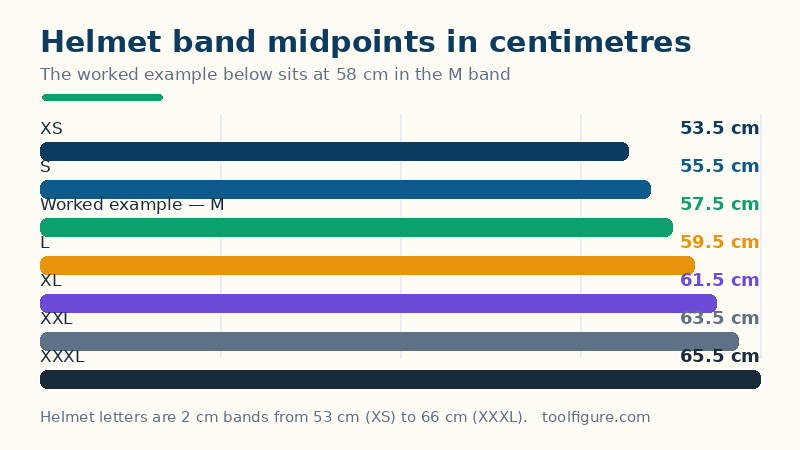
Worked example: a 58 cm head
Take a head measuring 58 cm. It falls in the M band of 57–58 cm, which is 22.4–22.8 inches and hat 7⅛–7¼ — 58 ÷ 2.54 = 22.83 inches, shown as 22.8, and 22.83 ÷ 3.1416 = 7.27, nearest eighth 7¼. Four more conversions prove the table holds: 55 cm is S (21.7 inches, hat 6⅞ — 21.65 ÷ 3.1416 = 6.89, nearest to 6.875); 61 cm is XL (24.0 inches, hat 7⅝ — 24.02 ÷ 3.1416 = 7.65, nearest to 7.625); hat 7½ works back to L (7.5 × 3.1416 = 23.56 inches = 59.8 cm, inside the 59–60 cm band); and 24.4 inches is XL as well — 24.4 × 2.54 = 61.98 cm, inside the 61–62 cm band, whose inch range is 24.0–24.4.
Helmet size table
| Helmet size | Head (cm) | Head (in) | Hat size |
|---|---|---|---|
| XS | 53–54 | 20.9–21.3 | 6⅝–6¾ |
| S | 55–56 | 21.7–22.0 | 6⅞–7 |
| M | 57–58 | 22.4–22.8 | 7⅛–7¼ |
| L | 59–60 | 23.2–23.6 | 7⅜–7½ |
| XL | 61–62 | 24.0–24.4 | 7⅝–7¾ |
| XXL | 63–64 | 24.8–25.2 | 7⅞–8 |
| XXXL | 65–66 | 25.6–26.0 | 8⅛–8¼ |
How to read your result, and its limits
Three checks before buying. First, measure the largest circumference: the tape goes about an inch above the eyebrows and above the ears, level all the way around, and the largest of several measurements is the one that counts — a tape pulled tight or riding high gives a smaller number and a helmet that pinches. Second, between sizes, try the smaller one first: liner padding compresses with wear, so a snug new helmet breaks in, while a loose one never tightens — but if the smaller size gives you a headache in fifteen minutes, it is too small, not breaking in. Third, circumference is only half the fit: heads are round oval, intermediate oval or long oval, and a helmet cut for a rounder head than yours will pinch at the forehead and gape at the sides whatever the letter says — and no size chart replaces trying the helmet on, checking it sits squarely with the eye port just above the eyebrows, or replacing a helmet that has taken a real impact, since the damage is usually invisible.
Related tools: Hat Size Converter — US, UK, EU and letter hat sizes — from your head circumference; Glove Size Converter — Palm circumference to glove size — numeric and letter sizes; Clothing Size Converter — Men's and women's clothing sizes between US, UK and EU — with the measurements behind them.
Frequently asked questions
What helmet size is a 58 cm head?
M — the 57–58 cm band, 22.4–22.8 inches, hat 7⅛–7¼. A 58 cm head is 22.83 inches around, and 22.83 divided by pi is 7.27, nearest eighth 7¼.
How do I measure my head for a helmet?
Wrap a soft tape around the fullest part of your head, about 1 inch above your eyebrows and above your ears, keeping it level all the way around. Take several measurements and use the largest — a tape riding high gives a smaller number and a helmet that pinches.
What if my head falls between two helmet sizes?
Try the smaller one first. Liner padding compresses with wear, so a snug new helmet breaks in, while a loose one never tightens. If the smaller size still gives you a headache after fifteen minutes, it is too small — size up.
What hat size is a large helmet?
A large helmet covers 59–60 cm heads, which is hat 7⅜–7½. Hat size is the head diameter: circumference in inches divided by pi, rounded to the nearest eighth.
