The formula: torso length + 26 inches (straight shaft), minus 4 (bent shaft)
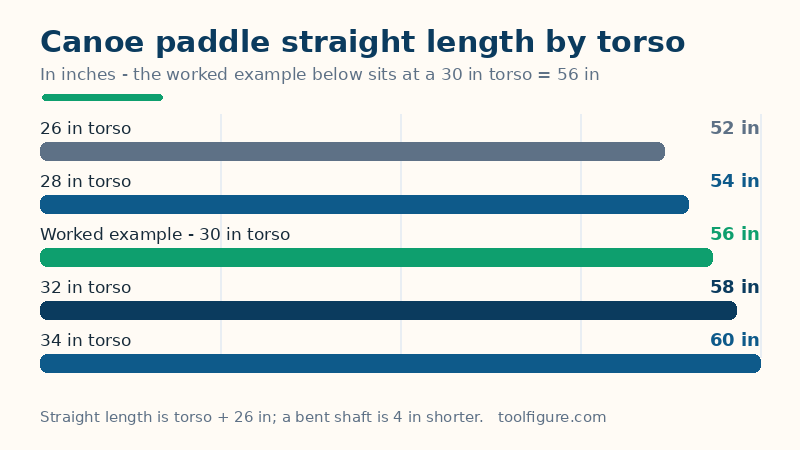
A canoe paddle is sized by the body above the seat, not by standing height, because the seat — not the floor — is where paddling starts. The measurement the guides agree on is torso length: sit on a chair and measure from the flat seat surface between your legs straight up to your nose. Call that length T, in inches. For an adult torso (25 in and over) the straight-shaft length is T + 26; for a youth torso (under 25 in) it is 3 × T − 24; a bent shaft is 4 inches shorter than the straight length; and a wide canoe or the stern paddling position adds 2 inches. The two formulas meet exactly at a 25 in torso, where both give 51 in, so there is no jump between the youth and adult rows. The table below is the chart in full.
| Torso | Straight shaft | Bent shaft |
|---|---|---|
| 20 in | 36 in | — |
| 22 in | 42 in | — |
| 24 in | 48 in | — |
| 26 in | 52 in | 48 in |
| 28 in | 54 in | 50 in |
| 30 in | 56 in | 52 in |
| 32 in | 58 in | 54 in |
| 34 in | 60 in | 56 in |
| 36 in | 62 in | — |
| 38 in | 64 in | — |
Spot checks against the published guides: a 26 in torso gives 26 + 26 = 52 in straight and 52 − 4 = 48 in bent, matching the guide rows exactly; a 28 in torso gives 54 in and 50 in; a 34 in torso gives 60 in and 56 in. Where the guides print a range rather than one number — 51 or 52 in for a 26 in torso, 56 or 57 in for 30 in, 57 or 58 in for 32 in — this calculator's answer (52, 56, 58) sits inside each published range. Bent shafts are not made in youth sizes and are generally stocked only up to about 56 in, which is why those table cells are dashes and why the calculator says so instead of inventing a bent length there.
Worked example: 30 in torso
A seated torso of 30 in takes a 56 in straight-shaft paddle (142.24 cm) or a 52 in bent-shaft paddle (132.08 cm). The arithmetic is 30 + 26 = 56, and 56 − 4 = 52; in centimetres, 56 × 2.54 = 142.24 and 52 × 2.54 = 132.08. With the wide-canoe or stern-position box ticked the straight length becomes 58 in (147.32 cm). The same formula at a 26 in torso gives 52 in straight and 48 in bent, and at a 22 in youth torso gives 3 × 22 − 24 = 42 in straight, with no bent option. The field check confirms the worked example: sitting with the grip between your legs, the throat of a 56 in straight paddle should sit at your forehead, and the throat of the 52 in bent paddle at your nose.
How to read your result, and its limits
Three checks before buying. First, check it in the field, not just on paper: sit with the paddle's grip between your legs and look at where the throat falls — forehead for a straight shaft, nose for a bent shaft. If the throat sits well above your forehead the paddle is too long; well below, too short. Second, remember the shortest-that-reaches rule: experts agree on buying the shortest paddle that still lets your top hand sit at about nose height mid-stroke with the throat at the water line, because extra length is extra weight swung on every stroke. Third, allow for your seat: the torso method assumes a standard seat height, and the alternative blade method (torso + seat height + blade length) exists precisely for raised seats — a canoe with a seat several inches higher than standard wants a correspondingly longer paddle, which is part of what the +2 in wide/stern allowance covers. Blade length itself varies by model (a common touring blade is about 19 in), so two paddles of the same overall length can feel different in the water.
Common mistakes
- Using standing height instead of torso length. Height includes leg length, which never touches a paddle. Two paddlers of the same height can need paddles several inches apart.
- Measuring to the chin instead of the nose. Both appear in guides, and they differ by about an inch. This calculator uses the nose, the more common published reference — a chin measurement fed in as a nose measurement buys a paddle an inch short.
- Buying a bent shaft at the straight length. A bent shaft is 4 inches shorter by design, because its blade is shorter and wider. Ordering the straight length in a bent shaft buys a paddle that is too long.
- Ignoring the boat. A wide canoe and the stern position both push the paddle further from the water, which is why the guides add 2 inches there — the torso alone does not capture it.
Related tools: Kayak Paddle Length Calculator — The right kayak paddle length from your height, boat width and paddling style: the published height-by-width chart as a calculator; Paddleboard Size Calculator — The right stand-up paddleboard from your weight, use and skill: minimum volume, length range and width from one published rule, shown openly; Surfboard Volume Calculator — A recommended surfboard volume in litres from your weight and skill level, with the full skill and weight tables.
Frequently asked questions
How do I measure my torso for a canoe paddle?
Sit on a chair and measure from the flat seat surface between your legs straight up to your nose. That seated torso length — not your standing height — is what the paddle length comes from.
Straight shaft or bent shaft — which length do I need?
A bent shaft is 4 inches shorter than the straight length for the same torso, because its blade is shorter and wider. Bent shafts suit flatwater cruising; they are not made in youth sizes and are generally stocked only up to about 56 in.
What if my torso falls between the chart rows?
The formula covers every value, not just the printed rows: straight length is torso + 26 inches for adults and 3 × torso − 24 for youths. Makers sell in 2–3 inch steps, so round to the nearest stocked length.
Does canoe width change the paddle length?
Yes — a wider canoe or the stern paddling position adds about 2 inches, because the paddle sits further from the water. Tick that box above and the calculator adds it.
