The pick: shape first, then weight
Padel rackets are not sized the way tennis rackets are. A tennis racket comes in lengths from 19 in to 27 in by height; a padel racket does not, because the rules cap every adult racket at the same maxima — 45.5 cm long (17.91 in), 26 cm wide (10.24 in) and 38 mm thick — and most adult rackets sit close to those caps. So the guides do not sell a size ladder; they sell a profile by level, and the three decisions inside that profile are shape, weight and balance. The table below is that profile in full, and the calculator above applies it to your level and style.
| Level | Shape | Weight | Balance | Core | Face | Thickness |
|---|---|---|---|---|---|---|
| Beginner | Round | 340–365 g | Low | Soft EVA | Fibreglass | 36–38 mm |
| Intermediate | Teardrop | 360–375 g | Medium | Medium EVA or hybrid | Carbon and fibreglass | 38 mm |
| Advanced | Teardrop or diamond | 365–385 g | Medium–high | Hard EVA or FOAM | Carbon | 38 mm |
Shape is the biggest lever. A round racket puts the sweet spot — the forgiving area in the middle of the face — in the centre, which is why every guide gives it to beginners and control players. A teardrop moves the sweet spot slightly higher and adds punch while staying forgiving, which is why it is the intermediate and all-round shape. A diamond is top-heavy with a smaller, higher sweet spot: it rewards a fast, consistent swing with real power and punishes anything else, which is why it belongs to advanced attacking players only. Weight follows the same ladder: light rackets (under 360 g) are easier to move and kinder to wrist and shoulder; heavy rackets (over 370 g) are more stable and more powerful but tire the arm faster. The guides' weight classes overlap on purpose — a 365 g racket can be a heavy beginner racket or a light advanced one — and the shape and balance, not the grams alone, decide which it is.
Worked example: intermediate, all-round
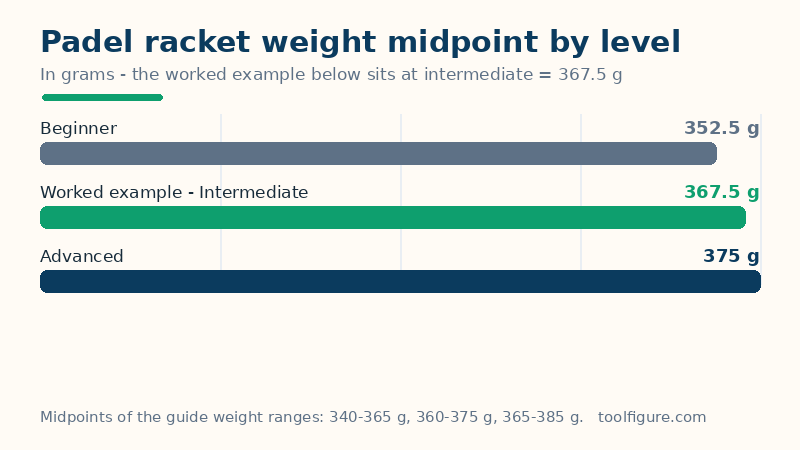
An intermediate all-round player takes a teardrop racket, 360–375 g, medium balance, medium EVA or hybrid core, carbon and fibreglass face, 38 mm thick. The weight midpoint is (360 + 375) ÷ 2 = 367.5 g, which is 367.5 ÷ 28.349523125 = 12.96 oz; the range in ounces is 360 ÷ 28.349523125 = 12.70 oz to 375 ÷ 28.349523125 = 13.23 oz. For comparison, the beginner midpoint is (340 + 365) ÷ 2 = 352.5 g = 12.43 oz, and the advanced midpoint is (365 + 385) ÷ 2 = 375 g = 13.23 oz. The legal maxima sit above every row: 45.5 cm ÷ 2.54 = 17.91 in long and 26 ÷ 2.54 = 10.24 in wide. The same arithmetic at the beginner level gives a round racket at 340–365 g with a low balance and a soft EVA core, and at the advanced power level gives a diamond racket at 365–385 g with a medium–high balance and a hard core.
How to read your result, and its limits
Three checks before buying. First, style moves the shape, not the level: a control-focused advanced player is correctly given a round racket here, and a power-focused beginner is given a teardrop rather than a diamond, because the guides agree a first racket should never be a diamond — the small sweet spot teaches bad habits, not power. Second, grip is adjusted with overgrips, never by shrinking: when holding the racket there should be about a finger's width between fingertips and palm, and an overgrip can thicken a grip but never thin one, so start from the smaller size when in doubt. Third, juniors are not small adults: junior rackets run 280–320 g and about 30–35 cm long at a minimum 36 mm thick, and a child handed a 370 g adult racket will tire, lose technique and risk their shoulder. Price is the last honest note: entry rackets run roughly £60–£100 and pro-level carbon rackets £200 or more, and the guides agree the extra money buys stiffness and durability, not a different size.
Common mistakes
- Shopping by length. Padel rackets barely differ in length — the 45.5 cm cap sees to that. Shape, weight and balance are the choice; length is not.
- Buying a diamond first. The top-heavy shape with the small sweet spot is the fastest way for a beginner to lose rallies and confidence. Start round, move to teardrop, earn the diamond.
- Choosing the heaviest racket for power. Over 370 g only adds power if the swing is already fast. With a slow swing it adds fatigue and elbow trouble, not pace.
- Ignoring the core. A soft EVA core absorbs shock and forgives; a hard core gives precision and power but no forgiveness. The core matters as much as the shape for how a racket feels.
Related tools: Tennis Racket Size Calculator — The right tennis racket length from height: 19 in to the 27 in adult standard, with a grip-size starting point and the fit checks; Squash Racket Size Calculator — The right squash racket from your profile: grip size 0–2, frame weight 120–130 g, balance and string tension; Badminton Racket Size Calculator — The right badminton racket from age and level: length, weight class (U) and grip size (G) in grams and millimetres.
Frequently asked questions
What size padel racket do beginners need?
A round racket at 340–365 g with a low balance, soft EVA core and fibreglass face, 36–38 mm thick. Round puts the sweet spot in the centre of the face, which is what a first racket needs most.
What is the maximum legal padel racket size?
45.5 cm long (17.91 in), 26 cm wide (10.24 in) and 38 mm thick, under the International Padel Federation rules. Most adult rackets sit close to those maxima, which is why padel is sized by shape and weight rather than by length.
Teardrop or diamond — which shape should I choose?
Teardrop for most players: it balances power and control with a still-forgiving sweet spot. Diamond only for advanced attacking players with a fast, consistent swing — its smaller, higher sweet spot punishes off-centre hits.
What padel racket does a child need?
A junior racket: 280–320 g and about 30–35 cm long, at a minimum 36 mm thick. An adult racket in a child's hands is too heavy to swing properly and risks their shoulder.
