What angular acceleration is
Angular acceleration, written α, is how fast a spin itself changes — the change in angular velocity per second. A washing-machine drum spinning up, a flywheel braking, a servo slewing to position and a car wheel pulling away all have one, and the number is the same whether the object is a millimetre across or a flywheel across: only the rate of change of the turn matters, never the size. The SI unit is the radian per second squared, because the radian is the angle that fits the circle it measures — one full turn is 2π radians — and the rotation formulas come out cleanest in radians. Workshops, though, count whole turns per minute gained per second, physics problems count degrees per second squared, and slow mechanisms count turns per minute squared, so the same spin-up arrives under half a dozen labels. This page restates any angular acceleration in all eight units at once, worked through radians per second squared with every factor defined, and answers the question the conversion alone cannot: at a radius you enter, how fast does a point on the rim gain linear speed?
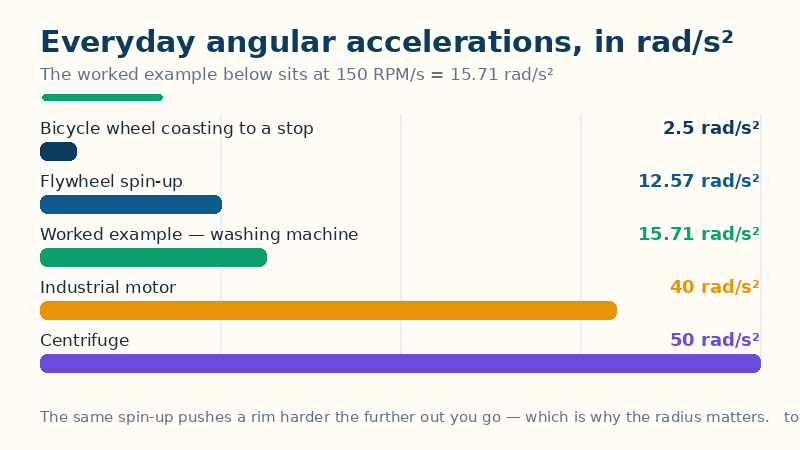
The formula
answer = radians per second squared ÷ (rad/s² in one "to" unit)
tangential acceleration = |radians per second squared| × radius
Three terms, all visible on the page. value is the number you enter. rad/s² in one "from" unit is the definition of the unit you are converting from: 1 for radians per second squared itself, 1/3600 for radians per minute squared, π/180 for degrees per second squared, π/648000 for degrees per minute squared, 2π for revolutions per second squared, π/30 for revolutions per minute per second, π/1800 for revolutions per minute squared, and π/200 for gradians per second squared. answer is the result in the unit you asked for. radius is the distance from the centre to the moving point, in metres, and the tangential acceleration is its product with the magnitude of the angular acceleration — an acceleration magnitude, unlike the signed angular acceleration, has no direction, which is why the absolute value appears here. The sign of the angular acceleration itself is kept everywhere else: a negative value means the spin is slowing down (for a positively turning shaft) or speeding up in the opposite direction.
Worked example
Convert 150 revolutions per minute per second to radians per second squared — the spin-up of a washing-machine drum that reaches 1,200 RPM in 8 seconds — the way the tool does it. One honest note first: the tool converts an acceleration you enter; the 150 itself comes from the spin-up, 1,200 ÷ 8 = 150 RPM/s, assuming the spin-up is steady.
Step 1 — get to radians per second squared. One revolution per minute per second is π/30 rad/s², so 150 × π/30 = 5π = 15.70796 rad/s², displayed as 15.71 rad/s² at the page's two-decimal step for values above 10.
Step 2 — read the display. The headline reads 15.71 rad/s², and the detail line shows the working: 150 RPM/s = 15.71 rad/s² — worked through radians per second squared: 15.71 rad/s² ÷ the Radians per second squared factor.
Step 3 — read the table. The full table for this example reads: 15.71 rad/s², 56,548.67 rad/min², 900 °/s², 3,240,000 °/min², 2.5 rev/s², 150 RPM/s, 9,000 rev/min² and 1,000 grad/s². The tangential-acceleration line, at the default radius of 0.5 m, reads 7.854 m/s² (0.8009 g): 15.70796 × 0.5 = 7.85398 m/s², and 7.85398 ÷ 9.80665 = 0.8009 g.
Check it. Multiplying back from the displayed 15.71 gives 15.71 × 30/π = 150.02 RPM/s, a rounding shadow of 0.02, not a second answer — the exact value multiplies back to 150 exactly, because the π cancels. The tangential line checks the same way: dividing the displayed 7.854 m/s² by the 0.5 m radius gives 15.708, which rounds to the same 15.71 headline. Two tangential cross-checks for the extra line, each one the same multiplication: the same 15.71 rad/s² spin-up at a 0.1 m radius gains a point 1.5708 m/s², and at a 1 m radius it gains 15.71 m/s² — the same spin-up, very different push, because the radius does the multiplying.
Conversion table
The conversions motor work, physics homework and servo datasheets reach for most, each one the same two steps as the example:
| From | To |
|---|---|
| 1 rad/s² | 9.5493 RPM/s |
| 1 rad/s² | 57.3 °/s² |
| 1 rad/s² | 3,600 rad/min² |
| 10 rad/s² | 95.49 RPM/s |
| 360 °/s² | 6.2832 rad/s² |
| 1 rev/s² | 60 RPM/s |
| 50 RPM/s | 5.236 rad/s² |
| 60 RPM/s | 3,600 rev/min² |
| 100 rev/min² | 0.1745 rad/s² |
| 1 grad/s² | 0.0157 rad/s² |
| 400 grad/s² | 6.2832 rad/s² |
Two spin-ups from the worked-example family, each one the same division as the example: a flywheel whose speed changes from 1,200 RPM to 3,120 RPM in 16 seconds gains 1,920 ÷ 16 = 120 RPM/s, which is 12.57 rad/s²; and an industrial motor that applies 1,000 N·m to a 25 kg·m² flywheel produces 40 rad/s², the torque divided by the moment of inertia, before any unit conversion begins.
Reading the result, and its limits
Four distinctions keep this page honest. First, angular acceleration is not angular velocity: this page restates how fast a spin changes, and a shaft turning steadily at 1,800 RPM has an angular acceleration of exactly zero — the companion angular velocity converter handles the steady spin, and this page handles its change. Second, the sign is the direction of the change, not an error: a negative figure means the spin is slowing down if it was turning positively, and a plate reading quoted without a direction cannot be given a sign from this page alone. Third, the per-minute-squared units square the 60: 1 rad/s² is 3,600 rad/min², and dividing by 60 once instead of 3,600 is the commonest slip in this whole family — the table above exists so that slip is visible. Fourth, the tangential line is not the whole acceleration of the point: a spinning point also carries centripetal acceleration ω²r toward the centre, which needs the angular velocity, not the acceleration, and no figure on this page can produce it — the tangential line is only the part that changes the speed along the rim.
Related tools: Angular Velocity Converter — RPM to rad/s, deg/s, Hz and more — every answer in all eight units; Angle Converter — Degrees to radians and back, gradians, turns, arcmin/arcsec, mrad and NATO mils — every answer in all eight units, plus sin/cos/tan; Acceleration Converter — m/s² to g-force, ft/s², knots per second and more — every answer in all eight units.
Frequently asked questions
How do I convert RPM/s to rad/s²?
Multiply the RPM/s figure by π/30, which is about 0.10472. A spin-up of 150 RPM/s is 150 × 0.10472 = 15.71 rad/s², the worked example on this page. To go the other way, multiply rad/s² by 30/π, about 9.5493.
What is the difference between angular velocity and angular acceleration?
Angular velocity is how fast something is turning; angular acceleration is how fast that turning rate itself changes. A shaft spinning steadily at 1,800 RPM has an angular velocity of 188.5 rad/s and an angular acceleration of zero. Only while it speeds up or slows down is the acceleration non-zero.
What does a negative angular acceleration mean?
The spin is slowing down, if it was turning in the positive direction — or speeding up in the opposite direction. The magnitude is how fast the rate changes and the sign is which way the change runs. This page keeps the sign through every unit, and the tangential-acceleration line uses the magnitude, because a magnitude has no direction.
Why are there per-minute-squared units at all?
Slow mechanisms — clockwork, astronomical drives, large turntables — are naturally described per minute, and their tables quote turns per minute squared. The conversion squares the 60: 1 rad/s² = 3,600 rad/min², and 1 RPM/s = 60 rev/min². Forgetting the square is the commonest error in this family.
