Ratings follow space, not headcount
Tent makers rate capacity on a body-length footprint of roughly 2.2 by 5.5 feet per sleeper — about 15 sq ft per rated person — with essentially no margin for gear, dogs or comfort. A tent rated for four people will comfortably sleep two people with standard car-camping gear, or three people packing light, which is why experienced campers use the rule of thumb: buy a tent rated for double your actual group size when you want comfort. This page does the same arithmetic honestly instead of hiding it inside the rating. It starts from three inputs: the number of sleepers, the space each sleeper gets, and whether packs stay inside. Space per person is 15 sq ft for snug backpacking, 22 sq ft for standard car camping, and 30 sq ft for roomy glamping, and packs inside add a stated allowance of 8 sq ft per sleeper. The total floor area is sleepers times space per person, and the recommended rating is the smallest standard rating whose typical floor area — 15 sq ft per rated person — covers that total.
Total floor area = sleepers × (space per person + gear allowance) — Space: snug 15 · standard 22 · roomy 30 sq ft per person — Packs inside: +8 sq ft per person — Rating = smallest standard rating whose typical area (15 sq ft × rating) covers the total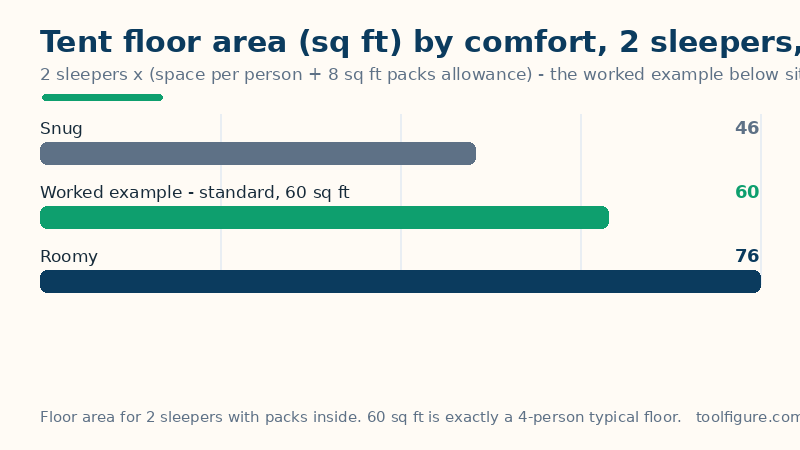
A total exactly equal to a rating's typical area takes that rating, not the next one up: 60 sq ft is a 4-person tent, not a 6-person tent, because the 4-person typical floor of 60 sq ft already covers it. The one-size-up suggestion beside the answer is a comfort choice, not a correction — the recommended rating already covers the space you asked for.
Worked example: 2 sleepers, standard comfort, packs inside
Two people car camping with their packs inside the tent need a 4-person tent. The working: 2 sleepers × (22 sq ft standard + 8 sq ft packs-inside allowance) = 2 × 30 = 60 sq ft, which is 60 × 0.092903 = 5.6 m². The smallest standard rating whose typical floor area covers 60 sq ft is 4-person, whose typical floor is exactly 60 sq ft (5.6 m²). Notice what this says about the rating: the group is two people, yet the honest answer is a 4-person tent — the rating doubles because the group wants standard comfort and packs inside, not because the arithmetic is generous. The same arithmetic at other groups shows the rating jumping in steps, not smoothly:
| Sleepers | Comfort | Gear | Working | Floor area | Rating |
|---|---|---|---|---|---|
| 1 | Snug 15 | Outside | 1 × 15 = 15 | 15 sq ft (1.4 m²) | 1-person |
| 2 | Standard 22 | Outside | 2 × 22 = 44 | 44 sq ft (4.1 m²) | 3-person (45 sq ft covers 44) |
| 2 | Standard 22 | Packs inside | 2 × 30 = 60 | 60 sq ft (5.6 m²) | 4-person |
| 4 | Standard 22 | Packs inside | 4 × 30 = 120 | 120 sq ft (11.1 m²) | 8-person |
| 3 | Roomy 30 | Packs inside | 3 × 38 = 114 | 114 sq ft (10.6 m²) | 8-person (120 sq ft covers 114) |
| 6 | Standard 22 | Outside | 6 × 22 = 132 | 132 sq ft (12.3 m²) | 10-person (150 sq ft covers 132) |
Notice the second and third rows together: the same two sleepers at the same comfort need a 3-person tent with gear outside but a 4-person tent with packs inside — the 8 sq ft packs allowance is what pushes the total from 44 sq ft, just under the 3-person typical floor of 45 sq ft, to 60 sq ft, exactly the 4-person floor. And the fourth row shows the doubling rule in full: four people wanting standard comfort with packs inside need an 8-person rating, because 4 × 30 = 120 sq ft is exactly the 8-person typical floor.
How to read your result, and its limits
Three checks before trusting the rating. First, check the actual floor dimensions, not just the rating: two tents with the same rating can differ in shape, and a long, narrow floor sleeps fewer people comfortably than a squarer one of the same area — a 60 sq ft floor that is 10 ft by 6 ft sleeps two people differently from one that is 8 ft by 7.5 ft. Second, peak height and vestibules are not in this number: the floor area says nothing about whether you can sit up, cook in the porch or store boots outside, and a tent with generous vestibules can feel larger than its floor suggests. Third, the rating is a floor-area guide, not a guarantee: makers measure floors differently, and the 15 sq ft per rated person figure is a typical value, not a standard every brand follows — always compare the stated floor dimensions against the area this page gives you, and when the two disagree, trust the dimensions. This page also does not choose the tent type — backpacking, car-camping, family or event tents differ in weight, poles and weatherproofing — it only sizes the sleeping floor once the type is chosen, and for events, where guests are seated rather than sleeping, the space per person is a different calculation entirely.
Common mistakes
- Buying the rating that equals your group. A 4-person tent fits four sleeping bags side by side and almost nothing else — for comfort with gear, the honest rating is usually double the group, as the worked example shows.
- Forgetting packs inside. Packs, boots and clothing take real floor space — the 8 sq ft per sleeper allowance is what moves the worked example from a 3-person to a 4-person rating.
- Comparing ratings instead of floor dimensions. Two tents with the same rating can have different floors and shapes — compare the stated length and width against the area you need.
- Assuming the rating covers sitting height. Floor area says nothing about peak height — check the height separately if you plan to sit up, change clothes or wait out rain inside.
Related tools: Backpack Size Calculator — Your backpack size in two parts: frame size from torso length, and litres from trip length, packing style and season; Trekking Pole Size Calculator — Your trekking pole length from height: flat, uphill and downhill settings in one page; Kayak Size Calculator — Your kayak size from height and weight: length range, volume class and minimum capacity.
Frequently asked questions
What size tent do I need for 2 people?
It depends on comfort and gear: two people car camping with packs outside need 44 sq ft, a 3-person tent, but with packs inside they need 60 sq ft, a 4-person tent. The rating is larger than the group because manufacturer ratings are built on roughly 15 sq ft per rated person, with almost no room for gear.
Why is the recommended tent rating larger than my group size?
Because ratings are built on a snug footprint of about 15 sq ft per rated person. Once you ask for standard comfort (22 sq ft each) and room for packs inside (8 sq ft more each), two people need 60 sq ft — exactly a 4-person typical floor — so the honest rating is 4-person, not 2-person.
How much floor space does each person need in a tent?
This page uses 15 sq ft for snug backpacking, 22 sq ft for standard car camping and 30 sq ft for roomy glamping, plus 8 sq ft per sleeper when packs stay inside. Those are planning figures, not a standard every brand follows — always compare the tent's stated floor dimensions against the area you need.
Should I buy a tent one size up from the recommendation?
The recommendation already covers the space you asked for, so one size up is a comfort choice, not a correction — it buys extra elbow room, space for a dog or wet gear, and a margin for makers whose floors run small. For a large group whose total passes the 12-person rating, split across two tents instead.
