Three steps: watts, hours, standby
The whole calculation is three multiplications. Watts divided by 1,000 is kilowatts; kilowatts times the hours a day is the watching energy; the standby watts divided by 1,000 times the hours the set is off is the standby energy; the two together times 365 days is the year's energy; the year's energy times the price is the year's money. The month is the year divided by 12, not the day times 30 — the two differ by a few cents, and the year-divided-by-12 figure is the one this page uses, so it agrees with the yearly total exactly:
energy per day watching (kWh) = watts ÷ 1,000 × hours a day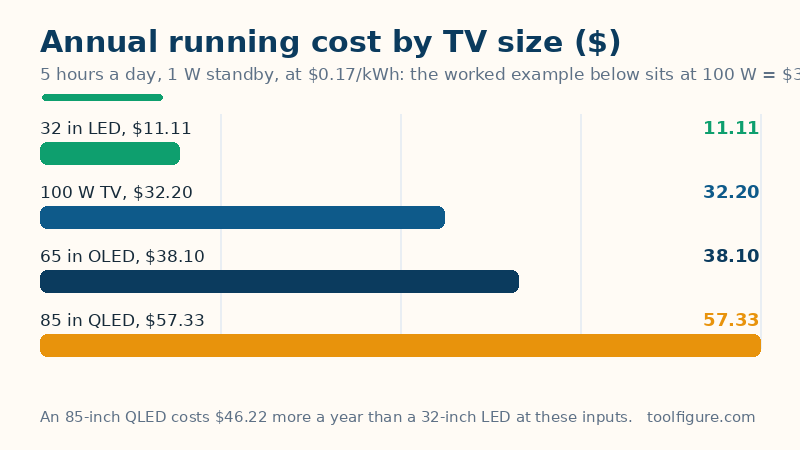
energy per day standby (kWh) = standby watts ÷ 1,000 × (24 − hours a day)annual cost ($) = (watching + standby) × 365 × electricity priceThe watts on the box are a test-pattern figure, and most sets spend their lives below it. A 32-inch LED draws about 30 to 50 W, a 55-inch LED about 85 to 100 W, a 65-inch OLED about 100 to 150 W and an 85-inch QLED about 150 to 190 W — the ENERGY STAR medians behind the table are 32 W for a 32-inch, 99 W for a 55-inch, 119 W for a 65-inch and 181 W for an 85-inch — and the standby draw is typically 0.5 to 3 W, with quick-start at the top of that range. What matters is the hours: five hours a day at 100 W is 0.5 kWh, and the set that runs all evening will always cost more than the set that runs for the news.
Worked example: 100 W, 5 hours a day, 1 W standby, $0.17/kWh
A 100 W TV watched 5 hours a day uses 0.1 × 5 = 0.500 kWh a day watching, costing 8.5¢. An hour is 0.1 kWh, costing 1.7¢. Standby at 1 W for the other 19 hours uses 0.001 × 19 = 0.019 kWh a day, costing 0.3¢. A month is 189.4 ÷ 12 = 15.8 kWh, costing $2.68. A year is 0.519 × 365 = 189.4 kWh, costing $32.20. Watching on its own is 182.5 kWh and $31.03 a year, standby is 6.9 kWh and $1.18 — each line is rounded on its own, so the two can sit a cent either side of the $32.20 total. The table above shows the same maths for the other sizes at 5 hours a day: a 32-inch LED at 32 W costs 0.5¢ an hour and $11.11 a year, a 65-inch OLED at 119 W costs 2.0¢ an hour and $38.10 a year, and an 85-inch QLED at 181 W costs 3.1¢ an hour and $57.33 a year. At 2 hours a day the worked-example TV costs $13.78 a year, at 8 hours $50.63; ten years at this pace costs $322.04. Four published cross-checks reproduce exactly: wattcostcalc's 100 W TV at 5 hours a day and 17.5 cents costs $0.088 a day, $2.63 a month and $31.94 a year — this page gives the same 0.5 kWh a day and 8.8¢, and $31.94 a year watching, while its $2.63 a month is the day times 30 and this page's year-divided-by-12 month is $2.66; greencalculus's 55-inch TV at 99 W, 2.6 hours a day and 18.19 cents — this page gives the same 94.0 kWh a year watching and $17.09, plus 3.1 kWh of standby at 0.4 W, 97.1 kWh a year and $17.66, which they round to $18; tvcalc's 65-inch OLED at 120 W, 5 hours a day and 16 cents — this page gives the same $35.04 a year watching; and homeupkeep's 110 W TV at 5 hours a day and 35 cents costs about $0.04 an hour and $70.26 a year — this page gives the same 0.55 kWh a day and $70.26 a year watching.
How to read your result, and its limits
Four cautions keep the number honest. First, the month is the year divided by 12: 189.4 kWh a year is 15.8 kWh a month and $2.68, while the day times 30 would give 15.6 kWh and $2.65 — a three-cent difference that is only a convention, and the year-divided-by-12 figure is the one that adds up to the yearly total. Second, the label watts are a test-pattern figure: the watts on the box and the yellow EnergyGuide label come from a fixed test loop, while brightness, HDR and dark scenes move the real draw — the ENERGY STAR medians behind the table (32 W for a 32-inch, 99 W for a 55-inch, 119 W for a 65-inch, 181 W for an 85-inch) are the honest baseline, and a plug-in meter on your own set measures it exactly. Third, standby is the quiet half of the bill: 1 W for 19 hours is 6.9 kWh a year and $1.18, and with quick-start on a TV can draw 3 W and cost $3.54 — greencalculus notes a set with quick-start on can use more electricity sitting idle than while you watch it, so switching quick-start off is the one saving that costs no picture quality. Fourth, the electricity price is the all-in rate: the total on the bill divided by the kilowatt-hours on the bill, including delivery charges. For the cooling that runs while you watch, the air conditioner cost calculator prices it watt by watt from its BTU rating and SEER; for the breeze, the ceiling fan cost calculator prices it by watts and hours with the speed setting kept honest; and for the cost of running anything else in the house, the electricity cost calculator prices any appliance by watts and hours.
Common mistakes
- Pricing the EnergyGuide figure as your bill. The yellow label uses a fixed 16 cents per kWh and 5 hours a day, so its dollar figure is for comparing models, not a forecast of your bill — your hours and your rate decide the real number.
- Forgetting standby. A set that is off is not a set that draws nothing: 1 W for 19 hours a day is 6.9 kWh a year and $1.18, and quick-start at 3 W is $3.54. Count the hours the set is off, not just the hours it is on.
- Multiplying the daily cost by 30 for the month. Thirty days is not a twelfth of a year: the day times 30 gives $2.65 a month at the worked example's inputs, while the year divided by 12 gives $2.68. Use the year-divided-by-12 figure, which is the one that adds up.
- Comparing TVs on watts alone. An 85-inch QLED and a 32-inch LED look far apart on watts, but the watts track the screen area: $57.33 a year against $11.11 at 5 hours a day. Compare kilowatt-hours a year at your hours, not watts — and remember the bigger set also runs longer in most homes.
- Adding the standing charge to every hour. The daily supply charge is payable whether the TV runs or not. Only the per-kWh rate belongs in the per-hour maths — the fixed charge is a separate line on the bill.
Frequently asked questions
How much does it cost to run a TV per year?
A 100 W TV watched 5 hours a day costs $32.20 a year at $0.17 per kWh, including 1 W of standby for the other 19 hours. A 32-inch LED costs $11.11 a year at the same hours and rate, a 65-inch OLED $38.10 and an 85-inch QLED $57.33, so the size matters more than the hours — and the standby is only $1.18 of the 100 W set's year.
How much electricity does a TV use in standby mode?
A TV on 1 W of standby for 19 hours a day uses 0.019 kWh a day, 6.9 kWh a year, costing $1.18 at $0.17 per kWh. With quick-start switched on the standby can be 3 W, costing $3.54 a year — and greencalculus notes a TV with quick-start on can use more electricity sitting idle than while you watch it. Switching quick-start off is the one saving that costs no picture quality at all.
Does a bigger TV cost much more to run?
Yes, roughly in proportion to the screen area: at 5 hours a day and $0.17 per kWh a 32-inch LED costs $11.11 a year, a 100 W set $32.20, a 65-inch OLED $38.10 and an 85-inch QLED $57.33 — the 85-inch costs about five times the 32-inch. The watts on the label, or the ENERGY STAR median for the size, are the honest way to compare them.
Does turning the brightness down save money?
Yes: on an LED TV the backlight is most of the power, so a lower backlight or eco mode draws fewer watts the whole time you watch — and on an OLED the draw follows the brightness of the picture itself, so dark scenes cost less than bright ones. The saving is real but modest next to the size of the set: dropping from an 85-inch to a 65-inch saves about $19 a year at 5 hours a day, more than any setting on the same set.