The formula: 88% of your height, plus ability, plus style
Recommended centre length = height × 0.88 + ability offset + style offset, rounded to the nearest centimetre, with a recommended range of centre ± 4 cm. The ability offsets are beginner −2 cm, intermediate 0 cm, advanced +2 cm; the style offsets are park & freestyle −3 cm, all-mountain 0 cm, powder & freeride +3 cm. The 0.88 factor is the chin-to-nose rule made arithmetic: 88% of a 175 cm rider is 154 cm, and a board of that length stood on end reaches just below the rider's nose — inside the classic chin-to-nose span. This is ToolFigure's own convention, built from that rule and from published height-and-ability charts, and it is labelled as such: no brand publishes one universal formula, and a brand's own chart for the exact model you are buying gets the last word.
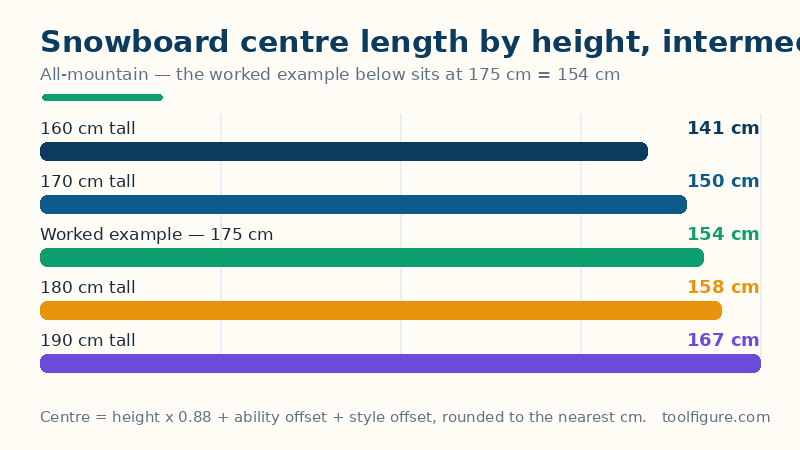
Worked example: 175 cm, intermediate, all-mountain
Take a rider who is 175 cm tall, an intermediate, riding all-mountain. The arithmetic is 175 × 0.88 = 154.0, plus 0 for intermediate and 0 for all-mountain, so the recommendation is 154 cm, range 150–158 cm — a board that stands 21 cm below the top of the rider's head, between chin and nose, exactly where an intermediate's all-mountain board belongs. The same rider at every ability level, all-mountain, reads: beginner 152 cm (148–156), intermediate 154 cm (150–158) and advanced 156 cm (152–160). The same intermediate rider in every style reads: park & freestyle 151 cm (147–155), all-mountain 154 cm (150–158) and powder & freeride 157 cm (153–161).
More heights, intermediate, all-mountain
| Height | Centre length | Recommended range |
|---|---|---|
| 160 cm | 141 cm | 137–145 cm |
| 170 cm | 150 cm | 146–154 cm |
| 180 cm | 158 cm | 154–162 cm |
| 190 cm | 167 cm | 163–171 cm |
How to read your result, and its limits
Three checks before buying. First, weight moves you inside the range: weight is the main thing a board feels — it sets how much pressure you put on the flex — so where height and weight point to different rows, follow weight: heavy for your height means the top of the range and light means the bottom, and a rider well outside the usual weight for their height should check the brand chart, which is built on weight first. Second, children are a different chart: this calculator covers adults from 140 to 210 cm, and a child's first-season board stands between the chest and the chin, not between chin and nose — age, height and weight together set a junior length, and junior boards are sold in shorter steps. Third, length is not the whole purchase: the board's waist width has to fit your boots — riders with large boots should check wide models so the toes and heels do not drag on a turn — and bindings must be set by a trained technician, not guessed at home. Demo the recommended length when you can; a morning on snow settles what a chart can only suggest. For the rest of the kit, the helmet size converter sizes head protection from a tape measure, and the ski size calculator sizes the two-plank alternative from the same three inputs.
Related tools: Bike Frame Size Calculator — Your frame size for road, gravel, hybrid and mountain bikes from one inseam measurement, plus starting saddle height.
Frequently asked questions
What size snowboard do I need at 175 cm as an intermediate?
154 cm, range 150–158 cm: 175 × 0.88 = 154.0, plus 0 for intermediate and 0 for all-mountain. The same rider as a beginner takes 152 cm and as an advanced rider takes 156 cm.
Is snowboard size based on height or weight?
Both, with weight first in most brand charts: height gives the starting length through the chin-to-nose rule, and weight sets how the board flexes under you. This calculator starts from height and lets weight move you inside the ±4 cm range — heavy for your height takes the top, light takes the bottom.
Should beginners buy shorter snowboards?
Yes. A shorter board is easier to turn and more forgiving of mistakes, which is why beginners take 2 cm off the baseline here, while advanced riders add 2 cm for stability at speed. Park riders go a further 3 cm shorter for spins and rails; powder riders go 3 cm longer for float.
Can children use this snowboard size calculator?
No — it covers adult heights from 140 to 210 cm. A child's first-season board should stand between the chest and the chin, and junior lengths are set by age, height and weight together on a kids snowboard chart, not by this formula.
